AP Gov Argumentative Essay Rubric (FRQ 4)
The AP U.S. Government and Politics argumentative essay (FRQ 4) uses a 6-point analytic rubric across four scoring rows. The AP Gov essay rubric evaluates how students develop arguments, cite evidence from foundational documents, explain reasoning, and address alternate perspectives. College Board's AP Gov FRQ scoring guidelines award points across Row A (thesis), Row B (evidence), Row C (reasoning), and Row D (alternate perspectives).
- Total Points: 6 points (Row A: 0-1, Row B: 0-3, Row C: 0-1, Row D: 0-1)
- Evidence Requirement: The task asks for at least 2 pieces of specific and relevant evidence (Row B awards partial credit for 1 piece)
- Response Type: Develop and support a defensible claim with reasoning
- Foundational Documents: One piece of evidence must come from a foundational document listed in the prompt to earn full credit in Row B. The prompt specifies which documents are acceptable.





Free AP Gov Argument Essay Grading Tool
Grade AP Gov FRQ 4 argument essays using the official argumentative essay rubric. Get row-by-row scoring for thesis, evidence, reasoning, and alternate perspectives—exactly how AP readers evaluate responses.


%201.svg)
Official AP Gov FRQ 4 Scoring Guidelines (PDF)
AP U.S. Government and Politics Argument Essay (FRQ 4) Scoring Rubric (PDF)
This is the official AP Gov FRQ rubric AP readers use to score argument essays. Download the scoring guidelines for classroom use and reference during grading. (Note: The scored student example PDFs below also include the full rubric with additional application guidance.)
How the AP Gov FRQ Rubric Works
The AP Gov argumentative essay rubric awards up to 6 points across four rows evaluating thesis, evidence, reasoning, and response to alternate perspectives. This argument essay rubric structure is designed to promote consistent scoring across AP Government exams.
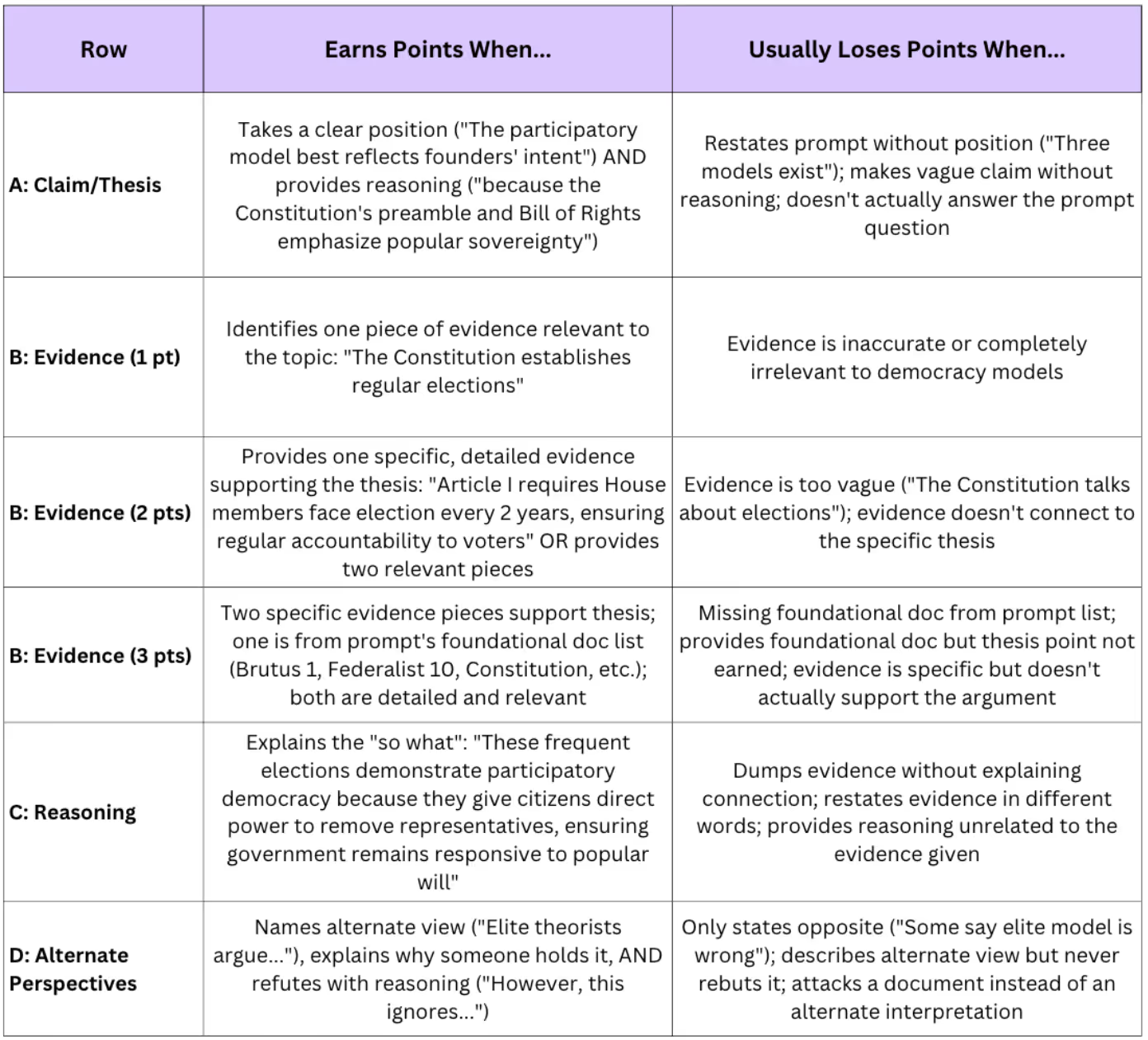
- Row A (Claim/Thesis): 0-1 point - Earn the point with a defensible claim that establishes a line of reasoning. Restating the prompt without taking a position doesn't earn credit.
- Row B (Evidence): 0-3 points - Points scale based on evidence quality and quantity:
- 1 pt: One relevant evidence
- 2 pts: One specific+relevant evidence OR two relevant pieces
- 3 pts: Two specific+relevant evidence pieces; one must be from the prompt's foundational document list
Gate rule: Row B's third point requires the Row A thesis point AND a foundational document from the prompt. - Row C (Reasoning): 0-1 point - Explain how or why evidence supports the argument. Evidence alone without connection to the claim doesn't earn the point.Gate rule: Requires at least one specific and relevant piece of evidence.
- Row D (Alternate Perspectives): 0-1 point - Describe an alternate perspective AND refute or rebut it. Mentioning an opposing view without rebuttal doesn't earn credit.Gate rule: Requires the Row A thesis point.
AP Gov FRQ 4 Rubric Scoring Breakdown

What Full Credit (6 Points) Looks Like
Note: Examples below illustrate how the rubric awards points. For official scored student responses with College Board commentary, see the Official Scoring Examples section.
- Row A: Clear position + reasoning line. Example: "The pluralist model best reflects founders' intent because competing groups check government power."
- Row B: Two specific evidence pieces—one from prompt's foundational documents (Federalist 10's faction theory), one from course concepts (modern PAC influence on policy). Both directly support the thesis.
- Row C: Explicit connection. Example: "This demonstrates pluralist success because Madison's framework explains how group competition prevents tyranny while maintaining representation."
- Row D: Name alternate view + rebut it. Example: "Elite theorists cite the Electoral College as proof of founders' distrust. However, the 17th Amendment and voting rights expansion show evolution toward broader participation."
Detailed Row-by-Row: Earns vs. Misses
AP Gov Argument Essay Examples with Scoring
Looking for AP Gov argumentative essay examples to see the rubric in action? The official scoring sets below show real student responses scored at 6 points, 4 points, and 1 point—with detailed commentary explaining why each AP Gov argument essay example earned or missed points in Row A, B, C, and D.
Official Scoring Examples
These examples show the exact reasoning AP readers use when awarding or withholding points in each row of the AP Government argumentative essay rubric.
Benefits of EssayGrader

Time efficiency & streamlined grading
Simplify and speed up the grading process with intuitive features, allowing you to focus on impactful teaching.

Consistency
& fairness
Ensure fair and accurate grading by eliminating human bias, all while aligning with your curriculum standards.

Actionable insights
& feedback
Receive detailed feedback and growth insights on each essay and seamlessly share them with your students.
Less grading, more teaching
EssayGrader cuts down grading workload so teachers can focus on teaching the craft of writing instead of getting stuck in conventions and mechanics.
Better student outcomes
Students get consistent practice and instant feedback that helps them improve writing skills, build confidence, and prepare for timed assessments like AP exams.
Hours saved every week
Teachers save 5–6 hours a week on grading. That time can be redirected to lesson planning, one-on-one support, or simply reclaiming personal time.
What teachers say about EssayGrader
"EssayGrader is unparalleled in giving students the opportunity to practice their writing and receive the feedback they need to improve. The extensive practice my students get from EssayGrader reduces my grading workload and prepares them for the timed writes I read and score, as well as for the AP exam itself."
.avif)
"This is the first time that an innovation has directly impacted my ability to reach students at a higher level. EssayGrader helps me not to be bogged down by the tedious, albeit necessary, minutia of things like conventions and grammar which frees up my grading time for me to teach and evaluate the “art” of writing."

"EssayGrader has been phenomenal to use for my ELA classes.I grade all of my ELA essays with Common Core State Standards, and it probably saves me 5-6 hours of time per week. I loved it so much that I recommended it to our principal, and we are looking to roll this out with other teachers at our school."
.avif)
Common AP Gov Argument Essay Rubric Questions
Common questions teachers ask about the NJSLA rubric. Contact us if you don't see your question answered below.
What counts as a defensible claim in an AP Gov argument essay?
A defensible claim takes a clear position on the prompt's question AND provides a reason. In the AP Gov argumentative essay rubric, simply restating the prompt (like "Congress should have more power") doesn't earn Row A's point. You need reasoning: "Congress should have more power because representatives are directly elected by constituents." The claim and line of reasoning can appear anywhere in the essay.
How does the AP Gov FRQ 4 rubric award evidence points in Row B?
The AP Gov FRQ rubric awards 0-3 points for evidence based on specificity and relevance. Row B has a gate rule for the 3rd point: the essay must earn Row A's thesis point AND include one piece of evidence from the prompt's foundational document list. Without both requirements, the maximum Row B score is 2 points, even if the essay provides strong evidence from other sources.
What makes evidence "specific and relevant" in AP Gov FRQ 4?
In the AP Gov essay rubric, specific evidence includes details beyond general statements. "The Constitution establishes elections" is relevant but not specific. "Article I requires House members face election every 2 years" is specific because it names the article and timeframe. Relevant means the evidence directly supports the thesis—not just relates to the general topic. This level of detail helps essays earn Row B's higher evidence points.
Where can I find AP Gov argument essay examples with scoring?
The AP Gov FRQ scoring guidelines include official student samples at 6, 4, and 1 points with detailed commentary. These AP Gov argumentative essay examples show exactly how readers apply the argumentative essay AP Gov rubric to award or withhold points in each row. See the Official Scoring Examples section above for downloadable PDFs from 2024 and 2025.