AP History DBQ Rubric Overview
The Document-Based Question (DBQ) is a free-response essay that appears on the AP U.S. History, AP European History, and AP World History: Modern exams. All three AP History courses use the same official College Board DBQ rubric, which awards up to 7 points across four scoring categories: Thesis/Claim, Contextualization, Evidence, and Analysis & Reasoning.
- Applicable Courses: AP U.S. History (APUSH), AP European History (AP Euro), AP World History: Modern
- Total Points: 7 points maximum
- Scoring Categories: Thesis/Claim (1 point), Contextualization (1 point), Evidence (3 points), Analysis & Reasoning (2 points)
- Document Requirement: Document Requirement: 7 documents provided; must use at least 4 documents to support an argument to earn the full document-based evidence points.
- Updated: Post-2023 rubric (current scoring framework)





Free DBQ AI Grader
We've developed an AI DBQ grader that allows you to grade an entire class's DBQ essays in 2 minutes or less using the official College Board rubric. Our DBQ grader supports APUSH, AP Euro, and AP World History: Modern essays. Try it out for free below.


%201.svg)
Official College Board DBQ Rubrics, Scoring Guidelines, and Essay Examples (PDF Download)
The College Board provides comprehensive DBQ resources including the official 7-point rubric, detailed scoring guidelines, and student essay examples with scoring commentary. These documents show how the DBQ rubric is applied to actual student essays at different score levels.
AP U.S. History (APUSH) DBQ Resources
- 2025 APUSH Scoring Guidelines Set 1 (PDF) - Complete rubric and all FRQ scoring guidelines
- 2025 APUSH Scoring Guidelines Set 2 (PDF) - Complete rubric and all FRQ scoring guidelines
- 2025 APUSH DBQ Sample Student Responses Set 2 (PDF) - Rubric, student essay examples, and scoring commentary
- 2024 APUSH DBQ Sample Student Responses Set 1 (PDF) - Rubric, student essay examples, and scoring commentary
AP European History DBQ Resources
- 2025 AP European History Scoring Guidelines Set 1 (PDF) - Complete rubric and all FRQ scoring guidelines
- 2025 AP European History Scoring Guidelines Set 2 (PDF) - Complete rubric and all FRQ scoring guidelines
- 2025 AP European History DBQ Sample Student Responses Set 1 (PDF) - Rubric, student essay examples, and scoring commentary
AP World History: Modern DBQ Resources
- 2025 AP World History: Modern Scoring Guidelines Set 1 (PDF) - Complete rubric and all FRQ scoring guidelines
- 2025 AP World History: Modern Scoring Guidelines Set 2 (PDF) - Complete rubric and all FRQ scoring guidelines
The College Board provides comprehensive DBQ resources including the official 7-point rubric, detailed scoring guidelines, and student essay examples with scoring commentary. These documents show how the DBQ rubric is applied to actual student essays at different score levels.
How the DBQ Rubric Scoring Works
The AP History DBQ rubric uses an additive 7-point scoring system across four categories. Students earn points by demonstrating specific skills in each category, with no points deducted for errors or omissions—only awarded for meeting criteria.
Scoring Categories:
- Thesis/Claim (0-1 point): Responds to the prompt with a historically defensible thesis or claim that establishes a line of reasoning about the topic.
- Contextualization (0-1 point): Describes a broader historical context immediately relevant to the prompt, situating the topic within larger historical developments or processes.
- Evidence (0–3 points):
- 1 point: Uses the content of at least three documents to address the topic of the prompt.
- 1 point: Uses the content of at least four documents to support an argument in response to the prompt.
- 1 point: Uses at least one piece of specific historical evidence beyond the documents relevant to the argument.
- Analysis & Reasoning (0-2 points): Demonstrates complex understanding through document sourcing (HIPP: Historical context, Intended audience, Purpose, Point of view) and complexity.
- 1 point: Explains how or why the point of view, purpose, historical situation, and/or audience of at least two documents is relevant to an argument.
- 1 point: Demonstrates complex understanding through sophisticated argumentation and/or effective use of evidence, as defined in the scoring guidelines.
DBQ Rubric Scoring Breakdown
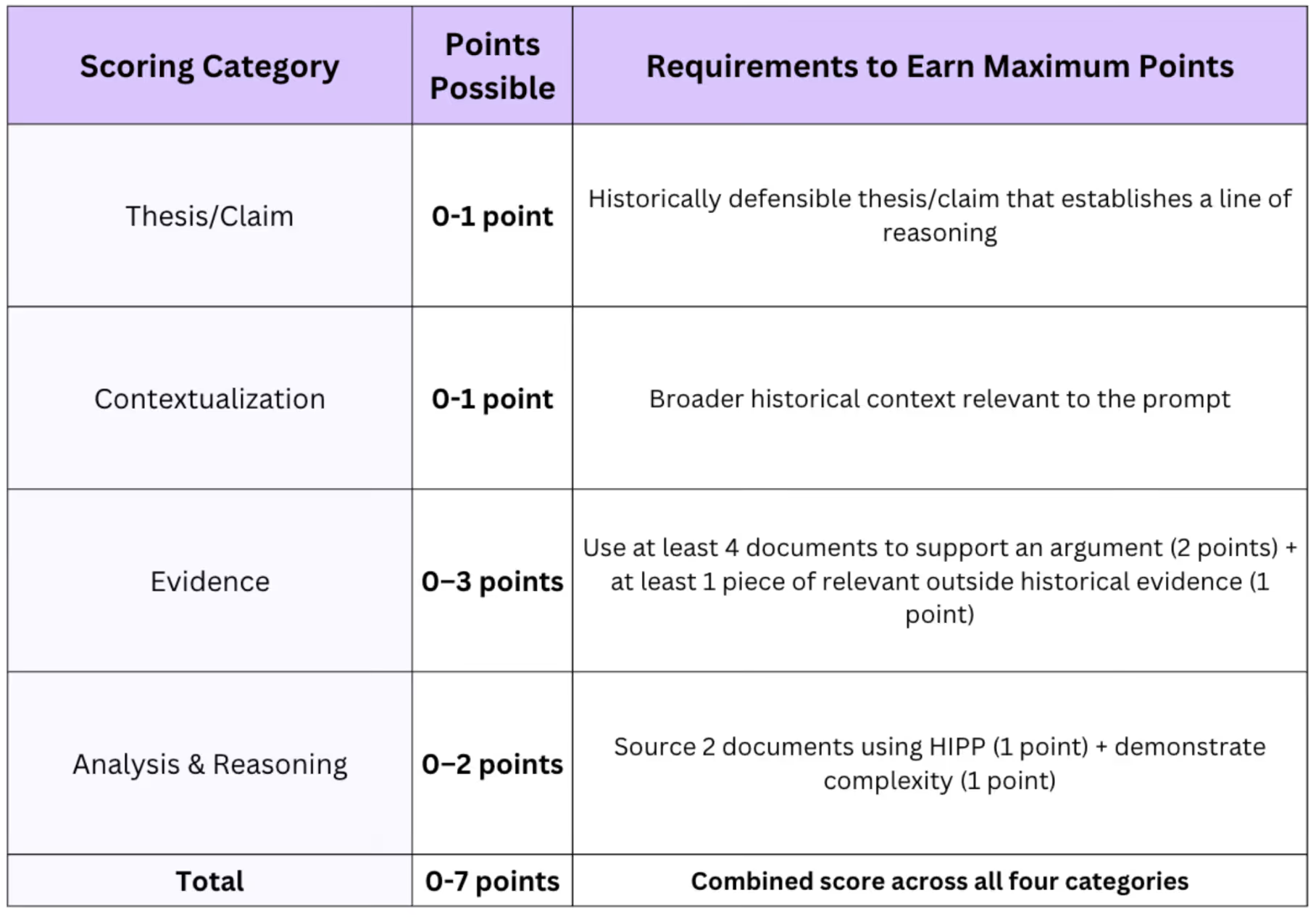
Important Note: The new DBQ rubric requires a minimum of 4 documents to earn full evidence credit (updated post-2023). Using only 3 documents earns 1 point maximum in the Evidence category.
DBQ Sourcing (HIPP) and the Complexity Point
To earn the sourcing point, students must explain how or why the historical situation, intended audience, purpose, or point of view (HIPP) of at least two documents is relevant to their argument. Simply identifying these elements without explaining their relevance does not earn the point.
The complexity point is earned by demonstrating a nuanced understanding of the historical development in the prompt. This can be shown by analyzing multiple causes or effects, qualifying or corroborating an argument with diverse evidence, or making relevant connections across periods or perspectives. The complexity must be integrated into the argument, not added as a list of extra facts or advanced vocabulary without analysis.
What Earns vs. Does Not Earn DBQ Points
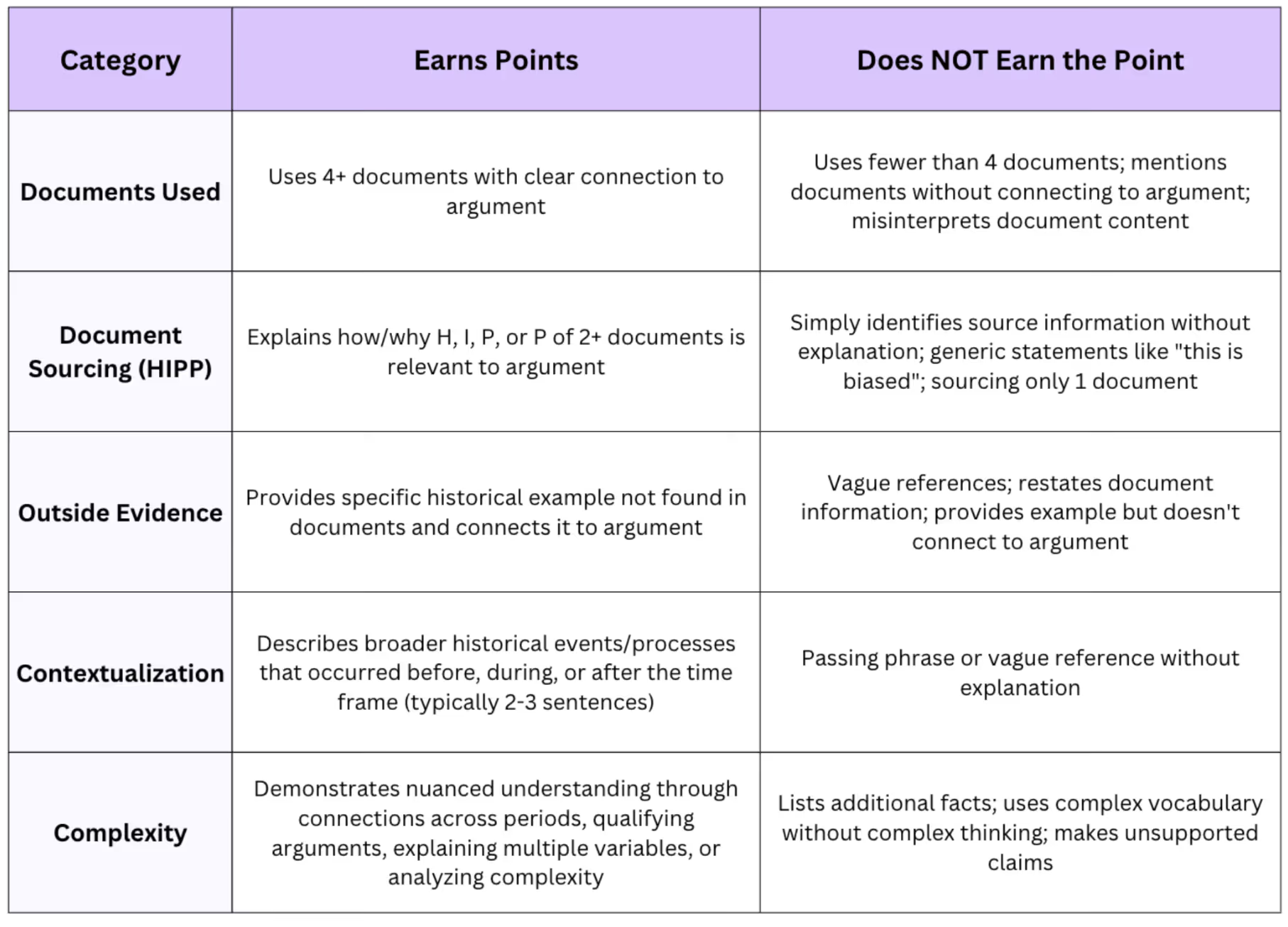
Note: All three AP History courses (APUSH, AP Euro, AP World History: Modern) use the same DBQ rubric with identical scoring criteria. The only difference is the historical content being assessed.
Benefits of EssayGrader

Time efficiency & streamlined grading
Simplify and speed up the grading process with intuitive features, allowing you to focus on impactful teaching.

Consistency
& fairness
Ensure fair and accurate grading by eliminating human bias, all while aligning with your curriculum standards.

Actionable insights
& feedback
Receive detailed feedback and growth insights on each essay and seamlessly share them with your students.
Less grading, more teaching
EssayGrader cuts down grading workload so teachers can focus on teaching the craft of writing instead of getting stuck in conventions and mechanics.
Better student outcomes
Students get consistent practice and instant feedback that helps them improve writing skills, build confidence, and prepare for timed assessments like AP exams.
Hours saved every week
Teachers save 5–6 hours a week on grading. That time can be redirected to lesson planning, one-on-one support, or simply reclaiming personal time.
What teachers say about EssayGrader
"EssayGrader is unparalleled in giving students the opportunity to practice their writing and receive the feedback they need to improve. The extensive practice my students get from EssayGrader reduces my grading workload and prepares them for the timed writes I read and score, as well as for the AP exam itself."
.avif)
"This is the first time that an innovation has directly impacted my ability to reach students at a higher level. EssayGrader helps me not to be bogged down by the tedious, albeit necessary, minutia of things like conventions and grammar which frees up my grading time for me to teach and evaluate the “art” of writing."

"EssayGrader has been phenomenal to use for my ELA classes.I grade all of my ELA essays with Common Core State Standards, and it probably saves me 5-6 hours of time per week. I loved it so much that I recommended it to our principal, and we are looking to roll this out with other teachers at our school."
.avif)
Frequently Asked Questions About the DBQ Rubric
Common questions teachers ask about the DBQ Rubric. Contact us if you don't see your question answered below.
How many documents do you need to use in a DBQ?
The College Board provides 7 documents in every DBQ, but the DBQ requirements specify minimum thresholds for earning evidence points. Using 3-4 documents earns 1 point, while using 4 documents to support an argument earns 2 points.
To earn the full 3 evidence points, students must use 4 documents AND provide 1 outside evidence example beyond the documents. Simply quoting documents without connecting them to the argument does not count toward these thresholds.
What is the complexity point in the DBQ rubric, and how do you earn it?
The complexity point in the DBQ is part of the Analysis & Reasoning category and is earned by demonstrating a nuanced understanding of the historical development in the prompt. It can be achieved through multiple pathways: explaining connections across periods or regions, analyzing multiple causes or effects, corroborating or qualifying an argument with diverse evidence, or effectively sourcing documents.
The complexity must be integrated into the argument—not just fancy vocabulary or lists of facts. Using all 7 documents effectively or sourcing 4+ documents with HIPP can help demonstrate complexity.
What are the DBQ requirements?
The APUSH DBQ rubric requirements include: a historically defensible thesis that establishes a line of reasoning (1 point), broader contextualization relevant to the prompt (1 point), evidence from at least 4 documents to support the argument (2 points), 1 outside evidence example beyond the documents (1 point), HIPP sourcing for at least 2 documents (1 point), and demonstrating complexity through nuanced argumentation (1 point).
Meeting all requirements earns the maximum 7 points on the College Board DBQ rubric.
What does the new DBQ rubric emphasize?
The new DBQ rubric, updated post-2023, emphasizes argument quality over document quantity. The updated rubric requires only 4 documents for full evidence credit (down from 6 in the previous rubric), offers multiple flexible pathways to earn the complexity point, and separates evidence from documents, outside evidence, sourcing, and complexity into distinct scoring categories.