AP History LEQ Rubric Overview
The Long Essay Question (LEQ) is a free-response essay that appears on the AP U.S. History, AP European History, and AP World History: Modern exams. All three AP History courses use the same official College Board LEQ rubric, which awards up to 6 points across four scoring categories: Thesis/Claim, Contextualization, Evidence, and Analysis & Reasoning.
- Applicable Courses: AP U.S. History (APUSH), AP European History (AP Euro), AP World History: Modern
- Total Points: 6 points maximum
- Scoring Categories: Thesis/Claim (1 point), Contextualization (1 point), Evidence (2 points), Analysis & Reasoning (2 points)
- Prompt Structure: Students choose 1 of 3 essay prompts, each aligned to a different historical reasoning skill (comparison, causation, or continuity and change)
- Updated: Post-2023 rubric (current scoring framework)






Free LEQ AI Grader
We've developed an AI LEQ grader that allows you to grade an entire class's LEQ essays in 2 minutes or less using the official College Board rubric. Our LEQ grader supports APUSH, AP Euro, and AP World History: Modern essays. Try it out for free below.


%201.svg)
Official College Board LEQ Rubrics and Scoring Guidelines (PDF Download)
The College Board provides comprehensive LEQ scoring guidelines that show exactly how the 6-point rubric is applied. These documents include the complete rubric framework, detailed scoring criteria for each category, and decision rules that explain what earns or doesn't earn points.
AP U.S. History (APUSH) LEQ Resources
- 2025 APUSH Scoring Guidelines Set 1 (PDF) - Complete rubric and all FRQ scoring guidelines
- 2025 APUSH Scoring Guidelines Set 2 (PDF) - Complete rubric and all FRQ scoring guidelines
AP European History LEQ Resources
- 2025 AP European History Scoring Guidelines Set 1 (PDF) - Complete rubric and all FRQ scoring guidelines
- 2025 AP European History Scoring Guidelines Set 2 (PDF) - Complete rubric and all FRQ scoring guidelines
AP World History: Modern LEQ Resources
- 2025 AP World History: Modern Scoring Guidelines Set 1 (PDF) - Complete rubric and all FRQ scoring guidelines
- 2025 AP World History: Modern Scoring Guidelines Set 2 (PDF) - Complete rubric and all FRQ scoring guidelines
These official materials provide the LEQ rubric framework and scoring criteria. Teachers can download these PDFs for classroom use and reference during instruction.
How the LEQ Rubric Scoring Works
The AP History LEQ rubric uses a 6-point scoring system across four categories. Points are earned independently—a strong thesis earns credit even if other areas are weak.
Scoring Categories:
Thesis/Claim (0–1 point):
Responds to the prompt with a historically defensible thesis that establishes a line of reasoning, and is located in one place (introduction or conclusion).
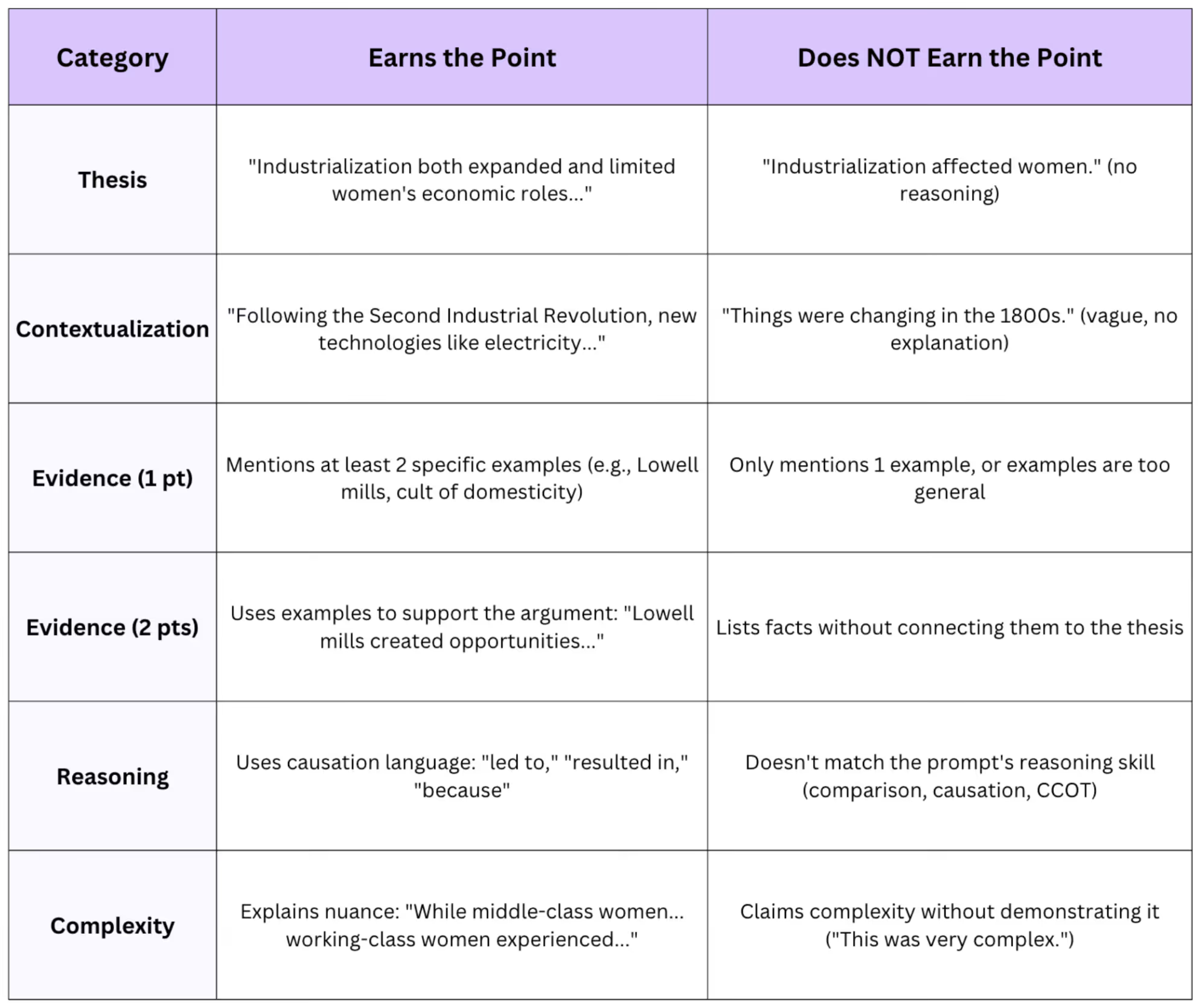
Does NOT earn the point: restating the prompt, overgeneralized claims, or claims without reasoning.
Contextualization (0–1 point):
Describes broader historical context relevant to the prompt. Context must be more than a passing phrase—typically 2-3 sentences describing events, developments, or processes before, during, or after the time frame that are relevant to the prompt.
Evidence (0–2 points):
- 1 point: Provides at least two specific historical examples relevant to the topic.
- 2 points: Uses at least two specific examples to support an argument in response to the prompt.
Analysis & Reasoning (0–2 points):
- 1 point: Uses historical reasoning (comparison, causation, or continuity and change) to frame or structure an argument.
- 2 points (Complexity): Demonstrates complex understanding by explaining nuance, corroborating/qualifying an argument, or making connections across periods, using evidence to corroborate, qualify, or modify the argument.
LEQ Rubric Scoring Breakdown
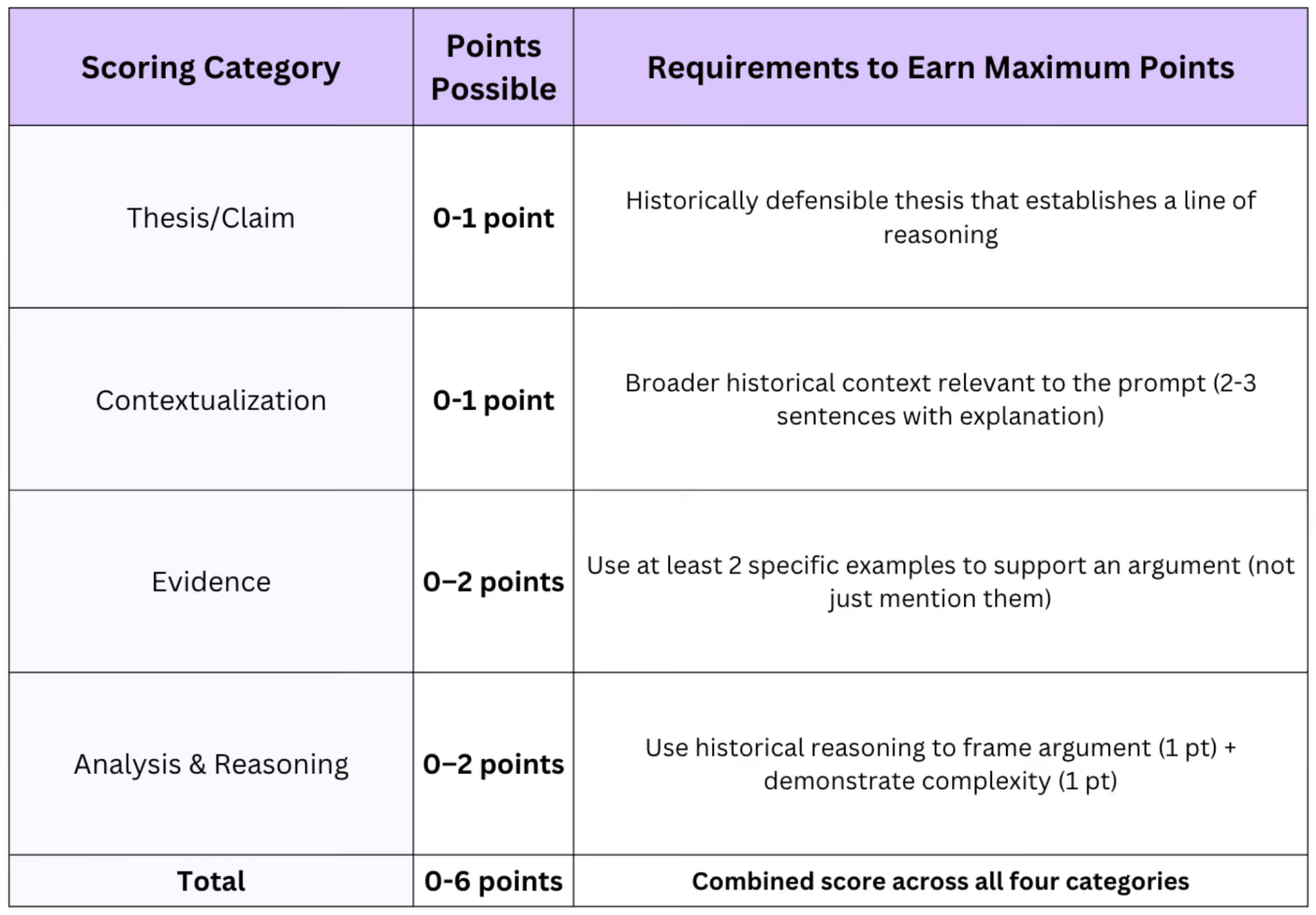
Important Note: The LEQ rubric expects at least two pieces of specific and relevant evidence. More evidence can help, but only if it clearly supports the line of reasoning.
LEQ Rubric by AP History Course
All three AP History courses—APUSH, AP European History, and AP World History: Modern—use the same 6-point LEQ rubric. The scoring criteria are identical across all courses.
APUSH LEQ Rubric
Teaching tip: Early U.S. history prompts (pre-1800) require broader contextualization—European developments, Indigenous nations, and colonial precedents count as valid context, not just events within the 13 colonies.
AP European History LEQ Rubric
Teaching tip: European history prompts often benefit from cross-regional comparison for complexity. Essays on industrialization or nationalism should reference multiple countries (Britain vs. France, Germany vs. Italy).
AP World History: Modern LEQ Rubric
Teaching tip: World History prompts typically require examples from multiple regions or civilizations. Students should use at least two distinct geographic areas (Ottoman Empire vs. Qing China, Latin America vs. Africa) for evidence and complexity.
What Earns vs. Does Not Earn LEQ Points
Grade LEQ Essays in Minutes Instead of Hours
Use EssayGrader's AI LEQ grader to apply the College Board rubric automatically. Get detailed feedback on thesis, contextualization, evidence, reasoning, and complexity—with hours of your time back for what matters most: teaching.

.avif)
.avif)
Benefits of EssayGrader

Time efficiency & streamlined grading
Simplify and speed up the grading process with intuitive features, allowing you to focus on impactful teaching.

Consistency
& fairness
Ensure fair and accurate grading by eliminating human bias, all while aligning with your curriculum standards.

Actionable insights
& feedback
Receive detailed feedback and growth insights on each essay and seamlessly share them with your students.
Less grading, more teaching
EssayGrader cuts down grading workload so teachers can focus on teaching the craft of writing instead of getting stuck in conventions and mechanics.
Better student outcomes
Students get consistent practice and instant feedback that helps them improve writing skills, build confidence, and prepare for timed assessments like AP exams.
Hours saved every week
Teachers save 5–6 hours a week on grading. That time can be redirected to lesson planning, one-on-one support, or simply reclaiming personal time.
What teachers say about EssayGrader
"EssayGrader is unparalleled in giving students the opportunity to practice their writing and receive the feedback they need to improve. The extensive practice my students get from EssayGrader reduces my grading workload and prepares them for the timed writes I read and score, as well as for the AP exam itself."
"This is the first time that an innovation has directly impacted my ability to reach students at a higher level. EssayGrader helps me not to be bogged down by the tedious, albeit necessary, minutia of things like conventions and grammar which frees up my grading time for me to teach and evaluate the “art” of writing."
"EssayGrader has been phenomenal to use for my ELA classes.I grade all of my ELA essays with Common Core State Standards, and it probably saves me 5-6 hours of time per week. I loved it so much that I recommended it to our principal, and we are looking to roll this out with other teachers at our school."