How accurate is our AI Essay Grader?


%201.svg)

How we measure grading accuracy
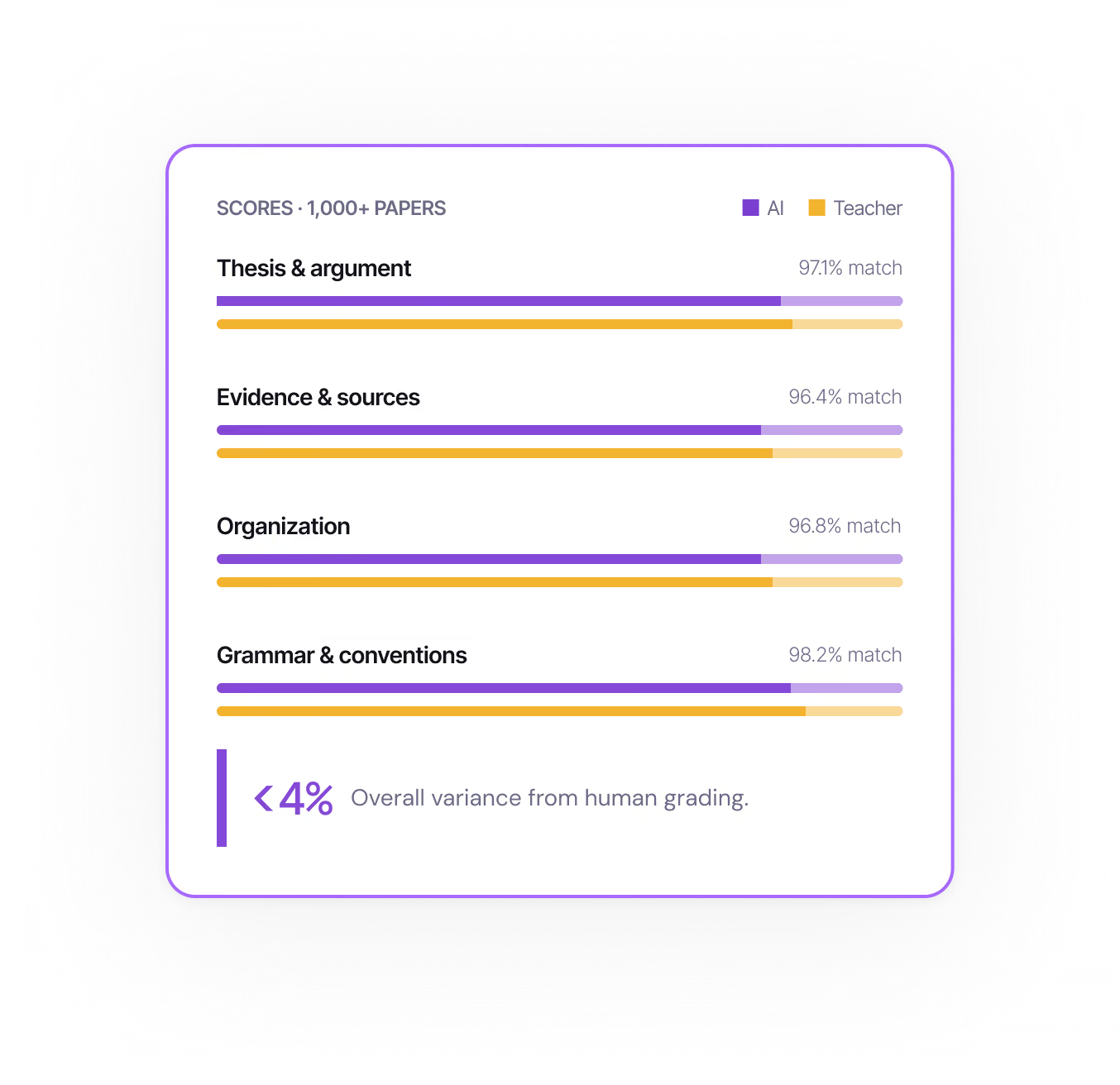
Each benchmark essay is scored independently by two experienced teachers on the same rubric. Where they disagree by more than a point, a third resolves it. The agreed score, not one teacher's opinion, is the target.
The engine never sees the human scores. We compare at the rubric-criterion level rather than the overall grade, because a right total built from two wrong criteria is not accuracy.
Exact-agreement percentages flatter any grader on a four-point rubric. We publish quadratic weighted kappa alongside them, the measure state assessment programs use, which penalises being badly wrong more than slightly wrong.
A grader can be accurate on average but too noisy to trust on any single essay. So we grade the same essay three times with identical inputs and measure how far the score drifts. A grade you can't reproduce is a grade you can't defend.
Studies we have run
Each study lists its sample, its protocol and its result — including the ones where we found a weakness and fixed it. Open any study to read the full report.
Teacher agreement
State-assessment alignment
Grading consistency
EssayGrader vs. human raters
Feedback at the right level
Actionable feedback
Teacher agreement benchmark, 22,000 essays
Every essay carries an official human score published by the program that released it: state anchor sets (Texas STAAR, Florida B.E.S.T., MCAS, PSSA/Keystone, NY Regents, Smarter Balanced), the ASAP 2.0 corpus, and College Board AP scoring guides. Our engine scored each essay blind against that program's own rubric, with no access to the human score. Results were compared criterion by criterion rather than on the overall grade, and scored with quadratic weighted kappa on each rubric's native scale.
Findings
94% criterion-level agreement, the AI score matched the official human score exactly or within one point, across 22,000+ comparisons.
Measured per criterion, not per essay, the harder test, because a matching total can hide two judgements that disagree.
Agreement held across eight independent programs and every grade band from 3 through AP.
What this study does not show
State anchor and released sets are chosen to be cleaner than a typical classroom stack, so read this as an upper bound on alignment, not a class average.
State-assessment alignment, six programs
Released state writing prompts with published anchor papers and official scores, across Texas STAAR, Florida B.E.S.T., MCAS, PSSA/Keystone, NY Regents and Smarter Balanced, graded on each state's own rubric to see whether our scores track the real ones.
Sample
1,453 criterion-level comparisons · grades 3-12 · six state programs - graded with exemplars.
Method
State programs publish released prompts alongside anchor papers with official scores. Because those scores are authoritative rather than reconstructed, they make an unusually clean test. We graded each anchor paper on the state's published rubric, criterion by criterion, and compared to the official score, then repeated the exercise for each state. Runs used graded exemplars (the same feature teachers use in the app), held out of the scored set, so no paper was graded against itself.
Findings
0.75 QWK across the six programs: 0.84 Florida B.E.S.T., 0.83 Texas STAAR, 0.78 MCAS, 0.73 NY Regents, 0.71 PSSA/Keystone, 0.65 Smarter Balanced.
96% criterion-level agreement within one point of the official score.
Exemplars raised agreement on every program measured both with and without them.
What this study does not show:
Quadratic weighted kappa depends on how many score points a rubric has, so the per-state figures are not directly comparable to one another.
Grading consistency: same essay, three times
If a teacher regraded the same essay, would the marks hold? We asked that of our own grader, using the same essays, the same rubrics and the same settings, graded three separate times, and measured how far the scores moved.
Sample
940 essays · 3 passes each · 691 criterion-level comparisons · 69 rubrics · elementary to college.
Method
Essays were sampled at random from a 10,000-essay production export and graded three times each on the production prompt, with every input held constant: same rubric, level, language, grading intensity and student instructions. Because rubrics don't share a point scale, each criterion score was normalised to a fraction of that criterion's maximum before scores were pooled.
Findings
99% of essays scored within 10% of themselves across three passes, and 88% within 5%.
63% received identical scores all three times: not close, identical, on every criterion.
84% of individual criterion scores were identical across all three passes; average movement was 1.5% of a rubric's scale.
Consistency held across levels and 69 rubric types, with no level or rubric concentrating the variance.
What this study does not show
Consistency measures reproducibility, not correctness. A grader can be perfectly consistent and still wrong, which is why we measure accuracy separately, in the studies above.
How we compare to human raters
The bar for essay scoring isn't perfection; it's a trained human rater, and two qualified teachers don't fully agree either. We set our agreement with official scores beside the human-to-human figures each state publishes for its own raters.
Sample
511 criterion-level comparisons · four state assessment programs · graded with exemplars
Method
Each essay was scored on its state's published rubric and compared to the official score, criterion by criterion, using quadratic weighted kappa. We then set those figures beside the average human-to-human QWK each program reports for its own raters, the same target a trained teacher is measured against.
Findings
Met or exceeded published rater-to-rater agreement on all four programs, averaging 0.79 against 0.74.
Florida B.E.S.T. is our strongest result: 0.84 against 0.82 reported for human raters.
Texas STAAR 0.83 vs 0.75 and MCAS 0.78 vs 0.70, both eight points clear of the human benchmark.
Pennsylvania PSSA is effectively a tie: 0.71 against 0.70, matching human raters, not claiming to beat them.
What this study does not show
Even two trained graders don't fully agree. Research on the ASAP benchmark reports human-to-human agreement of 0.61 to 0.85 QWK across eight prompts, averaging about 0.78 (Shermis, 2014).
Feedback at the student's reading level
Feedback that's accurate but written above a student's reading level doesn't get read. We scored every piece of feedback blind against a grade-level-appropriateness evaluator, across elementary through college.
Sample
940 graded submissions · elementary, middle, high school and college · 284 rubrics · real classroom grading
Method
Feedback was judged with the Learning Commons grade-level-appropriateness evaluator, which assigns text to a CCSS band from Flesch-Kincaid readability plus a four-dimension qualitative rubric. The judge saw the feedback text alone, never the score, the student, or which system produced it, and passages quoting the student's own writing were excluded. Every result was cross-checked against Flesch-Kincaid computed directly on the same text.
Findings
95% of feedback falls within one grade band of the level it was written for, and 61% lands in the exact band.
Where it misses, it skews below the student's level rather than above, the safer direction to err.
Independent readability agrees: elementary feedback reads at grade 5.4, middle school 8.7, high school 11.0, college 13.4.
What this study does not show
Readability measures whether feedback can be read, not whether the advice inside it is correct; scoring accuracy is measured separately.
Actionable feedback, not just corrections
Education research separates feedback that names a fault from feedback that names a next step. We measured, criterion by criterion, which kind ours produces, against Hattie & Timperley's model of effective feedback.
Sample
348 rubric criteria · 40 essays of live classroom work · 35 rubrics · elementary to college
Method
Hattie & Timperley's 2007 review distinguishes four levels feedback can operate at (the task, the process behind it, the student's own self-monitoring, and the student as a person) and finds the middle two carry learning. We coded every piece of feedback our grader wrote against those levels, and against the three questions effective feedback answers: where am I going, how am I going, where to next. Coding was blind to which prompt produced the text.
Findings
83% of suggestions operate at the process or self-regulation level: naming a method the student can reuse, or a check they can run on their own draft.
97.7% of criteria answer all three questions: What the work aimed at, where it stands, and what to do next.
94% of suggestions transfer to a different assignment rather than repairing one sentence.
Praise of the student rather than the work appears in only 0.3% of criteria. Person-directed praise carries no learning and crowds out the comments that do.
What this study does not show
This study measures the shape of the feedback, what level it operates at, not whether a teacher agreed with every individual suggestion.
Accuracy terms, defined
What our accuracy terms mean
Every figure on this page uses these definitions. Vague accuracy claims usually hide a loose one.
Agreement
The AI score matched the human score exactly, or within one point on the same rubric criterion. This is the figure we lead with, state programs use the same "within one point" bar to qualify their own raters, where it's called adjacent agreement.
Exact Match
The AI score and the human score were identical on that criterion, with no tolerance. A stricter measure, reported alongside agreement so the looser number is never read on its own.
Quadratic weighted kappa
A measure of how closely two raters agree, corrected for the agreement you'd get by chance. It penalises being badly wrong far more than being slightly wrong. Below 0.60 is weak, 0.60-0.70 is acceptable, 0.70-0.80 is solid working agreement, and above 0.80 is comparable to a well-trained human rater.
Criterion
A single line of a rubric, scored on its own scale. We compare criterion by criterion rather than on an overall grade, because a total can match while the underlying judgements disagree.
Consistency
Whether the same essay, graded again with identical inputs, gets the same score. Measured separately from accuracy, because a grader can be repeatable and repeatably wrong, or accurate on average and too noisy to defend a single grade.
How we handle AI-writing and plagiarism detection
No AI detector on the market is accurate enough to justify an academic integrity decision on its own, and any vendor claiming otherwise is selling you risk. Paraphrased AI text defeats every detector we have tested, including ours, and non-native English writing is disproportionately misflagged industry-wide.
So our reports go to the teacher, never automatically to the student or a parent, and they show evidence rather than a verdict. Use them to decide whether a conversation is worth having that conversation, not the score, is what establishes what happened.
How we keep grading accurate
Accuracy is not a one-time benchmark. These are the checks that run continuously, and the design choices that make a wrong score visible rather than silent.

Every score carries reasoning
The report cites the rubric language and the passage that earned each score, so a teacher can check the logic in seconds instead of trusting a number.

Teacher approves everything
No grade or comment reaches a student until a teacher releases it. Human review is not an optional setting it is how the product works.

Low-confident grading flagged
When an essay is unusual, off-prompt, very short, heavily code-switched it is surfaced for a closer look rather than scored quietly.

Teacher corrections feed the benchmark
Every score a teacher overrides is a labelled data point. We track override rates by rubric type and investigate drift upward.

No model ships without a rerun
The full benchmark suite runs against every model change. If agreement or kappa drops on any rubric type or student group, the change does not ship.

Calibration support for districts
Send us the essays where scoring felt wrong. We investigate with your team and tune the rubric alignment for your district, not just our benchmark.
What our AI grader is not good at
Any vendor claiming their grader has no weaknesses has not measured carefully. These are the cases where we tell teachers to look closely.

Creative and highly personal writing
Rubrics reward structure. Deliberate rule-breaking that a human reads as voice can score lower than it deserves, so poetry and experimental narrative need your eyes.

Factual claims outside the source material
If you have not attached the reading, the engine cannot always tell a confident wrong claim from a correct one. Reference materials close most of this gap.

Very short responses
Under roughly 75 words there is not enough evidence for criterion-level scoring to be reliable. These essays are flagged rather than scored with false confidence.

AI-writing detection is a signal, not a verdict
No detector, ours included, is accurate enough to accuse a student. We show the evidence and leave the judgment where it belongs - you, the teacher.
Do not take our word for it — audit us
Frequently asked questions?
Our answers to the most common questions teachers ask us.
What is an AI Essay Grader?
An AI Essay Grader is a tool that uses artificial intelligence to evaluate student writing against a rubric, provide personalized feedback, and recommend scores, helping teachers grade essays faster and more consistently.
Why does EssayGrader feel faster and simpler than other AI grading tools I’ve tried?
It mostly comes down to the thoughtful product design and the quality of our AI models. EssayGrader’s integrations with Google Classroom, Canvas and Schoology learning management systems are natively built into the platform, with no reliance on third-party middleware. That means no extra steps for the teacher, no app-hopping, and a friction less grading experience for the teacher. Everything works securely and seamlessly within EssayGrader, so you can import student work and start grading right away - without sacrificing speed or compromising student data privacy. Additionally, we leverage the most advanced AI models to deliver faster, more accurate, and more efficient grading.
Is EssayGrader just for grading essays?
While EssayGrader was originally purpose-built for grading essays, over time EssayGrader evolved into grading short answers, DBQs, research reports, case studies, journals, summaries, and more. If it involves writing, EssayGrader can handle the grading with precision.
How does an AI essay grader differ from traditional grading methods?
An AI Essay Grader leverages advanced artificial intelligence to significantly streamline and accelerate the grading process. Unlike traditional grading methods, which are time-intensive and can lead to inconsistent results due to fatigue or human bias, AI Essay Graders provides instant, objective, and rubric-aligned evaluations every time. By automating repetitive grading tasks, AI Essay Graders like EssayGrader frees teachers to spend more time delivering personalized feedback and engaging with students, improving learning outcomes and classroom interactions.
Does EssayGrader provide teacher training and onboarding?
Yes! every school receives a live onboarding training session at the time of purchase, so your staff can start grading with confidence from day one. We also offer two free certification courses for educators who want to become EssayGrader AI Certified - perfect for those who want to deepen their skills and master the platform.
In fact, schools that complete our expert-led onboarding see a 30% increase in adoption and usage, thereby giving you a better ROI on EssayGrader purchase.
Can I use EssayGrader to detect AI writing and plagiarism in the classroom?
Yes and yes! EssayGrader includes built-in tools for both AI writing detection and plagiarism checks. If a submission shows signs of AI-generated content or overlaps with work from other students, it will be flagged for your review. It’s a simple way to uphold academic integrity while streamlining your grading process.
What are the advantages of using an AI Essay Grader?
An AI Essay Grader can transform how teachers handle grading while helping students become better writers. Here’s how:
- Faster grading: Teachers can grade an entire class in minutes instead of hours, there by teachers have more time for instruction and student support.
- More consistent grading at scale: Whether it's grading 30 students or 300 students, every assignment is graded using the same rubric and standards, thereby reducing human-bias and grading fatigue.
- Detailed, actionable feedback: A well designed AI Essay Grader provides every student with detailed, personalized and curriculum aligned feedback on their writing, grammar, and standards mastery, giving them clear next steps to improve their work.
- Better visibility into student writing progress: Measure writing performance against curriculum standards & identify individual and class-wide learning gaps.
- Plagiarism and AI detection: An AI Essay Grader by definition doesn't need AI and Plagarisim detection tools. But incorporating these tools into an AI Essay Grader makes it well-rounded and highly suitable for classroom use.