
Good written feedback tells a student one specific thing to change and how to change it, and this page has fifteen examples you can adapt.
Ten of these examples cover general classwork, and five of these are for essays. Each one is written out in full, so you can copy the wording and swap in your own details. But first, here’s what the good ones have in common.
What makes feedback work
Feedback works when it is specific, timely, tied to a goal, and limited to one thing at a time.
- Specific. Name the sentence, the paragraph, or the skill. "Your second paragraph needs a quote" gives the student somewhere to start. "Your writing needs work" doesn't. A student needs to be able to point to the spot you mean, or the comment isn't actionable.
- Timely. Feedback lands best while the student still remembers writing the piece. A note on a draft they can still change beats a long one on work finished weeks ago. Quick checks during a unit help here, and the guide to types of assessment tools covers where each one fits.
- Tied to a goal. Link the comment to what the student is working toward, not only to what's on the page. "This is the kind of evidence you'll need for the research essay in May" tells them why the fix matters.
- One skill at a time. A page covered in red ink gets skimmed and put away. Pick the one skill that matters most for this student right now and leave the rest for the next piece.
You can pair what worked with what to change, and be honest about praise. A compliment with no next step feels kind but teaches nothing.
Ten feedback examples
Each example below shows the situation, the feedback written out, and why it works.
1. Recognizing improvement
Situation: A much better organized essay than last time, but the thesis is still vague.
Feedback: "Big step up from your last essay. Your transitions now walk me from point to point. Next job is the thesis. Right now it says the book is 'about change.' Tell me what kind of change, and why it matters."
Why it works: It names the improvement, then gives one next step.
2. Constructive criticism
Situation: Solid research, but presentation slides packed with text.
Feedback: "You clearly knew your topic. The slides worked against you, though. Most had full paragraphs, so the class read instead of listening. Next time, keep each slide to one image and a few words, and say the rest out loud."
Why it works: It separates content from delivery and gives a rule to follow.
3. Recognizing effort
Situation: Far more work than usual on a research project, but only websites as sources.
Feedback: "I can tell you put real hours into this, and section two shows how widely you read. Next project, add at least two primary sources, like a letter or a newspaper from the time."
Why it works: It praises a specific effort, not "hard work" in general.
4. Encouraging self-reflection
Situation: Math quiz scores rose all term, and a harder unit starts next week.
Feedback: "Your quiz scores went up all term. Before we start fractions, write two sentences on what changed. Extra practice? Checking your work? Whatever it was, keep doing it."
Why it works: The student works out what helped, so the habit carries forward.
5. Setting a goal
Situation: A well-organized essay with thin analysis.
Feedback: "Your essay is easy to follow. Where it falls short is analysis, because you often drop in a quote and move on. For your next two assignments, write two sentences after every quote explaining what it shows. I'll post model paragraphs on the class page."
Why it works: One goal, easy to check, with help attached.
6. Clearing up a misunderstanding
Situation: A lab write-up says plants get their food from the soil.
Feedback: "Photosynthesis got mixed up here. Plants make their own food from light, water, and carbon dioxide, and the soil mainly supplies water and minerals. Reread the section in chapter 5, then explain it back to me at lunch on Thursday."
Why it works: It corrects the exact misconception and sets a time to check.
7. Improving group work
Situation: A strong group project, but this student's reflection shows they did most of the work.
Feedback: "Your group's model was excellent. From your reflection, it sounds like you did most of the building. Next time, split the tasks on day one and write down who owns each part."
Why it works: It credits the result and fixes how the group works.
8. Offering support
Situation: A struggling student hands in unfinished work that still shows progress.
Feedback: "I know this unit has been hard, and I noticed you kept going on the last three problems. You got two of them most of the way. Come to Tuesday's help session, and we'll finish the third together."
Why it works: The encouragement is backed by evidence and a real offer.
9. Celebrating an achievement
Situation: First place at the school science fair.
Feedback: "Congratulations on first place! What impressed me most was how carefully you controlled your variables. Every trial ran at the same temperature, and the judges noticed. Keep that habit."
Why it works: It says what earned the result, so the praise teaches something.
10. Explaining a gap in detail
Situation: A convincing argument that rests on a single example.
Feedback: "Your argument is persuasive, but it all hangs on the 1920s strike. If a reader doubts that one case, the whole essay falls. Add two more examples from our unit and show how all three lead to the same conclusion."
Why it works: It explains why the gap matters, not just that it exists.
Five examples for essay feedback
Essay feedback has its own patterns, and these five cover the comments teachers write most often. Tying each comment to a rubric row helps, and you can browse the rubric library if you need a writing rubric to start from.
1. Thesis statement
Situation: A thesis too broad to argue: "Social media has good and bad effects."
Feedback: "Your thesis covers too much for five paragraphs to prove. Pick one side and one reason. Something like 'Social media makes teenagers lonelier because it replaces time with friends.' Then revise each body paragraph to support that claim."
Why it works: It shows a model thesis instead of saying "narrow it down."
2. Evidence
Situation: Good quotes with no analysis after them.
Feedback: "You've chosen strong evidence, but the quotes speak for themselves. In paragraph two, add two sentences after the green light quote: what the light stands for, and how that supports your point about Gatsby's hope."
Why it works: It shows what analysis looks like in one real spot.
3. Structure
Situation: One paragraph covering two separate points.
Feedback: "Paragraph three is really two paragraphs, one on cost and one on safety. Split it where you wrote 'Another issue is' and give each half a topic sentence. Put safety last, since it's your strongest point."
Why it works: It says exactly where to cut and why the order changes.
4. Grammar patterns
Situation: The same comma error, repeated throughout.
Feedback: "I've underlined three places where you join two full sentences with just a comma. That's a comma splice. Use a period, add 'and' or 'but,' or use a semicolon, then check the rest of your draft for it."
Why it works: Naming the pattern teaches the rule once.
5. Second draft
Situation: A revised essay handed in after first-draft comments.
Feedback: "Put this next to your first draft and you'll see how far it's come. Your thesis is clear now, and every quote has analysis after it. What's holding it back is the conclusion, which repeats your introduction. Revise it to say why your argument matters."
Why it works: Redraft feedback names what improved, which is where students see their progress.
Feedback that does not work
The most common weak feedback is not unkind, it is unusable. Here are five comments teachers write all the time, next to versions a student can act on.
The comments on the left feel supportive, and that's the trap. They give the student nothing to do. "Needs more detail" doesn't say where, and "check your grammar" doesn't say what. Each version on the right points at a real spot on the page.
Before you hand work back, ask one question:
Could the student start fixing it without asking you what you meant? If not, the comment needs one more detail.
Giving feedback on a full class set
The hard part is not writing good feedback once, it is writing it on the hundredth essay as carefully as on the first.
The first essays get detailed comments tied to the rubric. But eventually, by essay ninety, a lot of them just say "good" or "expand."
The students at the bottom of the pile get less useful feedback than the ones on top, though their work deserved the same attention.
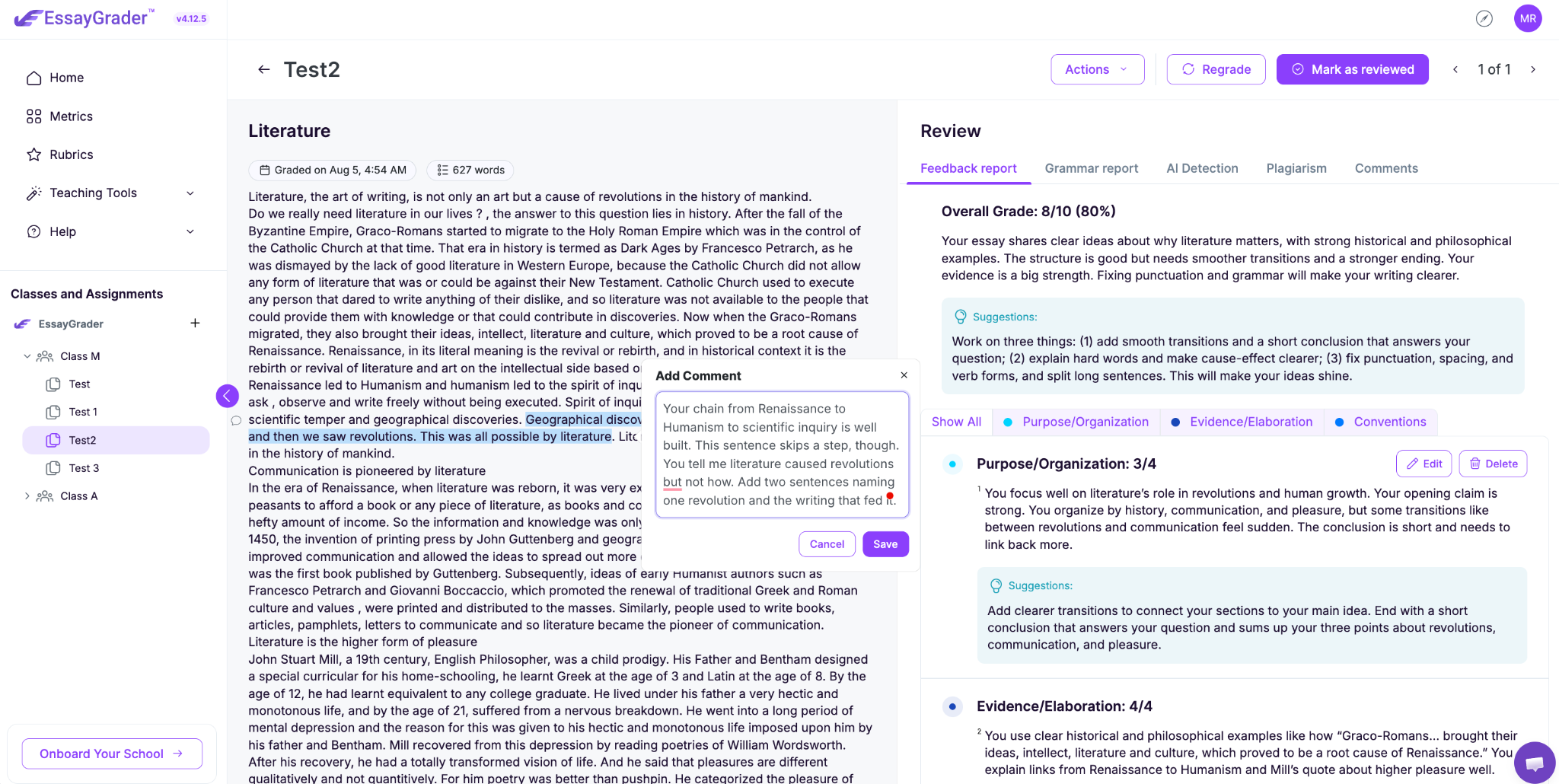
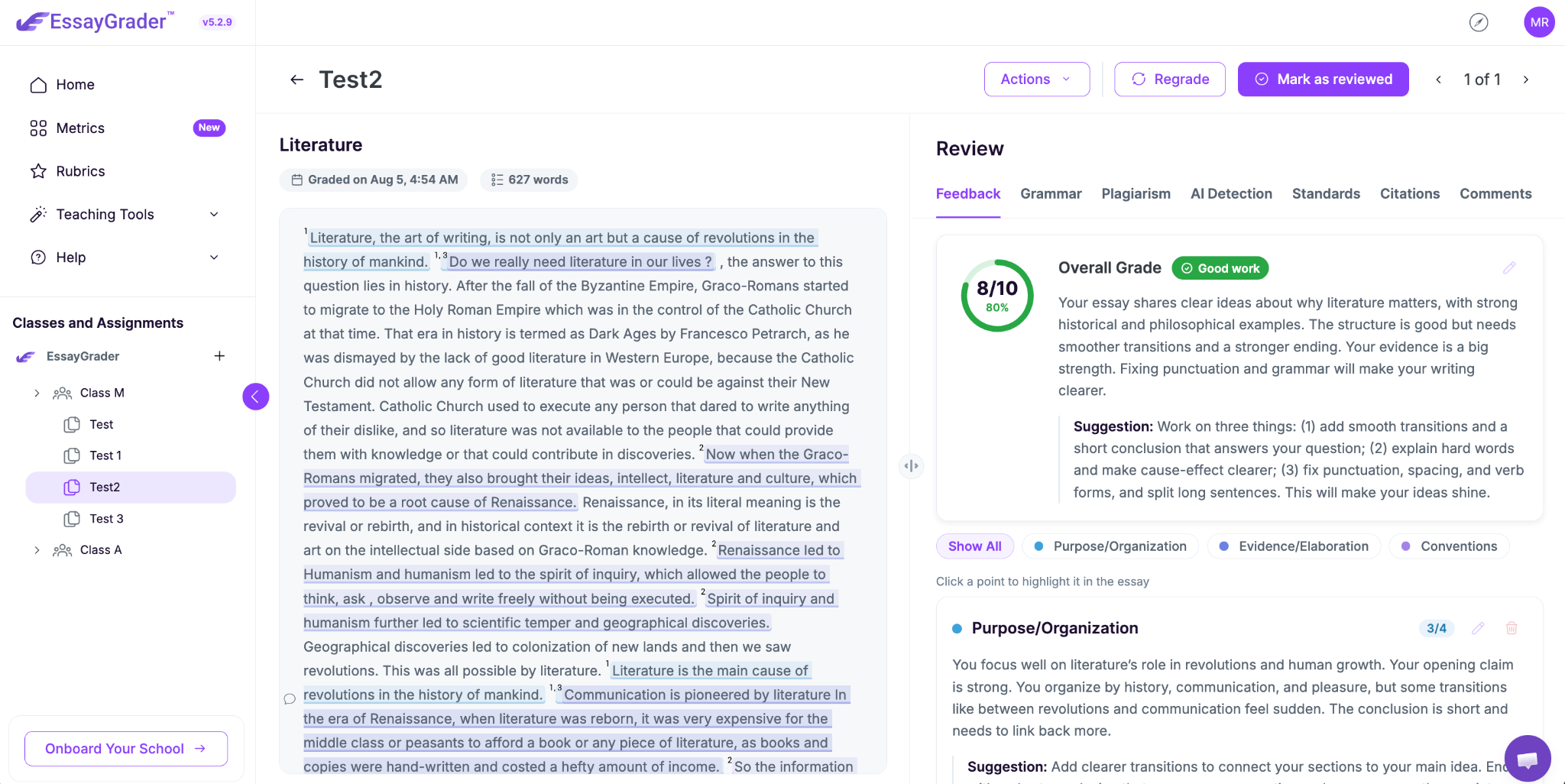
EssayGrader, a rubric-based AI essay grading platform for K-12 and higher-education teachers, grades each essay against the rubric criteria you define and writes specific feedback for each criterion. The last essay in the set gets the same treatment as the first.
You stay in charge of what students see. You review every score and comment, edit anything you'd put differently, and release the feedback only when you're happy with it. If you'd like to know what students would receive, you can see what a feedback report includes before trying it on your next class set.

.jpeg)



.avif)
.avif)
%201.svg)