Teacher burnout has become a national crisis, especially in the US.
In 2026, the University of West Alabama conducted a survey of K-12 classroom teachers and found that 52% of them would not encourage a young person they care about to become a teacher.
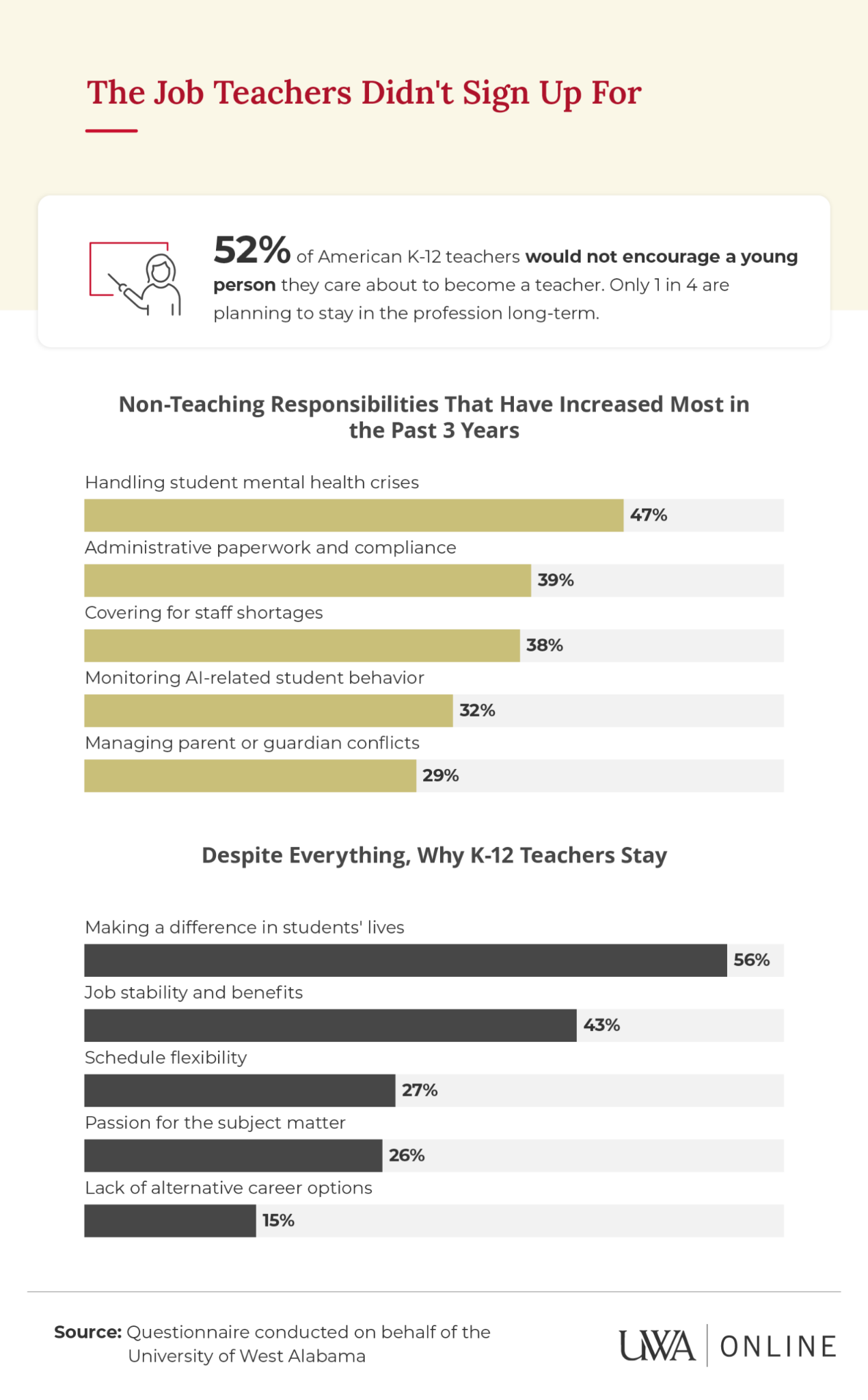
A 2025 University of Missouri study reported that a whopping 78% of teachers in the US have considered quitting their job since the pandemic.
These are deep-rooted structural issues in the education sector that cause burnout in teachers. If you want to thrive in the profession, you must take it into your own hands to proactively prevent burnout.
In this article, we discuss how to prevent teacher burnout through 5 actionable steps and what to do if you’re already there.
What Exactly Is Teacher Burnout?
The state of occupational exhaustion in teachers that happens due to a stressful working environment at schools is known as teacher burnout.
Research says that there are 3 core components of burnout:
- An overwhelming sense of emotional exhaustion, which presents as physical symptoms of fatigue, reduced sleep, changes in appetite, headaches, stomachaches, etc.
- A feeling of depersonalization and detachment from the job, such that you lose joy in teaching
- Feeling ineffective or incompetent at your work
The Job Demands-Resources (JD-R) model explains that working conditions are divided into two categories: job demands and job resources. In teachers, job demands cause exhaustion while a lack of job resources produces disengagement.
Common Causes of Teacher Burnout
Teacher burnout results from chronic accumulation of multiple different stressors that reach beyond the limit to which your brain can cope. They include:
- Excessive workload
- Time pressures that push teachers to work in their free times
- Role conflict, which can be between school management policies vs. student needs, or keeping the balance between a friendly vs. an authoritative role, meeting parental expectations against school policies, etc.
- Insufficient pay relative to the nature of their job (The National Education Association reports that 87% of US teachers express concerns over low pay and 40% work extra jobs)
- Rigid school hierarchies that leave little control to teachers over how they want to teach
- Lack of administrative support
- Disciplinary student behaviors that disrupt teaching
- Decisions of non-educators that affect the education sector, for example, banning specific textbooks, tying teacher evaluations to their student’s standardized test scores, budget cuts, micromanagement, etc.
Teacher Burnout Due to UK vs. US Grading Standards
Learnosity’s 2025 survey found that 52% of teachers in the UK consider leaving their profession due to the overwhelming burden of grading from March 2024 to March 2025.
The UK uses standardized grading criteria in schools. Adhering to rigid board exam criteria leaves little room for teachers to explore a student’s creativity.
Anticipatory performance anxiety also factors in when teachers are evaluated by inspectors from the Office for Standards in Education, Children's Services and Skills.
US schools mostly follow a continuous grading system throughout the academic year consisting of weekly quizzes, homework, projects, tests, etc. Some US districts enforce no-zero grading floors, setting the minimum score at 50 or 60. However, there have been legislative bans on such grading criteria in some states due to academic accountability concerns.
On average, a US teacher spends 9.9 hours per week, which is more than an entire workday, grading student assignments.
How to Prevent Teacher Burnout
Although many factors leading to burnout are structural, here are some changes you can make, or advocate for, that explain how to stop teacher burnout.
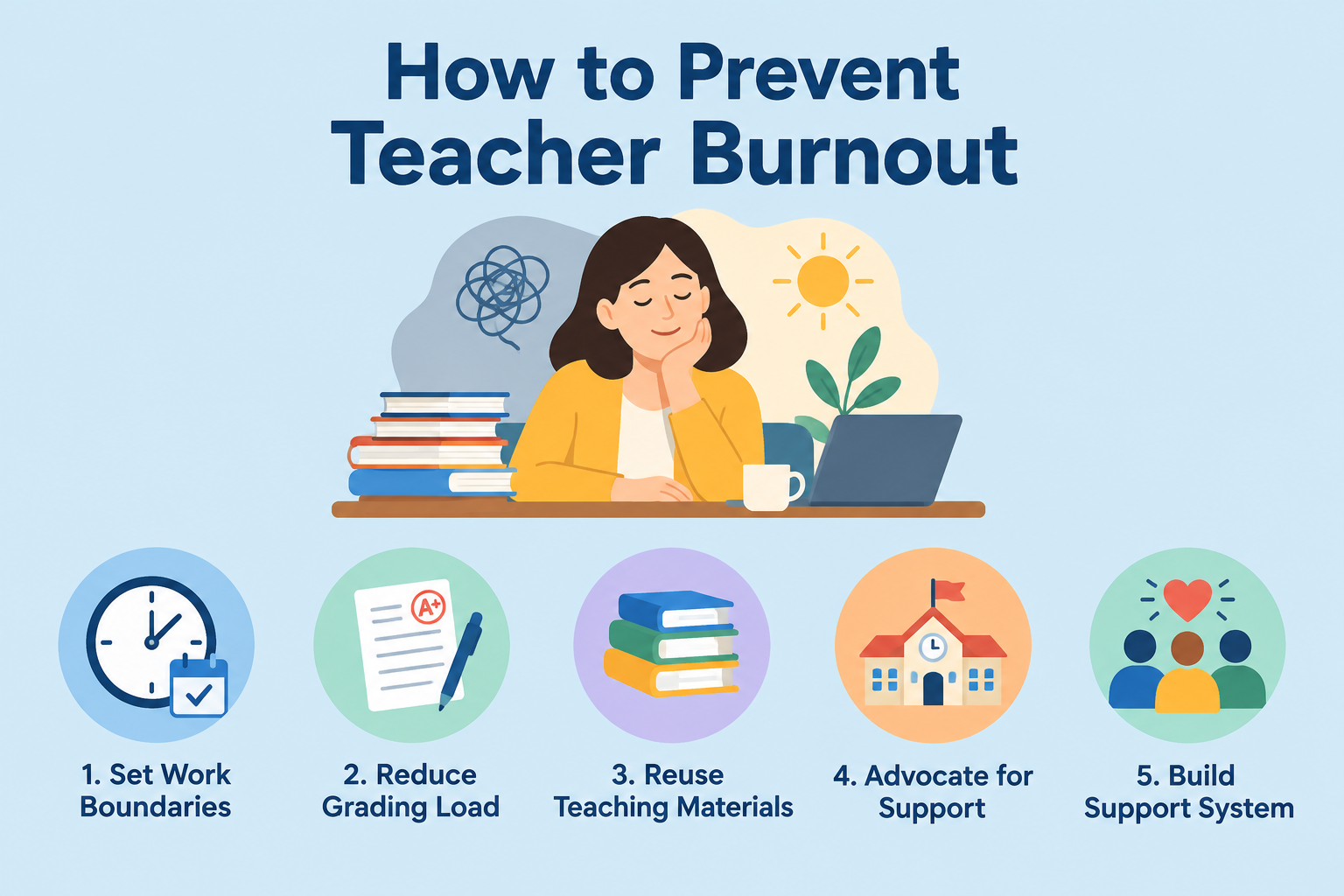
1. Set boundaries around work hours
Your work in teaching is never truly finished, no matter how much time you give to it. Therefore, you need to establish clear boundaries around your work hours and expectations people have of you.
First and foremost, decide on a specific time to leave the school premises every day.
Also decide on a time window during which you reply to school emails and add these working hours to your email signature. Set a dedicated time of the week to reply to parents’ emails rather than feeling obliged to reply exactly as they come.
When planning lessons, set a realistic timer for specific tasks. Once the timer goes off, stop your work even if you are not completely done.
Do not volunteer for every committee, club, after-school event, or anything extracurricular that takes your attention off your regular workload. Learn to say no to extra tasks that eat your time.
2. Reduce your grading time and workload
Marking or grading is one of the leading contributors to excessive teacher workload. Here are some grading strategies to manage or reduce your grading workload:
- Use objective, point-based grading rubrics to speed your decision-making
- Engage your students in peer-grading on low-stakes assignments where you discuss the grading rubric/correct answers, and they mark each other’s work.
- Create a document of your most-used feedback phrases for recurring types of student mistakes that you can copy and paste when grading assignments.
- If you notice a large number of students making similar errors, provide group feedback rather than individually grading each student’s work.
- Use digital quiz platforms with auto-grading features for multiple-choice and short-answer questions.
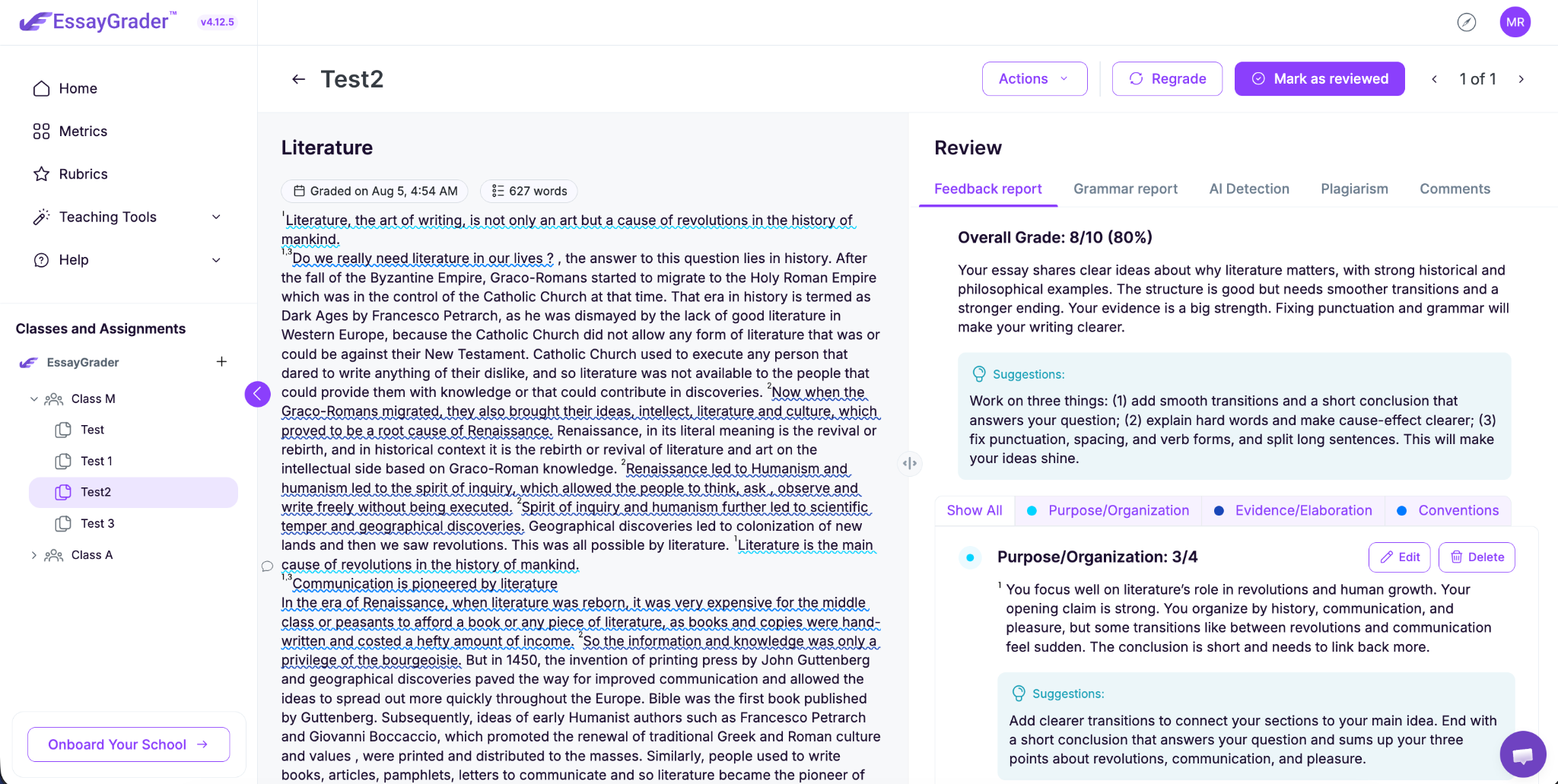
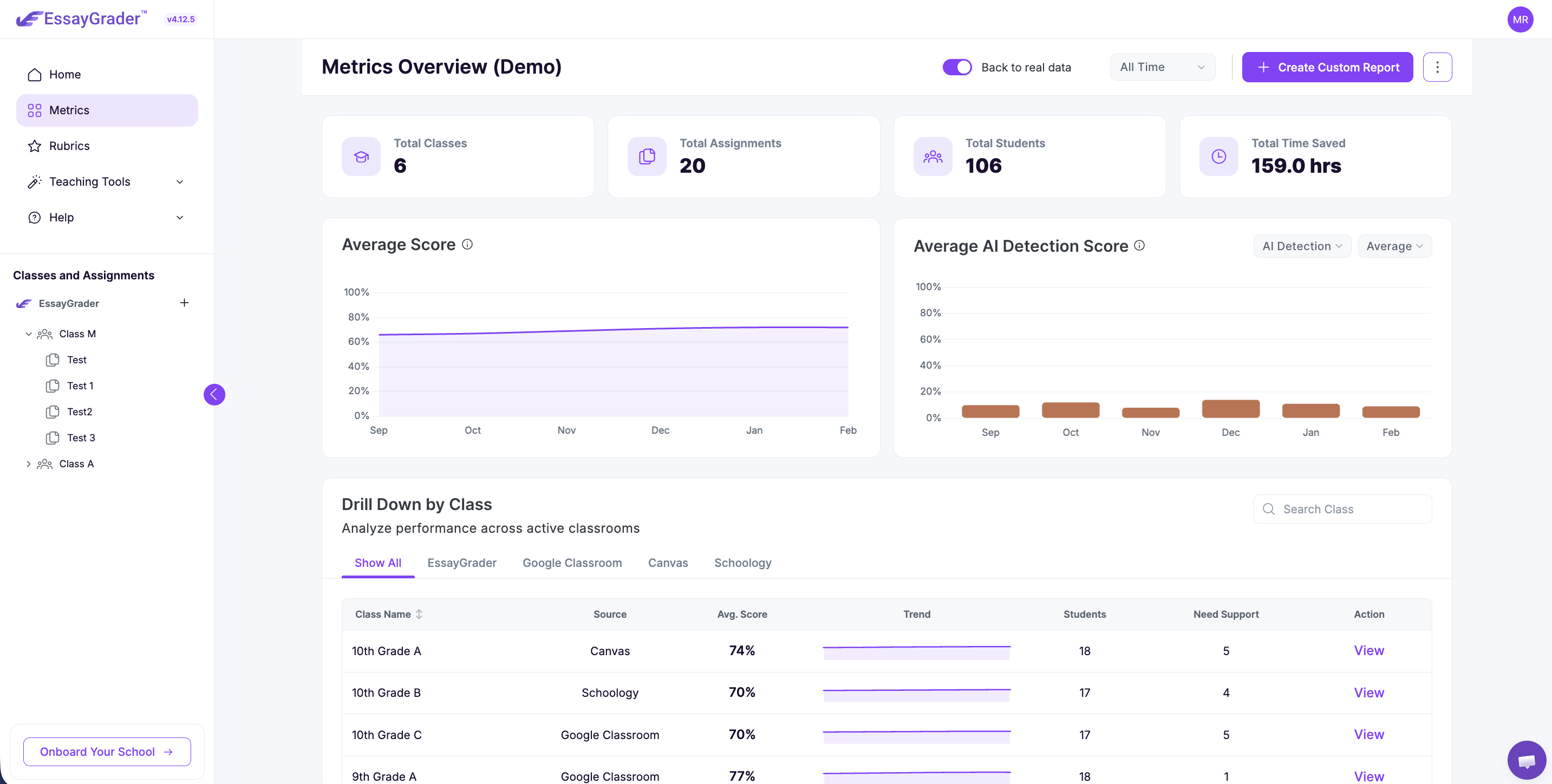
- You can use AI grading tools like EssayGrader and connect them with your LMS to grade narrative, argumentative, and expository types of writing using either one of its 800+ built-in standards rubrics or your own.
3. Build reusable teaching resources
Teachers spend a massive chunk of time and energy on “re-inventing the wheel” every single year by creating fresh lesson materials. However, you can shift from single-use materials to creating evergreen resources that get used again and again.
If you deliver lectures, create yourself a universal deck of slides and image templates (Venn diagrams, KWL charts, concept webs, etc.) such that you never have to worry about design elements again. All you do is plug in the content for a lesson.
For assignments and assessments, maintain a master sheet of tasks tagged by difficulty levels. Whenever you have to create one, pull a random set of questions rather than writing new questions every time. You can keep adding new questions to this sheet so it stays fresh.
You could also create a set of email templates with blank fields for communicating common situations, such as a student’s missed work, behavior update, sending positive feedback, etc.
4. Advocate for systemic support
Lack of administrative support is one of the biggest factors that increases anxiety in school teachers. Bringing a change in the system will be a slow process but a sustainable one since it targets the root cause of burnout.
You should push the school administration for a policy introducing protected lesson planning time. Make the request specific, i.e., an uninterrupted 45-minute planning block daily, with no meetings scheduled during it, enforced at the admin level.
Advocate for a cap on non-teaching duties (i.e., no more than 2–3 non-teaching tasks per week). Propose an official policy to request that staff are not expected to respond to work-related emails after set hours.
You could also push HR to dedicate a few wellness days off your yearly schedule that are not lumped in with sick leave and do not require a doctor’s note.
These efforts are more likely to produce results following collective advocacy by the majority of staff members.
5. Build a personal support system
Social support is a well-known buffer against burnout. You need to have a community of people comprising at least one colleague and friends/family outside of your teaching network.
A nonjudgmental colleague will help you stay accountable and understand you when you need to vent. But a friend outside the education sector will provide you with breathing space to think of other hobbies where you bond on non-work-related experiences.
You should also deliberately spend some time weekly on a hobby that has nothing to do with school just to get your mind off teaching.
How to Recover From Teacher Burnout (If You're Already There)
If you notice any of the three components of burnout we discussed earlier, consider a professional assessment.
The Maslach Burnout Inventory is the gold-standard questionnaire to measure occupational burnout. There are profession-specific, research-validated tools too.
Here’s how to recover from teacher burnout if your scores show high exhaustion or detachment:
- Talk to a therapist about your symptoms and the results of your assessment. Your therapist should understand what high-contact caregiving professions take from a person. Look at the reviews of the therapist to check if they have worked with teachers, nurses, social workers, or people in similar professions with high burnout rates.
- If you have sick days banked, get a break from work with zero school contact. Otherwise, have an open conversation with the administration about temporarily cutting down your duties. Make it a specific, time-bound request.
- Get your basics done right, i.e., a full 7-9-hour sleep at consistent times every night, nutritious meals, light movement, and spending time with people you love.
EssayGrader AI Reduces the Work That Causes Teacher Burnout
EssayGrader is an AI grading tool that has helped 200,000+ teachers in 10,000+ schools save hours of grading time they can put back into rest and their own well-being.
It offers 800+ curriculum-aligned rubrics specific to all 50 U.S. states, AP, Common Core, IB, and more.
The grading standards apply to all kinds of writing assignments. EssayGrader’s scoring system has been benchmarked on a dataset of 22,000 essays with a scoring accuracy within 1 point of teacher scores 94% of the time.
If you are wondering how to prevent teacher burnout caused by excessive grading workload, use EssayGrader for free today.
Frequently Asked Questions
What are the signs of teacher burnout?
Teacher burnout presents as a combination of unexplained physical and emotional signs. The signs include excessive fatigue from grading or other teaching duties, difficulty sleeping, changes in appetite, headaches, stomachaches, muscular pain, etc. You also feel disconnected from your passion for teaching and that the work you do does not have any impact on anyone.
Can you recover from teacher burnout?
Yes, you can recover from teacher burnout. Research says that it happens best when you gradually re-integrate yourself into work alongside support from your colleagues and school leadership.
What is the 42% rule for burnout recovery?
In 2019, Emily Nagoski, PhD, and Amelia Nagoski, DMA, wrote the best-selling book Burnout: The Secret to Unlocking the Stress Cycle, in which they introduced the 42% rule. It says that humans need roughly 42% of their time (about 10 hours a day, including sleep) for rest.
.png)


.avif)
.avif)
%201.svg)