
Teachers spend a lot of time grading.
A 2025 Learnosity survey of 258 US teachers found that they spend around 9.9 hours a week on grading. What's interesting is that 75% of them said they would be happy to use AI grading tools if it could reduce their grading workload.

This shows just how much time and effort teachers are willing to save on grading, so they can focus on other things.
And the problem isn't just the number of hours. Grading requires concentration. You have to read closely, apply the same criteria across different pieces of work, write useful feedback, and make decisions that can affect a student's grade.
When you have to do that for dozens of students, it can really add up and become a huge workload.
The best part is, you don't need to change your entire approach. Small changes to your rubrics, feedback process, deadlines, and assessment design can make a noticeable difference. Here are 11 grading strategies worth trying.
11 grading strategies that actually save time
We have divided these strategies into three parts based on an actual grading workflow. Some of these ideas come from assessment research.
Others are practical approaches teachers already use to make grading more manageable. The important thing is finding the ones that fit your classes and the type of work you're grading.
First of all, design assignments so they are easier to grade
This is where most of the weight lies, and if done correctly, it can save you time in both designing and grading papers.
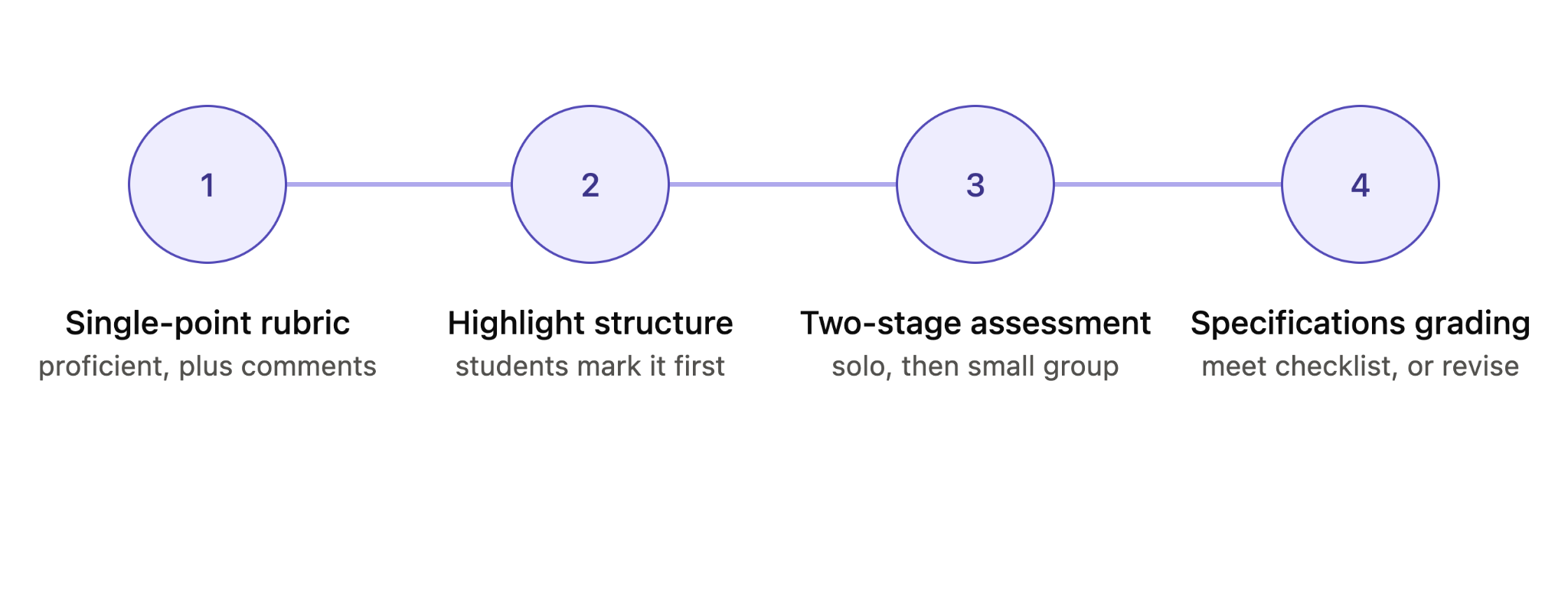
1. Try a single-point rubric
A detailed rubric can make grading feel more objective, but it can also create a lot of work.
A single-point rubric takes a simpler approach here. It focuses on what makes a piece of work proficient, well-written (or up to the mark). You can then add comments about where a student falls short or goes beyond those expectations.
The point isn't to make every rubric shorter. It's to remove detail that doesn't actually help you make a grading decision.
2. Ask students to highlight their own structure
Sometimes the quickest way to understand an essay is to have the student show you where the important parts are.
For instance, consider asking students to highlight key parts of their work, like their main argument, main points, and the evidence that backs them up, before they turn it in. This can help them make sure their work is clear and easy to follow.
This technique provides a clear overview of an essay's structure before getting into the details. You can just skim and scan, read the highlighted parts, mark them based on your single-point rubric, and that’s it you’re done grading a paper in no time.
This approach also provides students with the opportunity to take ownership of their work and think critically about how it is organized.
You're still doing the grading. You're just not making yourself hunt through every paragraph to find the same information.
3. Use two-stage assessments
This strategy is more about changing the learning experience so you have fewer papers to grade and other ways to assess what your students have learned.
When it comes to two-stage assessments, students start by completing a test on their own, and then they work together in small groups to tackle some or all of the same questions.
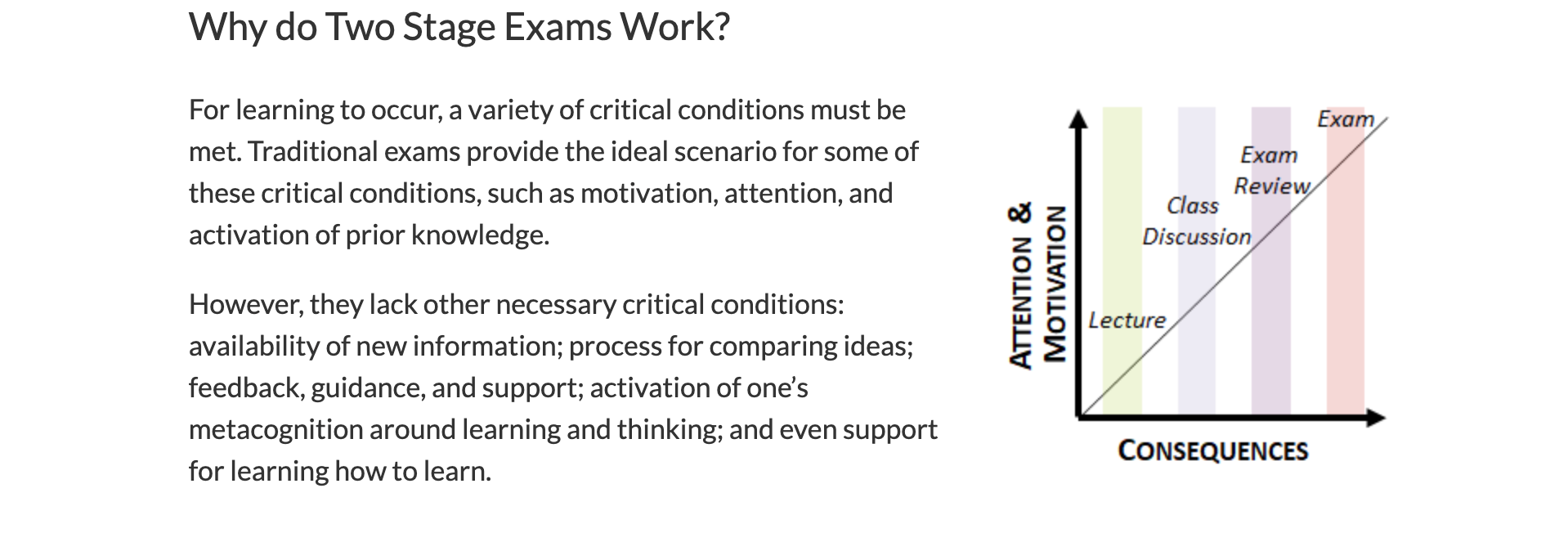
This approach is actually a great way to turn testing into a learning experience. According to Northeastern University’s teaching guidance, two-stage exams are all about getting students to discuss their answers and think critically about their reasoning after they've finished the individual part.
By doing it this way, students can learn from each other and really get a handle on the material.
This won't make sense for every subject or assessment, particularly where individual performance needs to be measured on its own. But where collaboration fits the learning objective, it's worth considering.
4. Consider specifications grading
Specifications grading is basically grading against a clear checklist.
Before students submit their work, you tell them exactly what it needs to include. For example, an essay might need a clear argument, three pieces of supporting evidence, and correct citations. If it meets those requirements, it passes. If it doesn't, the student knows what needs fixing and can revise it.
This can make grading easier because you're not writing a long explanation for every small mistake. Students already know what the assignment needs to meet, so your feedback can focus on what they need to fix.
Research on specifications grading is still limited, but there are some promising results. One small study of an organic chemistry lab found that teaching assistants spent less time grading when they used this approach.
Setting up the requirements takes some work at first. But if you often find yourself writing the same feedback about what students should have included, specifications grading can save you from repeating yourself.
Then, make the grading process faster itself
This might sound absurd at first, but with these grading strategies, you can actually make grading faster. To do so, you have to do the following.
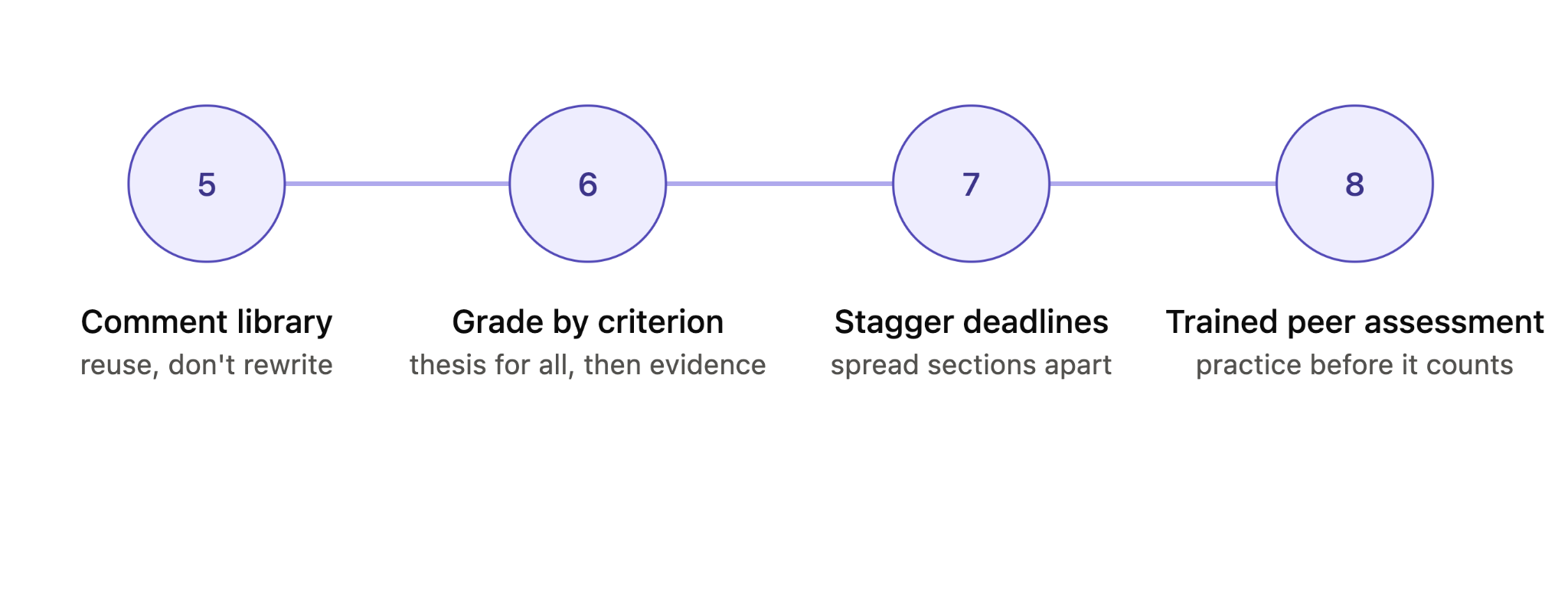
5. Build a comment library
Create a library of comments for issues that appear regularly in your students' work. These might include unclear thesis statements, weak evidence, missing citations, poor paragraph structure, or unsupported conclusions.
The University of Washington's teaching guidance recommends creating a comment library as part of an efficient grading process.
You can still make the feedback your own. The library just gives you a starting point, so you don't have to keep writing the same things over and over. It's like having a template to work from, which can be really helpful when you're giving feedback for the fifteenth time, it saves you time and effort and lets you focus on the important stuff.
Over time, you'll also notice which comments you use most often. Those are the ones worth turning into reusable feedback first.
6. Grade by criterion instead of going by student
Reading one student's entire essay, deciding on every criterion and then moving to the next student means your brain is constantly switching between different types of judgment.
Try grading by criterion instead.
For example, grade the thesis across every paper first. Then move to evidence. Then organization. Then conclusions.
You're making the same decisions across the whole class, which can make comparisons easier and help you apply your standards more consistently.
Looking at all the students' work at once really helps you see what's going on.
For example, if a lot of students are struggling with something, like 18 out of 30 having weak evidence, it's way easier to notice that when you're looking at everything together rather than just one paper at a time.
This way, you can get a better sense of what's going on and where your students need help.
7. Spread out your grading deadlines
Sometimes the problem isn't how you grade. It's when everything lands on your desk.
Rob Jenkins, an English professor writing in “The Chronicle of Higher Education, has recommended staggering deadlines between classes or sections where possible.
You may not always control the assessment calendar, particularly if you're working within a department-wide schedule. But when you have some flexibility, spreading deadlines can stop one enormous grading session from taking a toll on your mind.
Just changing the deadline for one class by a few days can really make a big difference.
8. Use peer assessment, but train students first
Peer assessment can take some of the grading load away from the teacher, but it shouldn't be treated as a way of simply getting students to do your job for you.
Students need to understand what they're looking for.
A 2019 meta-analysis covering 58 studies found that peer assessment was associated with improved student performance. The researchers also found stronger effects when students received training.
That makes sense. Giving students a rubric doesn't automatically make them good assessors.
Show them examples of strong and weak work. Explain the criteria. Let them practice giving feedback before their assessment counts.
You can then use peer assessment for appropriate assignments while keeping the teacher's judgment where it matters most.
Lastly, reduce the hassle of manual grading
You can reduce your workload altogether by using these strategies.
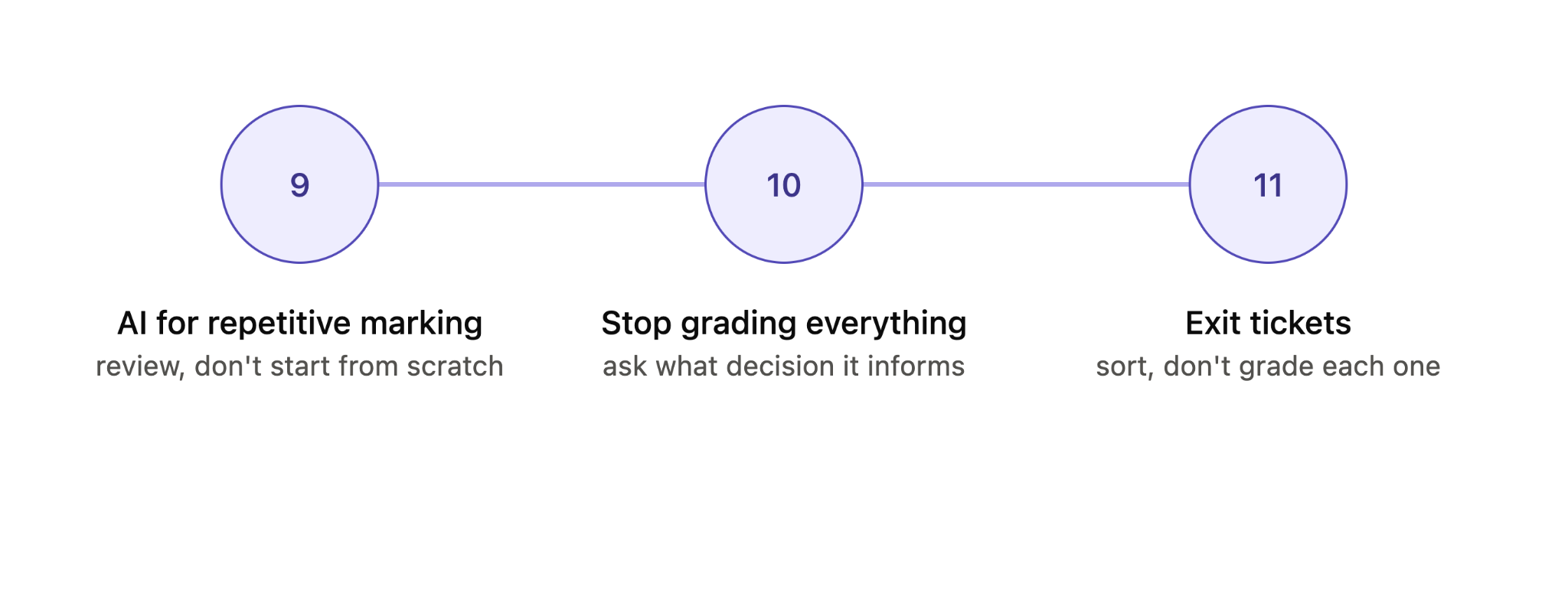
9. Use an AI grading tool for repetitive essay marking
If you've already simplified your rubrics, built comment banks, and improved your assessment process but you're still spending hours marking essays, technology may be the next place to look.
The same Learnosity survey found that 75% of teachers would use AI if it could cut their grading workload in half.
When you're dealing with a huge stack of essays, it's easy to see why an AI grading tool would be a big help. It can take care of some of the boring parts of using a rubric and coming up with initial feedback, which means the teacher can just review the results instead of starting from scratch with each paper.
That's the role EssayGrader AI is designed to play.
You can use EssayGrader to upload your grading criteria (or choose from its 800+ rubrics library) and multiple student essays. It will then evaluate each submission based on your criteria and automatically generate grades and feedback for you to look over.
After that, you can make any necessary changes to the feedback before sharing it with your students. This way, you can save time and provide consistent, high-quality feedback for your students.
10. Stop grading everything
Not every assignment needs a grade.
There are activities that let students practice what they've learned. Some help teachers figure out if the class really gets a new idea.
And then there are activities that give students a chance to make mistakes without it affecting their grades, which can be really helpful before they start working on things that actually matter.
Putting a grade on all of them creates more work without necessarily giving you more useful information.
The University of Michigan's Center for Research on Learning and Teaching makes a useful distinction between assessment and feedback. You can use quick assessment methods to understand what students know without turning every response into a formal grading exercise.
So before grading something, ask yourself what decision the grade will actually help you make.
If the answer is none, then it's possible that it doesn't require a grade.
11. Use exit tickets for quick checks
Exit tickets are a great way to see if students really get it without adding to your grading pile.
At the end of a lesson, ask students to answer one or a few short questions about what they learned, what they found difficult, or what they still don't understand.
You can then quickly sort the responses into categories such as “got it”, “almost there,” and “needs more help”.
The goal isn't about assigning a grade to each and every student, but rather to focus on something more meaningful.
To figure out what to review in the next class, you need to gather enough information about what your students already know and what they're still struggling with.
Exit tickets are really helpful for checking in with students. They give you a sense of how well students understand the material without adding to your grading workload. This way, you can get a feel for what students know without having to grade another big assignment.
Get your evenings back with EssayGrader AI
If these strategies feel overwhelming for you, you can start with the part of grading that is actually eating your time.
If your rubrics are complicated, simplify them. If you're writing the same feedback repeatedly, build a comment library. If grading a full class takes days, look at whether every assignment needs a formal grade.
You can also combine strategies.
For example, a teacher grading 60 essays might use a simpler rubric, grade by criterion, reuse common feedback, and use an AI grading tool to handle the repetitive first pass.
The best approach depends on where your workload is coming from.
If you're looking to simplify your workload, especially when it comes to grading essays, consider giving EssayGrader AI a try.
Try EssayGrader AI for free, so you can see how it works for you without any upfront cost. This could be a great way to save some time and focus on other important tasks.
FAQs
What are the best ways to manage marking and grading workload?
The best way to manage marking and grading workload is to use a reliable AI grading tool like EssayGrader. Using a grading rubric also saves time. It is better to provide 2-3 comments on each paper instead of grading everything because grading takes hours of a teacher’s week, and thus, any method that reduces time spent grading is important.
What is the best grading strategy?
Using an AI grading tool like EssayGrader AI is the best grading strategy. You can upload your rubric, run a stack of essays through it, and review the feedback before it goes out- done in minutes, not evenings. It's the single biggest time-saver on this list.





.avif)
.avif)
%201.svg)