EssayGrader vs. GPTZero AI Reviewer is an easy comparison at first glance.
On the surface, it may seem that both of these tools are designed to grade assignments and provide AI-assisted feedback on them.
But if we take a closer look, the overlap starts to thin out.
This is because EssayGrader is a grading tool by design, and it puts rubric-based grading and classroom assessment at the center of its system.
On the other hand, GPTZero combines AI Reviewer (which is just another tool it offers) with its wider suite of detection, plagiarism, and writing-analysis tools.
Let’s see how both work and which one proves to be better at its job (grading) so you don’t have to put in extra hours.
What is EssayGrader AI?
As its name suggests, EssayGrader is a teacher-only essay grading tool. It focuses on grading assignments and providing AI-generated (editable) feedback. Teachers can tweak, delete, or edit this feedback as needed before sending it to students.
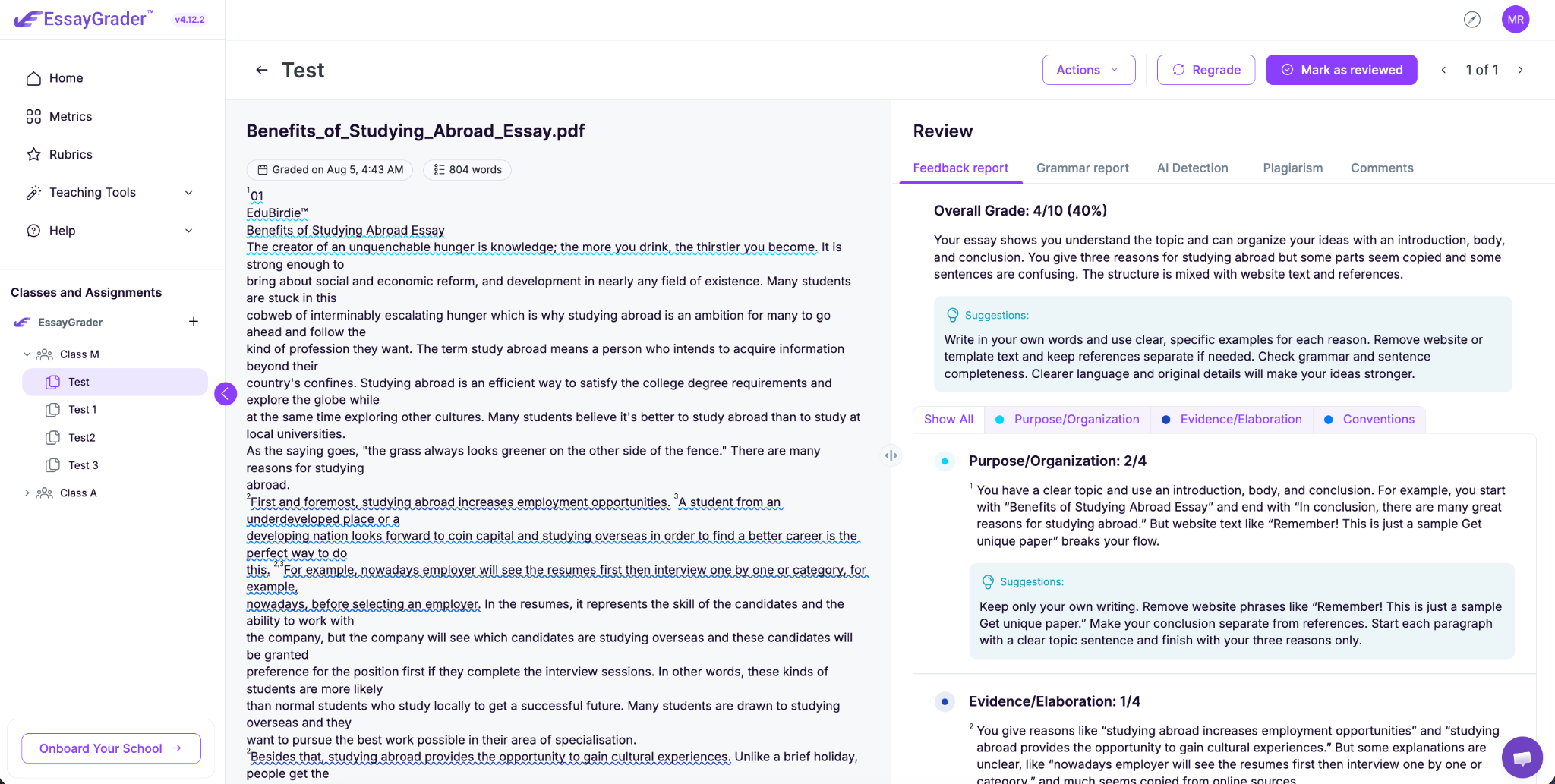
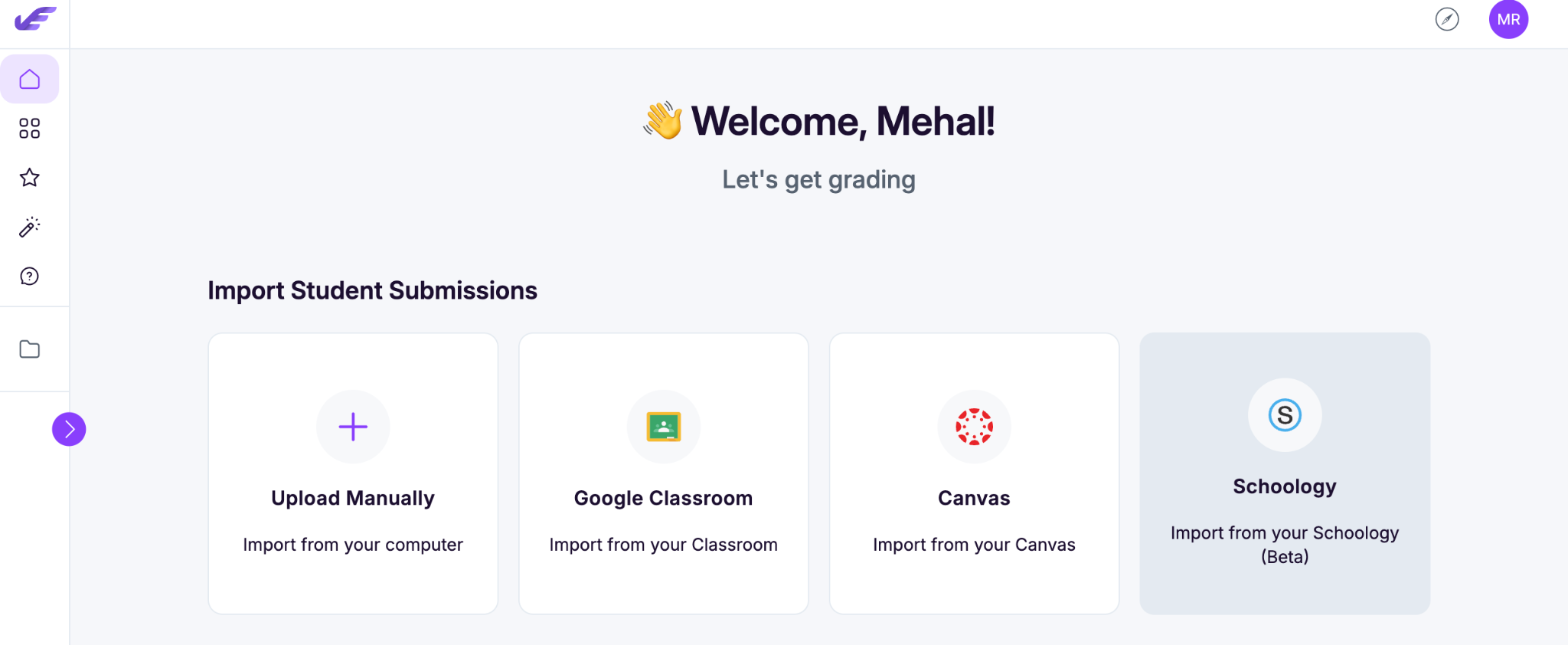
As an education-focused tool, EssayGrader supports integration with major LMS platforms as well, like Google Classroom, Canvas, and Schoology. This integration lets teachers just extract and upload the assignments directly without creating a class on the platform separately.
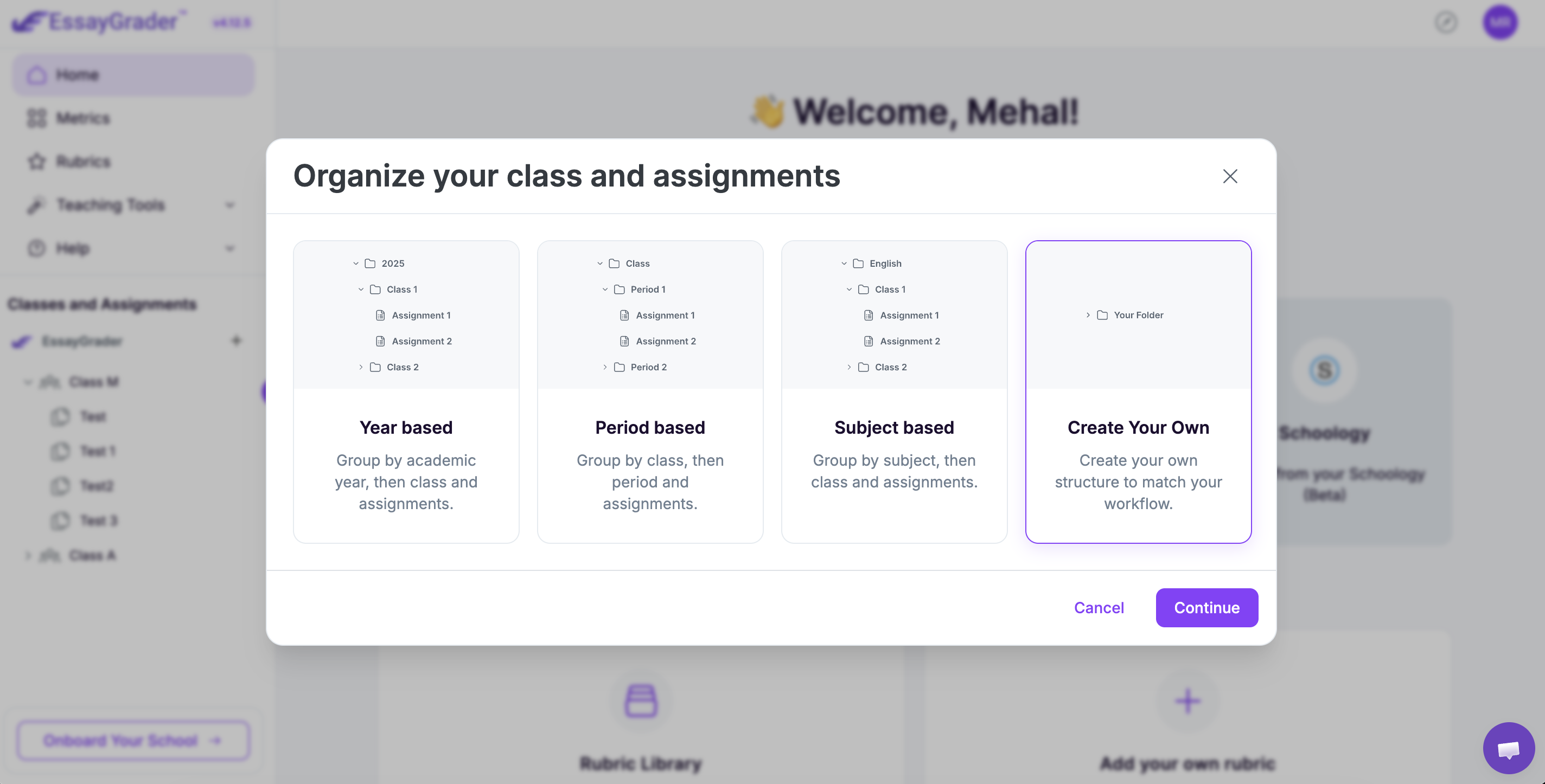
However, if you want, you can create multiple classes and assignment sets on EssayGrader AI. You can bulk upload, set your rubrics, and grade them at once, even for different classes (if you teach more than one). The platform also includes AI writing and plagiarism detection alongside its grading workflow, which saves you hassle and time.
It’s worth noting the company’s background to better understand what makes EssayGrader different from other educational tech companies. Rather than positioning itself as an all-in-one AI-based approach to teaching (as many edtech startups have), EssayGrader’s product focuses specifically on reducing the time teachers spend grading.

That is because the first version of the tool was made for a teacher (Payton made this tool for his wife). Now they are both on the team and contribute to its growth.
What is GPTZero AI Reviewer?
GPTZero AI Reviewer is a grading and feedback component of GPTZero's wider education platform (famous as an AI detector).
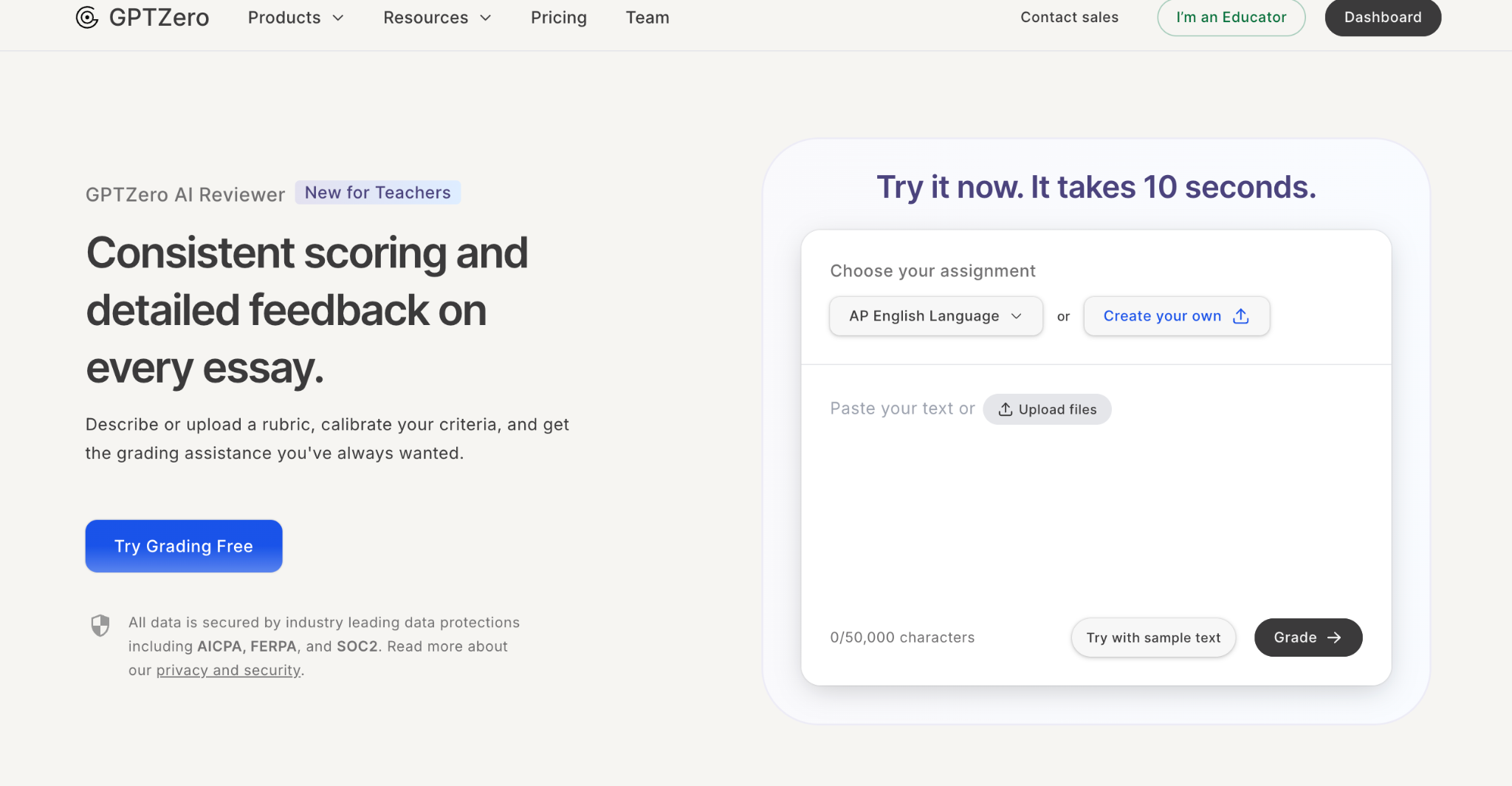
This tool (or feature of GPTZero, to be precise) lets teachers assess assignments using rubrics, generate feedback, and review or adjust AI-generated assessments. It also combines that reviewer with its established AI detection, plagiarism, and writing-analysis tools, just like EssayGrader.
However, the difference comes in the actual workflow and how much ease it provides to a teacher, which we will discuss in a bit.
GPTZero AI detector was launched in January 2023. It was originally made as an AI-text detection tool. Since then, it has introduced more features, including its AI Reviewer, which was launched in 2025.
As of now (August 2026), GPTZero has been acquired by a company named Superhuman, formerly known as Grammarly. That background matters here because GPTZero AI Reviewer is newer to grading, while its primary function was to act as an AI detection tool, which still remains a central part of the wider product.
EssayGrader AI vs. GPTZero AI Reviewer Feature Comparison
In this section, we will provide a detailed walkthrough of how both tools work and how they differ.
1. Grading and rubrics
EssayGrader AI
When it comes to rubrics, EssayGrader gives you 4 ways to set them. You can:
- Upload your existing rubric
- Create a rubric with AI through a prompt
- Choose from EssayGrader’s library of 800+ state-aligned rubrics
- Or create one from scratch on the platform
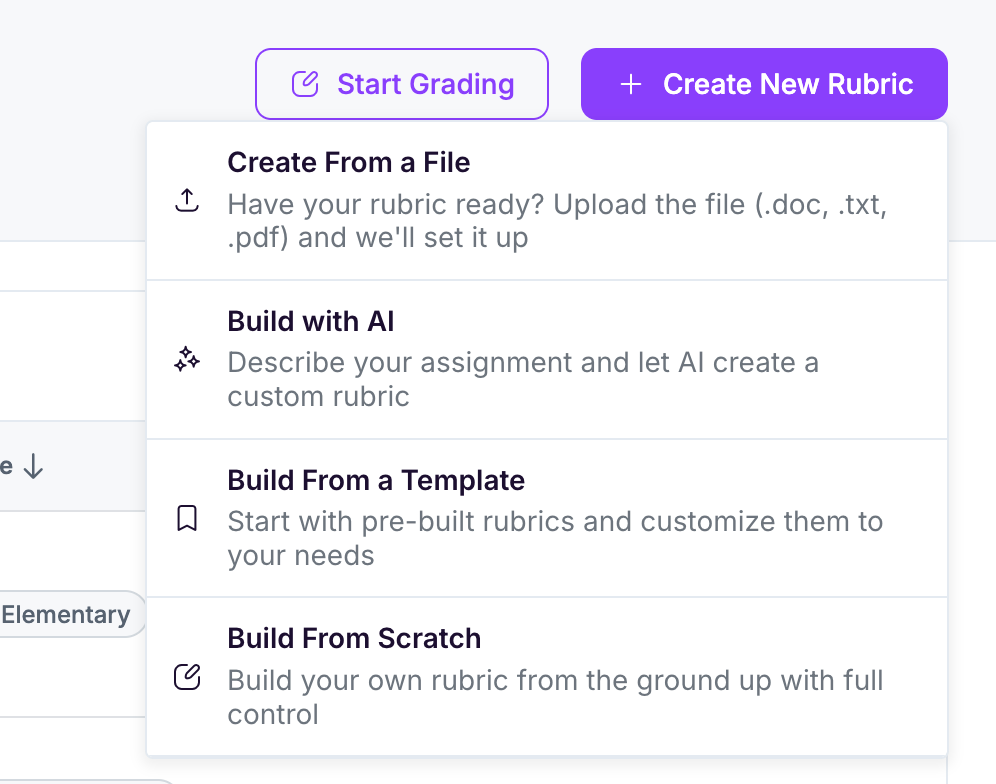
After creating or selecting your rubric one time, you can use it to grade your assignments in bulk, and it will apply the same criteria to each paper equally.
That is because EssayGrader is designed specifically for extended writing, so the grading process starts with a rubric as an important first step.
GPTZero AI Reviewer
GPTZero AI Reviewer also supports rubric-based grading and allows teachers to configure how assignments should be evaluated.

However, its stronger differentiator is calibration, which means that even after setting a rubric, a teacher still has to teach the system how to grade assignments by manually grading a few of them. This step is to better align the reviewer with their own expectations.
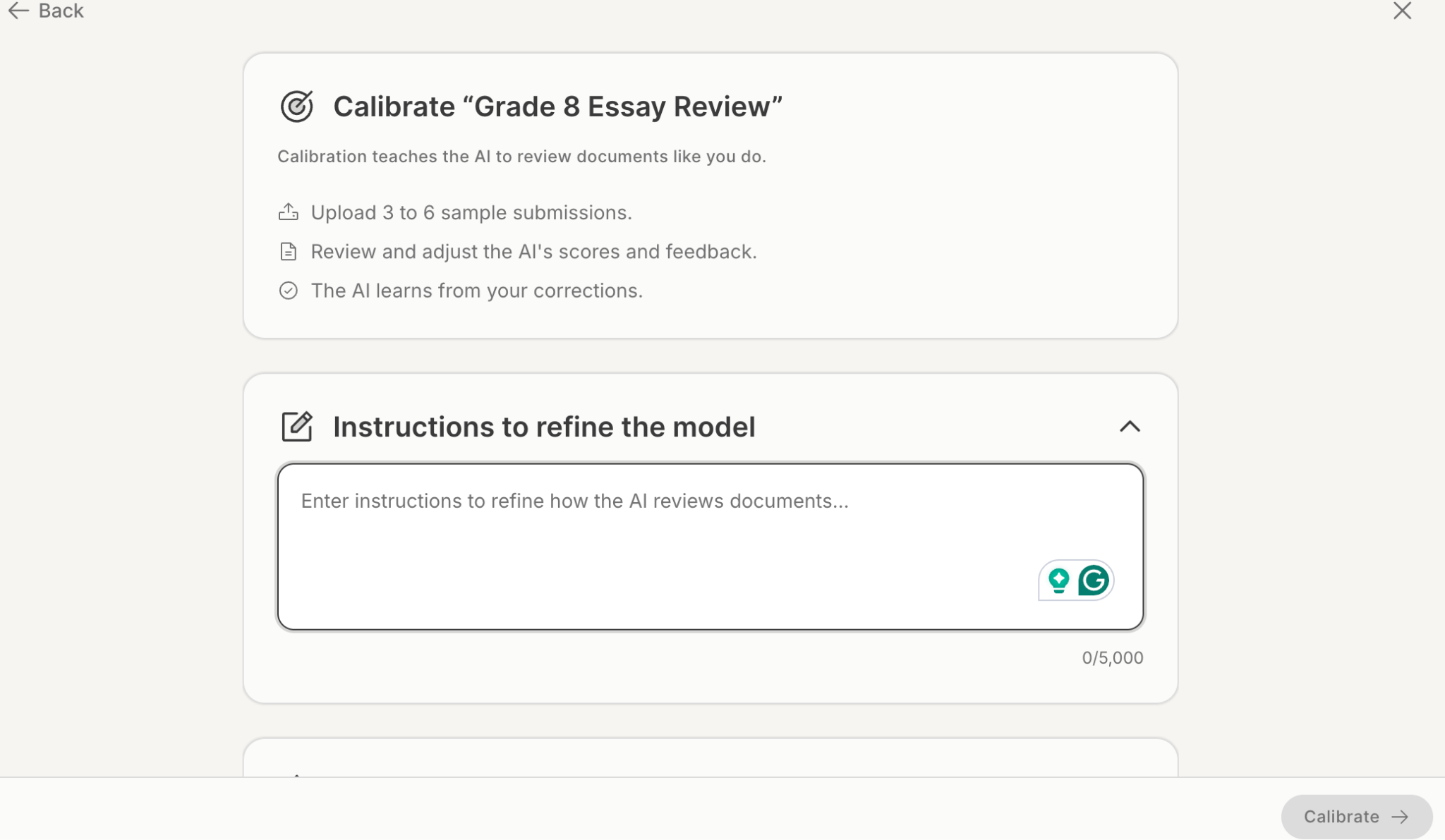
Verdict: EssayGrader has the edge for teachers whose priority is dedicated rubric-based essay grading. GPTZero is appealing if calibration is important to you. However, there is still manual work involved with this one.
2. Feedback quality and delivery
EssayGrader AI
As established before, EssayGrader is a teacher-first AI grading tool, so when a teacher uploads assignments to grade, it grades and sends feedback to the teacher first.
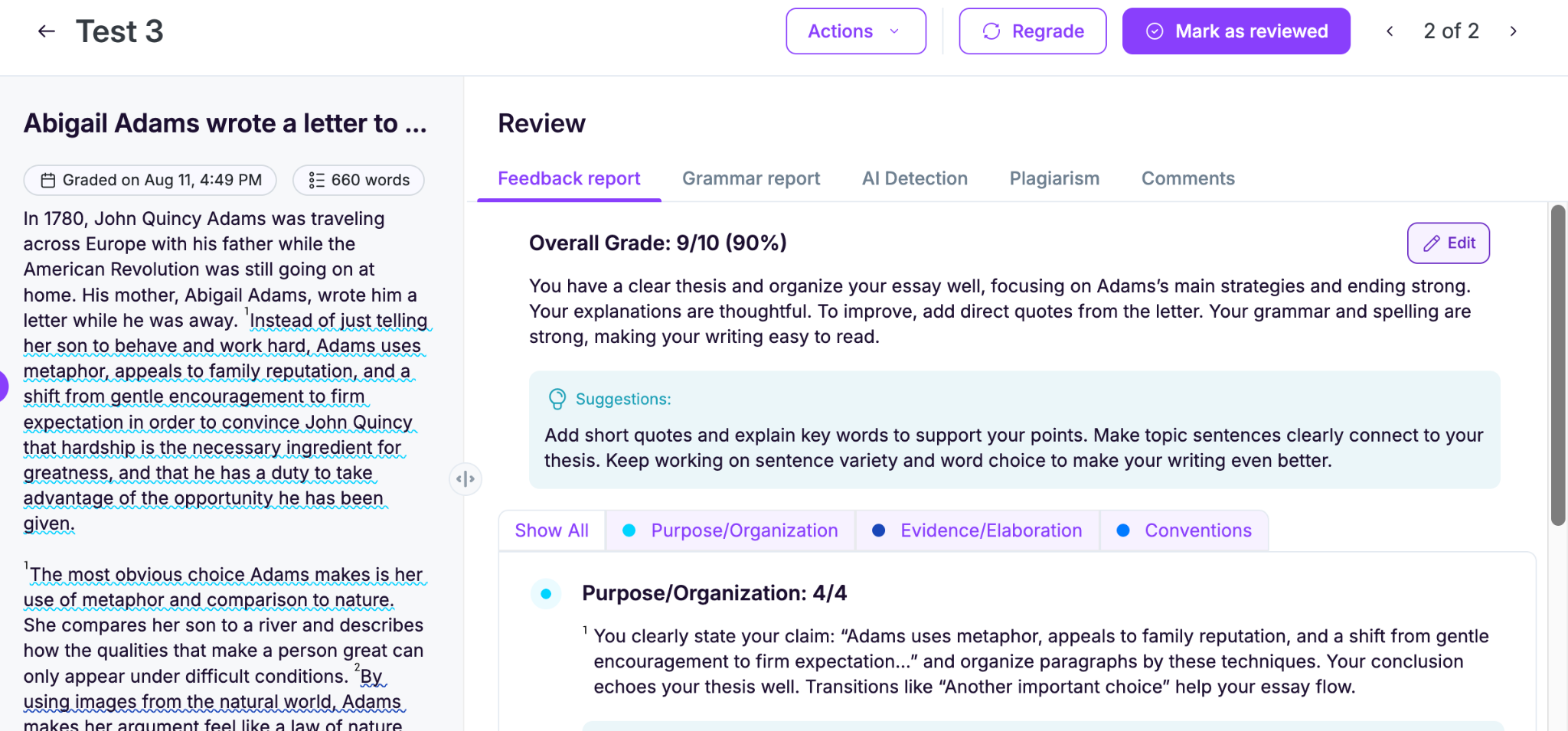
This way, as a teacher, you have control over the feedback being provided to your student (so they can revise later on), and you can also edit it if you want to.
EssayGrader values a teacher’s judgment and keeps it as an integral part of the entire grading workflow so you can be in control.
In public reviews, many teachers highlight and appreciate this teacher-first workflow
GPTZero AI Reviewer
GPTZero also positions AI Reviewer as an assistant where teachers have control. This tool also allows a teacher to review the generated feedback, make changes to it, and use calibration to adjust the review (same as in rubrics).
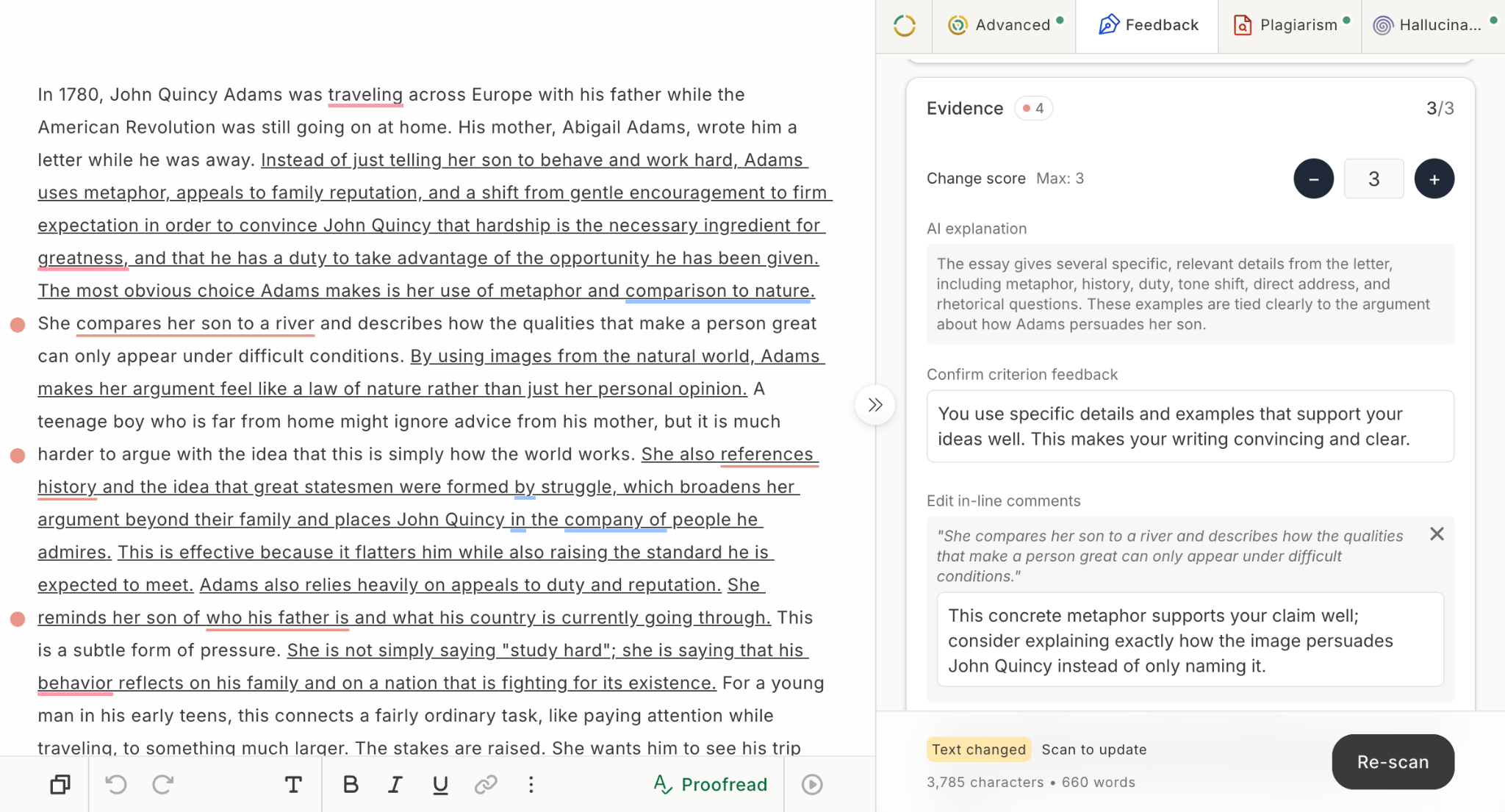
Verdict: Both keep the teacher involved. EssayGrader has the clearer teacher-review-first grading workflow, while GPTZero's calibration tools give it an interesting advantage for teachers who want to train the reviewer towards their own preferences.
3. Workload and bulk processing
EssayGrader AI
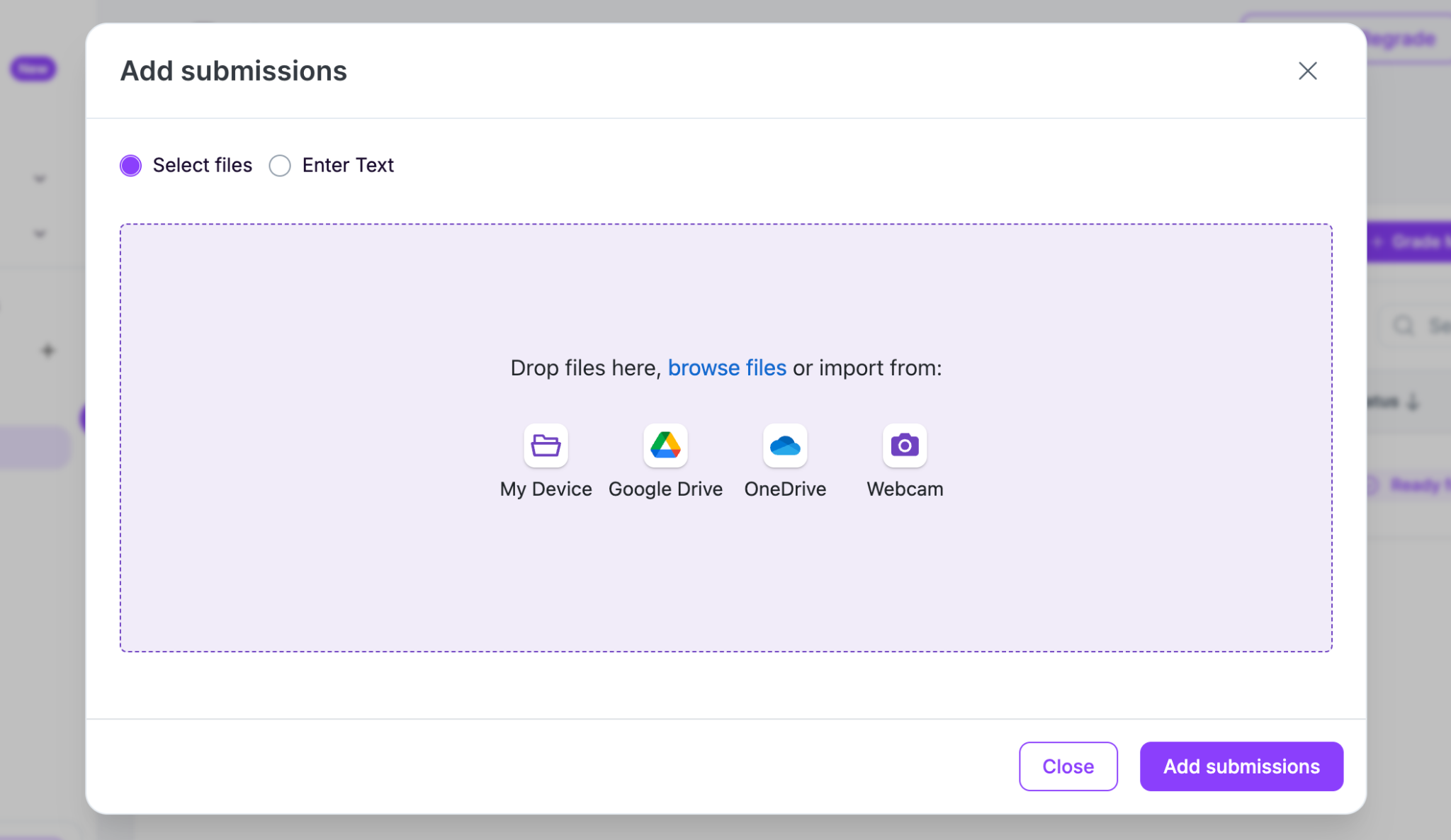
EssayGrader AI is designed around high-volume essay grading. Its current paid plans explicitly scale by the number of essays graded each month, with the Pro plan allowing up to 350 essays and Premium up to 800.
GPTZero AI Reviewer
It also supports batch processing, making it possible to analyze multiple documents at once, much like EssayGrader.
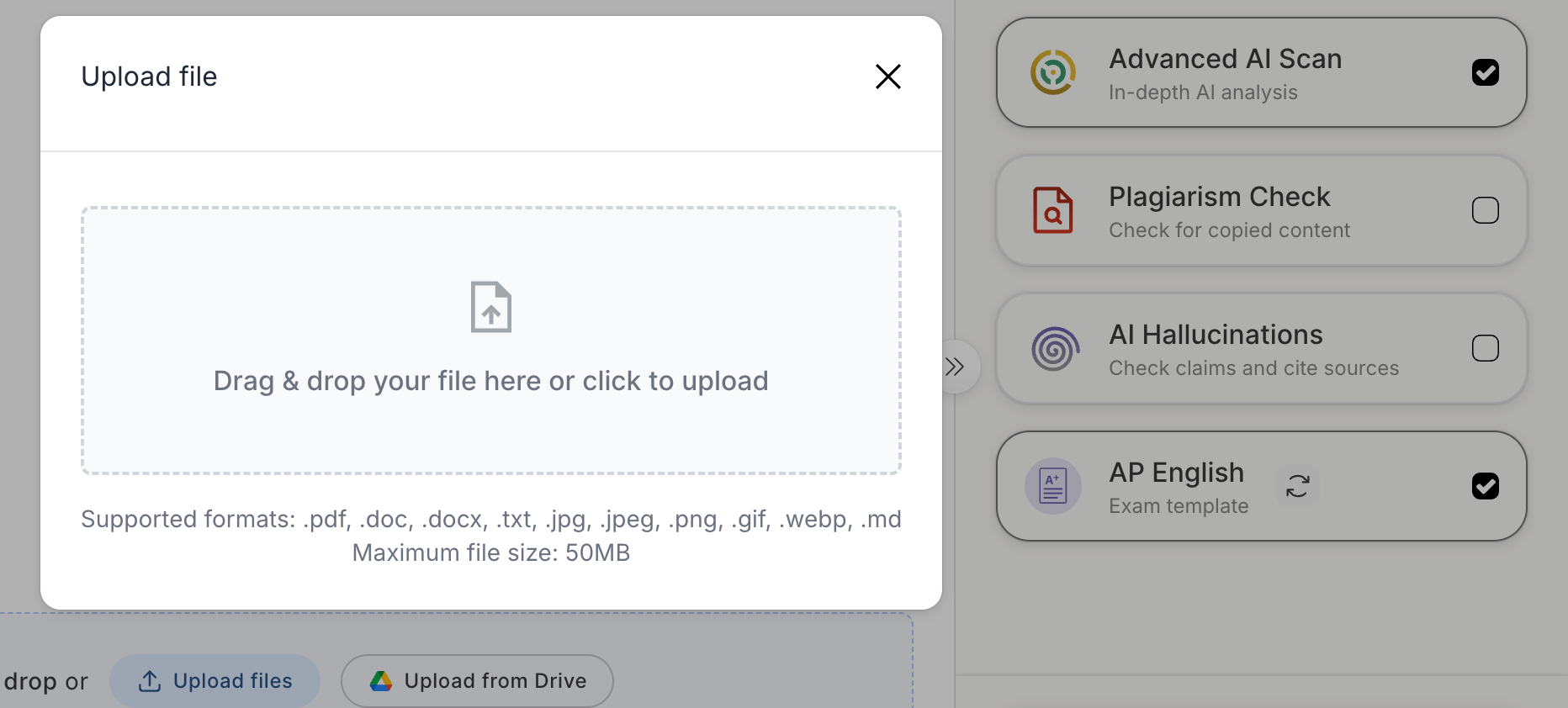
The distinction is mainly in emphasis. EssayGrader's entire product is structured around moving a large set of essays through a grading workflow. GPTZero's batch capabilities sit within a broader AI-detection and writing-analysis platform.
Verdict: EssayGrader is the stronger fit when bulk essay grading is the primary workload you're trying to solve.
4. Assignment creation and the student workflow
This is one area where neither platform should be mistaken for a full learning-management system.
EssayGrader AI: EssayGrader was made for grading essays automatically and making teachers' lives easier. It does not create or assign assignments to the students. It handles the student workflow and grades essays using AI in this way:
- Teachers create the class and assignment
- Upload submissions from their PC or extract from their LMS
- Apply the rubric (which they created) or choose from the 800+ rubrics library
- And review the results
Its Google Classroom, Canvas, and Schoology integrations help connect that process to existing classroom workflows. Therefore, it is not a tool where you can create assignments.
GPTZero AI Reviewer
Similarly, GPTZero AI Reviewer is just a reviewer. It does not create or assign papers to students. It is not a teacher-only tool, in the sense that its AI detector is used by both teachers and students. But GPTZero AI Reviewer itself is a reviewing (grading tool) through and through.
Verdict: Neither is the obvious choice if your main requirement is creating and distributing entire courses or assignments. For submitted written work, both fit naturally into an existing LMS.
5. AI and plagiarism detection
EssayGrader AI
EssayGrader also has built-in AI and plagiarism detection in the same panel as Feedback Report, Grammar Report, and Scores.
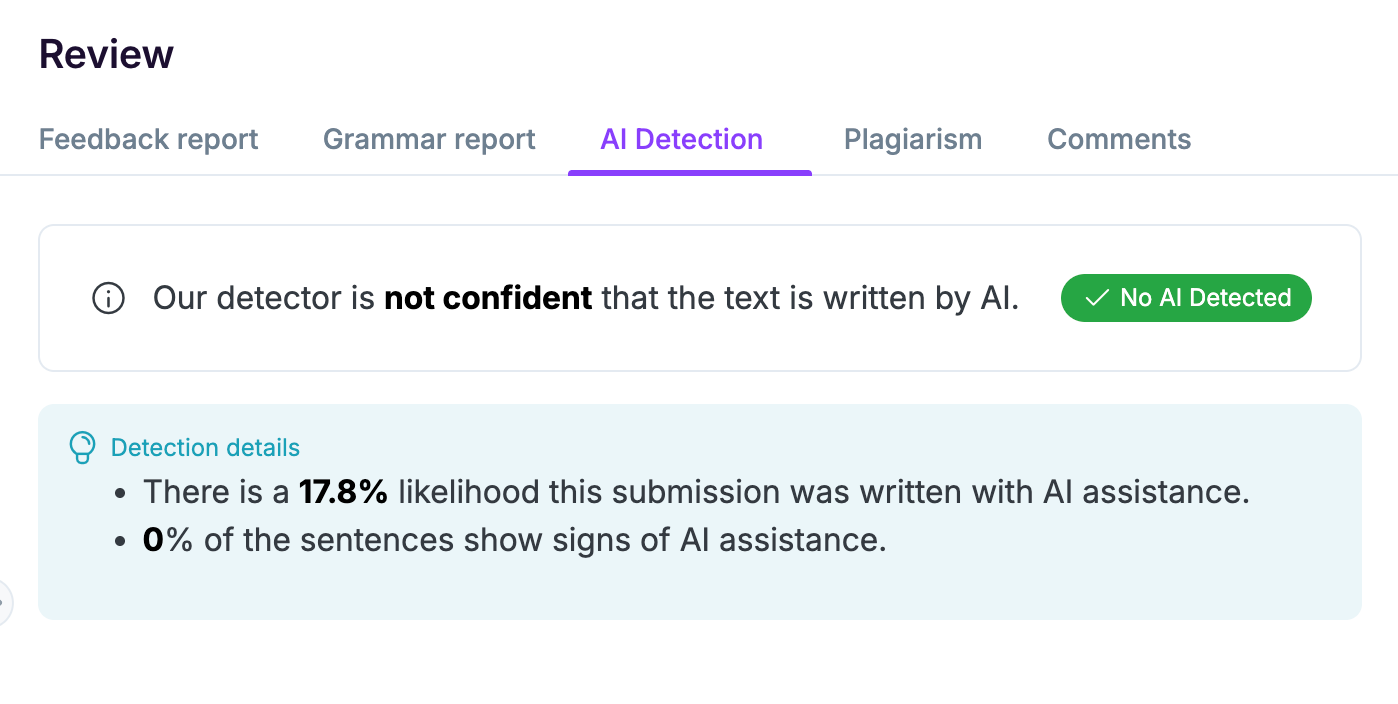
You can just click on it and see score percentages for either of them without switching tabs or changing tools.
GPTZero AI Reviewer
This is where GPTZero has the strongest advantage, just as EssayGrader has with rubrics.
AI detection is the foundation on which GPTZero built its product. It is designed specifically to identify text that may have been generated by AI models such as ChatGPT, Gemini, Claude, and Llama.
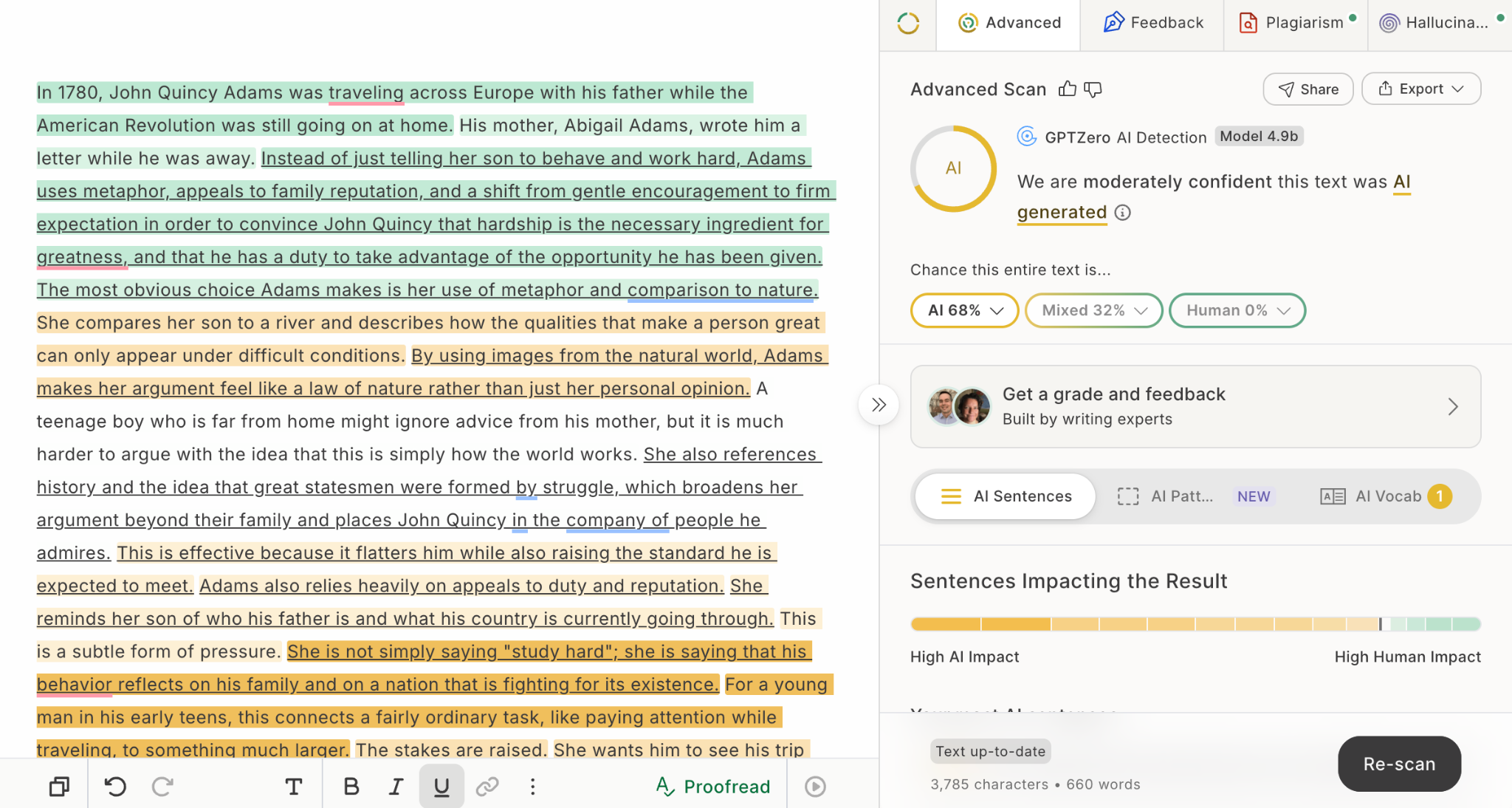
It color-codes results into three categories, and a single document can fall into one or all three, each with its own percentage:
- Human-written coded in green color
- AI-generated in yellow
- Mixed (AI+Human) in orange
This detailed, color-coded feedback makes grading easier if AI detection is your priority.
6. Class management
EssayGrader AI
If your class is already on an LMS platform like Google Classroom, Canvas, or Schoology, then you can simply integrate, upload, and grade your assignments all in one workflow.

You can also create different and as many classes or assignment sets as you want (of course, it will depend on the plan you choose). The Free plan allows you to grade 50 essays of 1000 words each.
GPTZero AI Reviewer
GPTZero's educator plans also support classroom and institutional use, with batch analysis and integrations designed for educators.
Its broader platform is aimed at schools and institutions as well as individual users.
Verdict: EssayGrader has the clearer class-management story for schools that primarily need structured essay assessment.
7. Analytics and reporting
EssayGrader AI
EssayGrader has a dedicated Performance Dashboard that displays average score, average AI detection and plagiarism scores, and more, making the reporting useful.
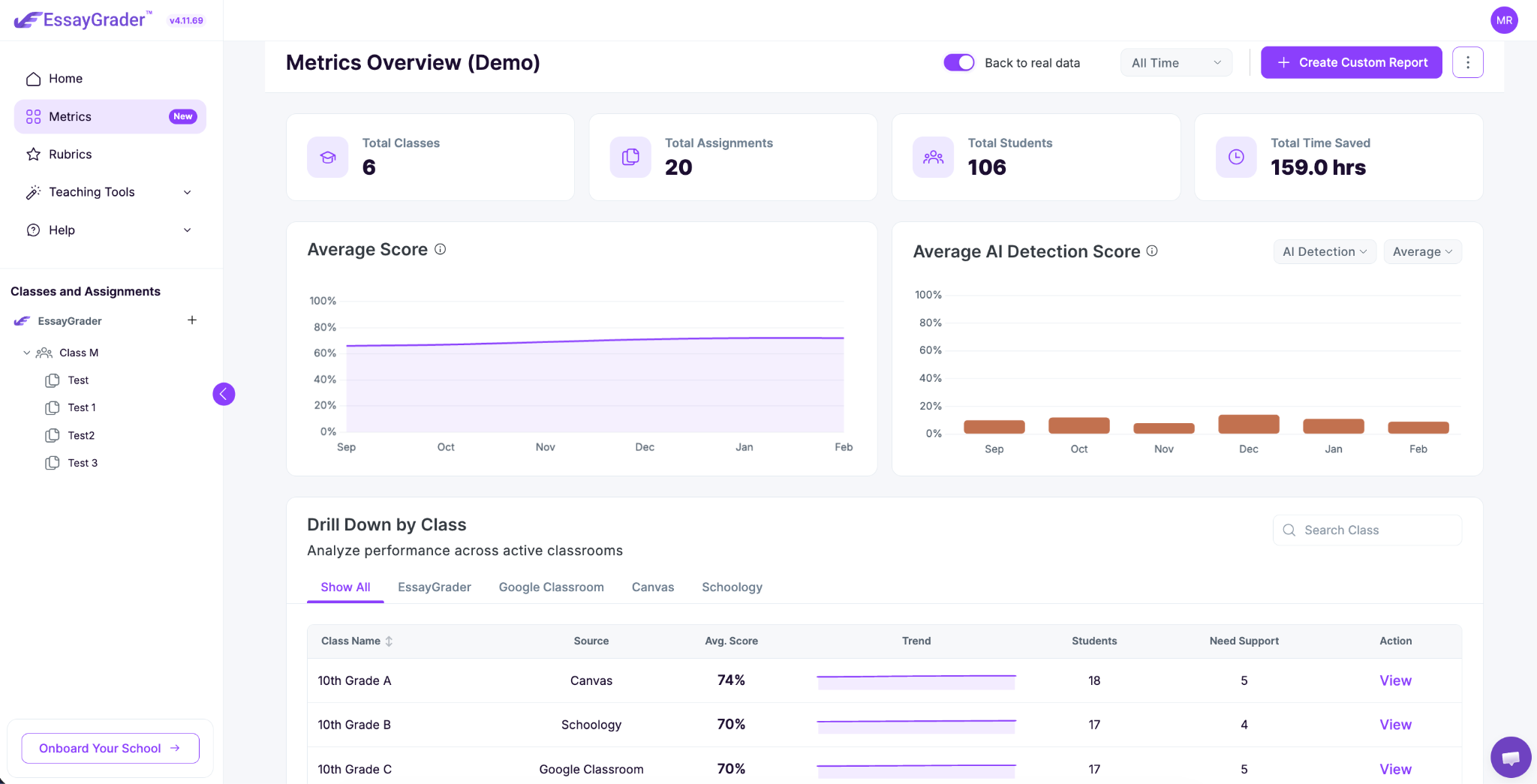
It tracks classroom performance and writing growth, while the Pro plan includes Writing Intelligence Layer for tracking student writing growth across assignments and classes.
GPTZero AI Reviewer
It’s just an AI Reviewer and doesn’t provide that much insight. GPTZero's reporting is more closely connected to writing integrity and analysis.
Its wider platform can show AI-detection results, plagiarism findings, and writing-related information, giving teachers a broader view of the provenance and characteristics of student writing.
Verdict: EssayGrader is stronger for grading and writing-performance analytics and tracking. GPTZero is stronger for writing-integrity analysis.
8. Integrations and exports
EssayGrader AI
EssayGrader currently has native integrations with Google Classroom, Canvas, and Schoology.
Teachers can import submissions, grade them, and send results back through their LMS. The platform also supports Google Drive, Dropbox, and Box integrations.
GPTZero AI Reviewer
GPTZero's education ecosystem supports integrations with major LMS platforms, including Google Classroom and Canvas, and GPTZero also promotes integrations and API access for wider workflows.
Verdict: EssayGrader is particularly straightforward for teachers who work primarily in Google Classroom, Canvas, or Schoology. GPTZero makes more sense where AI detection and writing-analysis tools need to connect with a wider technical workflow.
9. Subject and use-case coverage
EssayGrader AI
EssayGrader AI is centered on written assignments rather than one particular subject and can be used for essays, assignments, research papers, and other extended writing across different grade levels and subjects.
The platform also supports multilingual grading and different English dialects.
GPTZero AI Reviewer
GPTZero is broader in a different way. Its platform can be used across education, publishing, and other environments where the provenance of written content matters. That gives it a wider use case outside traditional essay grading.
For a teacher primarily grading student writing, however, the distinction is fairly simple: EssayGrader is specialized around the assessment task, while GPTZero offers assessment as part of a larger writing-integrity toolkit.
Verdict: EssayGrader is the better fit for dedicated written-assignment grading. GPTZero is more versatile if your work extends into AI detection, plagiarism, writing verification, and content-authenticity checks.
Side-by-Side Comparison of EssayGrader AI vs. GPTZero AI Reviewer
EssayGrader AI vs GPTZero: Price Comparison
EssayGrader AI
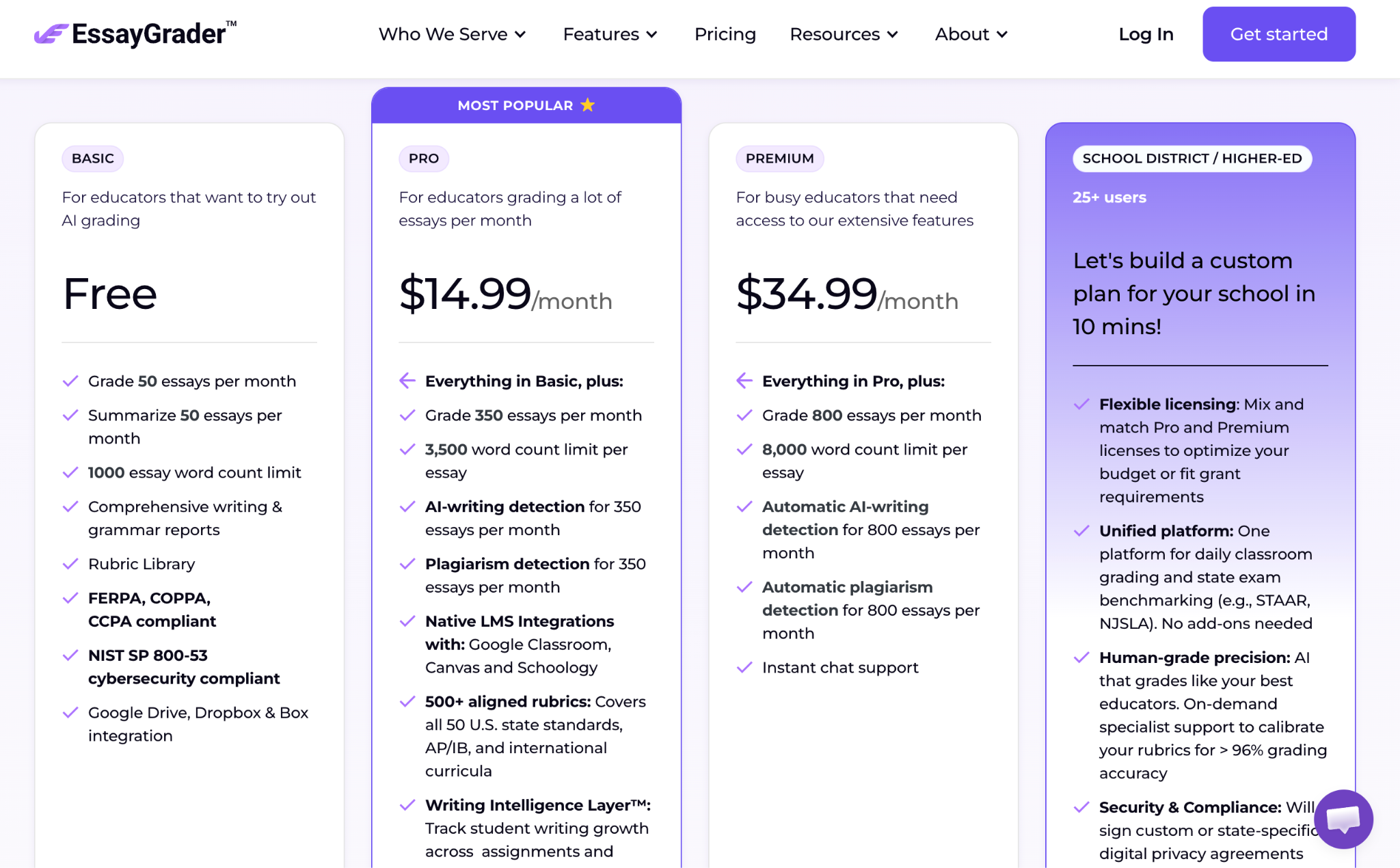
EssayGrader has transparent pricing for an educator-focused grading platform. Its current plans are:
- Basic: It’s free and allows teachers to grade up to 50 essays a month (1000 words each).
- Pro: This plan costs $19.99/month or $14.99/month when billed annually and allows you to grade up to 350 essays a month (3500-word limit for each essay).
- Premium: This plan costs $34.99/month when billed annually and allows you to grade up to 800 essays a month (8000-word limit for each essay). The paid plans also add features such as AI-writing detection, plagiarism detection, LMS integrations, and higher word limits.
GPTZero AI Reviewer
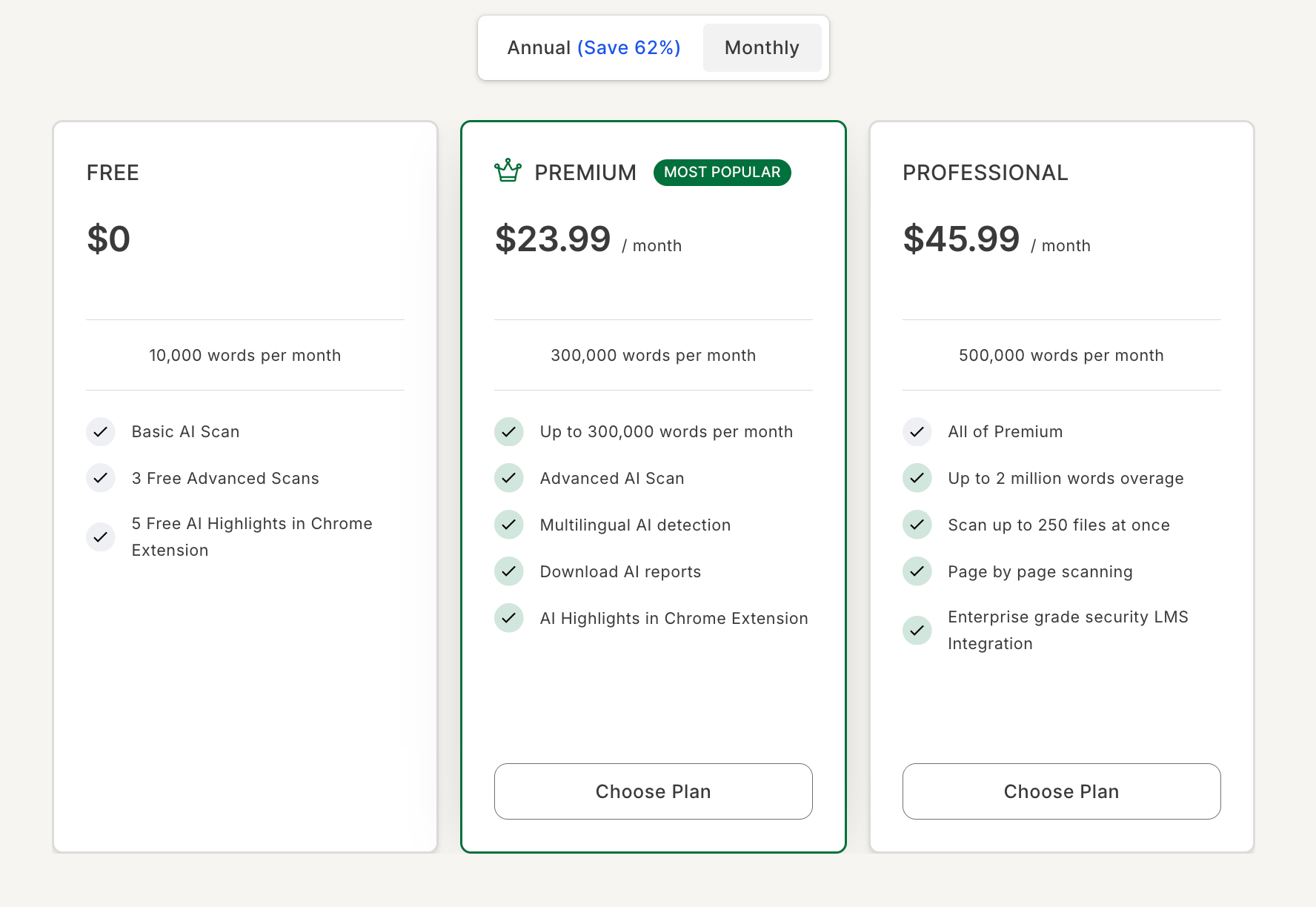
GPTZero's pricing is structured around its wider AI-detection and education platform rather than being directly tied to essay-grading volume.
It ranges from $23.99/month for Premium to $45.99/month for the Professional tier.
Which tool is more cost-effective?
For a teacher who mainly wants to grade essays, EssayGrader is easier to justify on price. You can start free with 50 essays a month, and the $14.99 Pro plan gives a substantially larger grading allowance alongside LMS integration, AI detection, and plagiarism checking.
GPTZero becomes more compelling when you will actually use its wider detection and writing-integrity features. If AI detection is your primary requirement, paying for GPTZero can make more sense than buying a dedicated grader and a separate detector.
So, for grading value, EssayGrader is a more cost-effective and suitable tool. For a broader writing-integrity toolkit, GPTZero can justify its cost.
What Are Users Saying?
EssayGrader AI
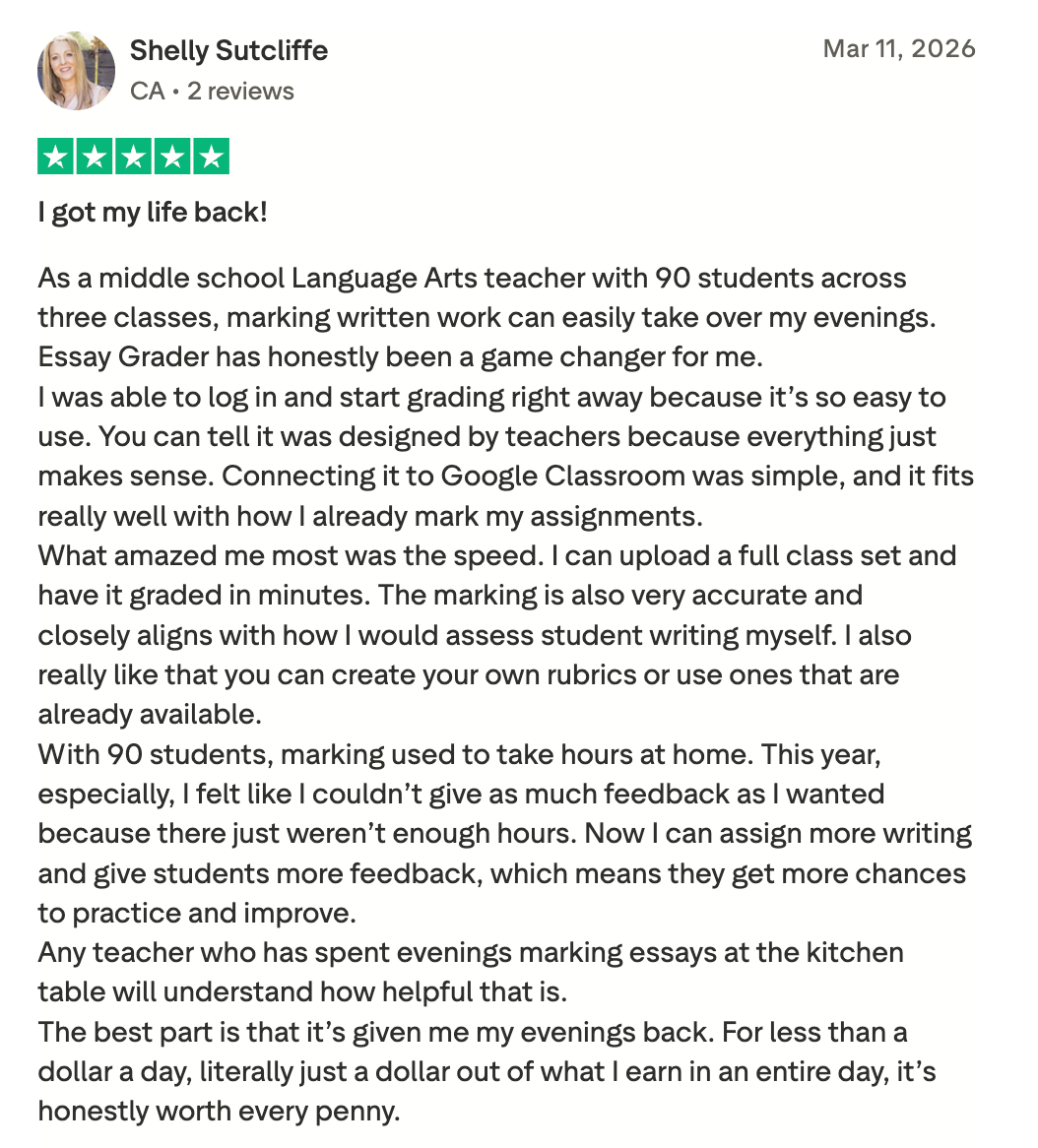
EssayGrader currently has a 4.5/5 Trustpilot score from 64 reviews.
Reviewers frequently mention its grading speed, ease of use, rubric flexibility, Google Classroom or Canvas integration, and the usefulness of editable feedback.
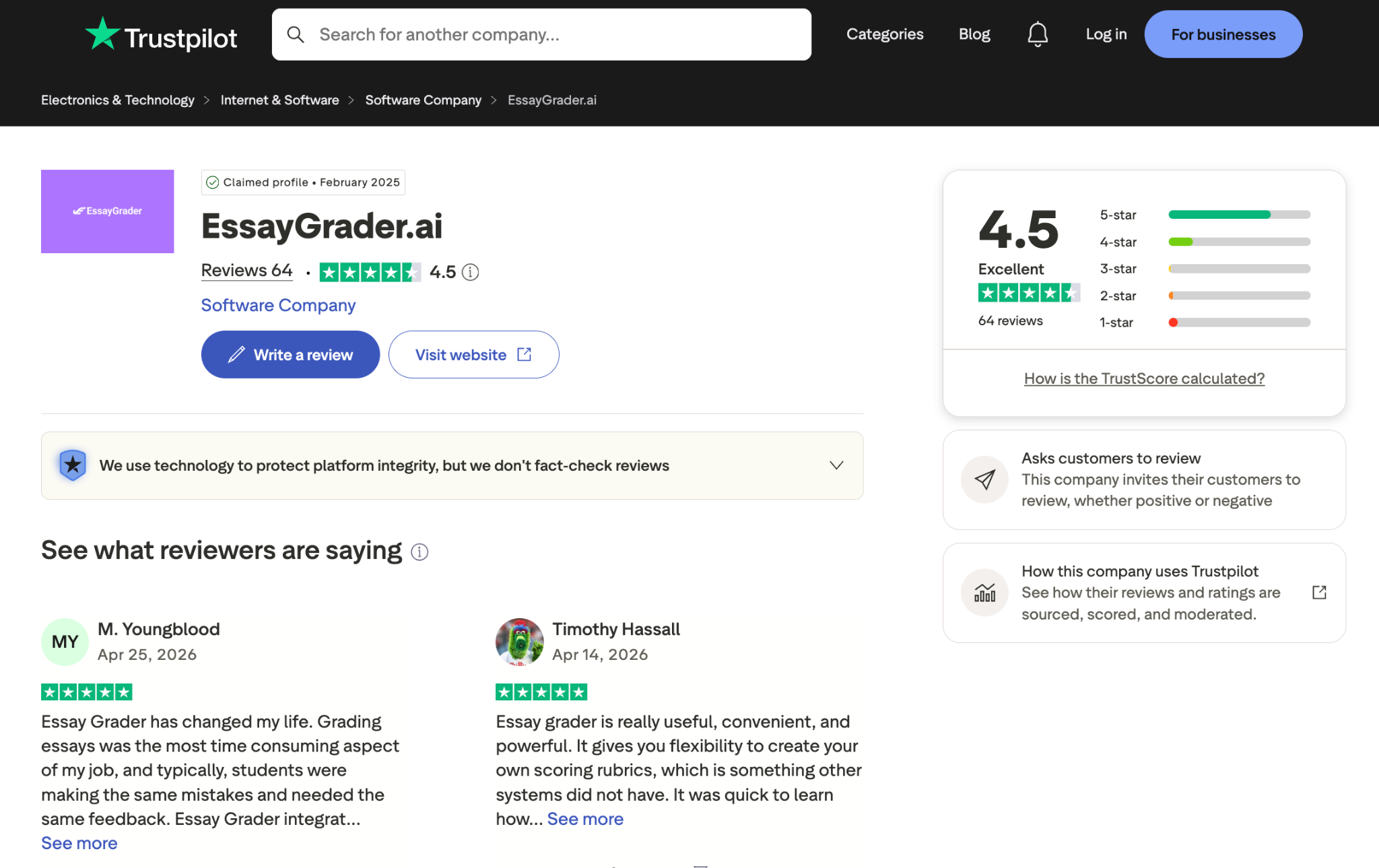
One teacher specifically praised EssayGrader and said EssayGrader AI saves her a lot of time she previously spent grading for hours.
GPTZero AI Reviewer
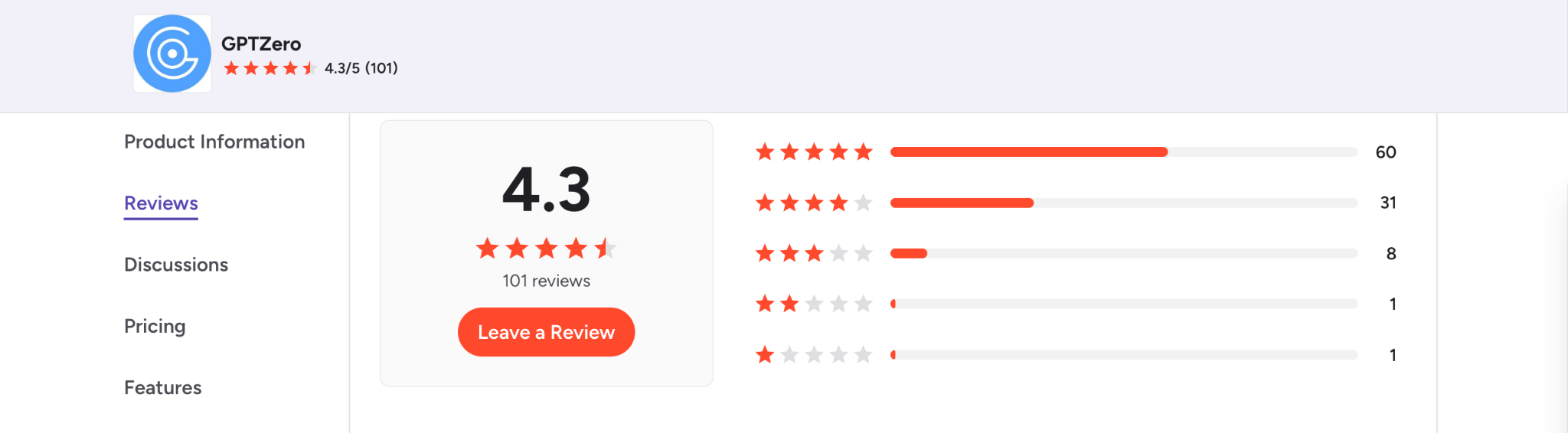
GPTZero has a G2 presence, with 4.3/5 from 101 reviews. G2 reviewers commonly praise its ease of use, speed, and AI-detection capabilities.
However, no reviews are available on any review platforms for the GPTZero AI reviewer tool. All existing reviews are for GPTZero’s AI detector. Part of the reason could be that GPTZero AI Reviewer is much newer than its AI detector.
Which One Should You Choose?
Choose EssayGrader if...
Choose EssayGrader if your main problem is grading a large volume of student writing. Its strongest areas are rubric-based assessment, bulk grading, teacher-reviewed feedback, classroom analytics, and native LMS integrations.
It also includes a built-in AI detector and plagiarism checker, so you don’t have to switch between grading and detection tools.
The transparent pricing also makes it easier for an individual teacher to try without committing to an institutional contract.
Choose GPTZero AI Reviewer if...
Choose GPTZero AI Reviewer if AI detection and academic integrity are your top priorities.
GPTZero's wider platform gives you AI detection, plagiarism checking, and writing analysis alongside its AI Reviewer, so it makes more sense when you need to investigate the writing.
EssayGrader AI vs GPTZero AI Reviewer: The Bottom Line
EssayGrader and GPTZero have moved closer together, but they still have different centers of gravity.
EssayGrader is the more focused option for teachers who want to move from:
rubric → grading → feedback → classroom insights in one workflow
GPTZero is the broader choice when the workflow also needs AI detection, plagiarism, and writing-authenticity analysis.
Neither should replace a teacher's judgment, particularly when AI-detection results could affect a student's academic record.
For dedicated essay grading, EssayGrader is the stronger overall choice.
For teachers who need a wider academic-integrity toolkit alongside grading, GPTZero AI Reviewer is worth considering.
Try EssayGrader for free and grade that first batch of essays so you can see how it tackles everything from start to finish.
FAQs
Is EssayGrader better than GPTZero for grading essays?
EssayGrader AI is built and designed for grading essays, so it naturally offers better features and more ease than any other tool, including GPTZero AI Reviewer.
So, yes, EssayGrader is the stronger choice if essay grading is your main requirement. GPTZero is a good option if you want more AI-detection features (which EssayGrader includes as well).
Can GPTZero AI Reviewer detect AI-generated writing?
Yes, it can detect AI-generated text and provide color-coded feedback for human-written, AI-detected, and mixed text, with percentages for each. However, AI-detection results should not be treated as final evidence to punish any student.

.jpeg)



.avif)
.avif)
%201.svg)