Last updated: November 2026
At least 10 states score students' written answers on their statewide tests with automated scoring engines in 2026, including Texas, New Jersey and Massachusetts.
Basically, AI scoring of state tests is the use of automated scoring engines, trained on human-scored student answers, to score the written responses on statewide K-12 assessments, usually with human scorers checking a share of the answers.
In this guide, we have covered what AI scoring of state tests looks like for these states, and how hybrid scoring works.
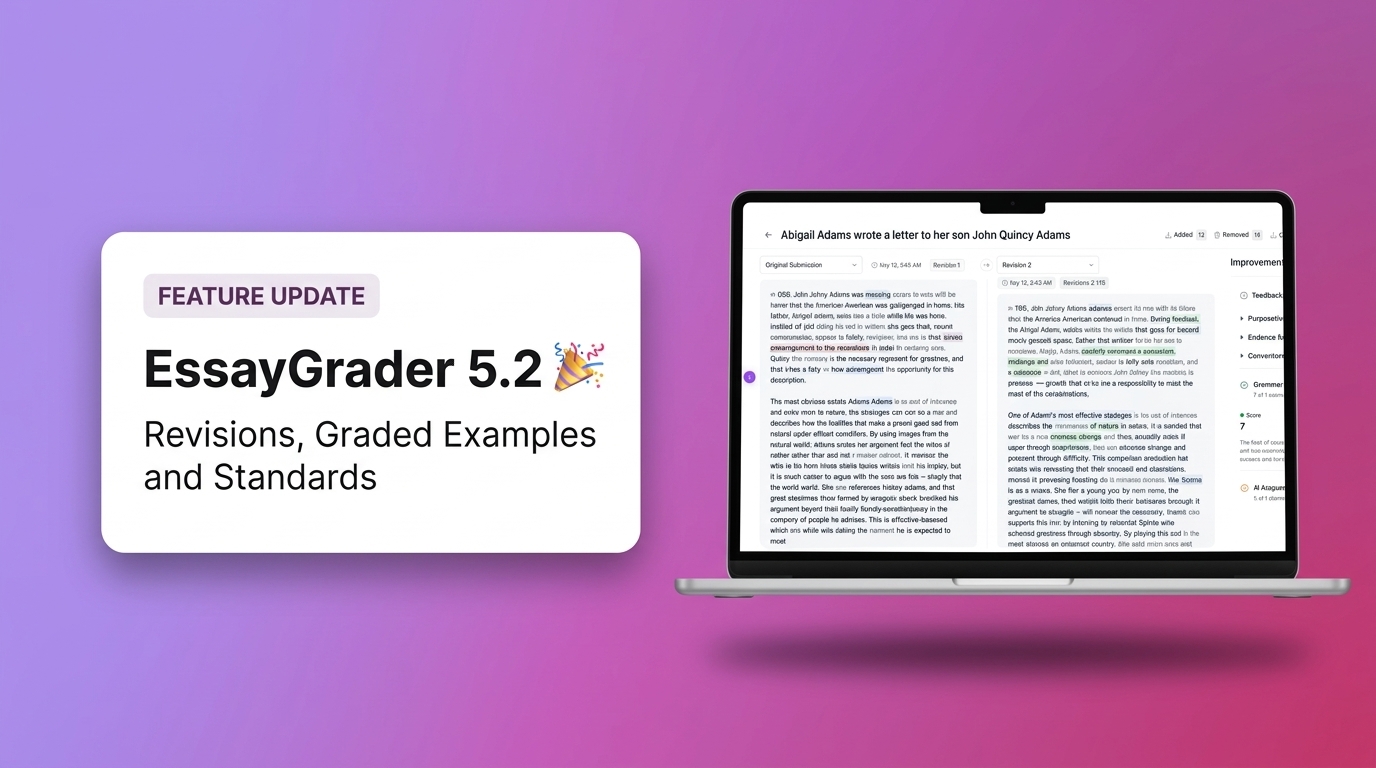
Further, you’ll see how the automated scoring engine works, the reported problems that came with it, and how to prepare your class for AI scoring of state tests. As far as practice before test day is concerned, you can practice with EssayGrader, a rubric-based AI essay grading platform for K-12 and higher-education teachers, which grades practice essays against state rubrics.
Please note that every name listed below is sourced and dated for full transparency, allowing you to check each claim.
Grade an essay against your own rubric in minutes. The free plan covers 100 essays a month.
Which states use AI to grade standardized tests?
Ten states have published enough to confirm that an automated engine scores part of their statewide writing tests, and the table below lists each one with its source.
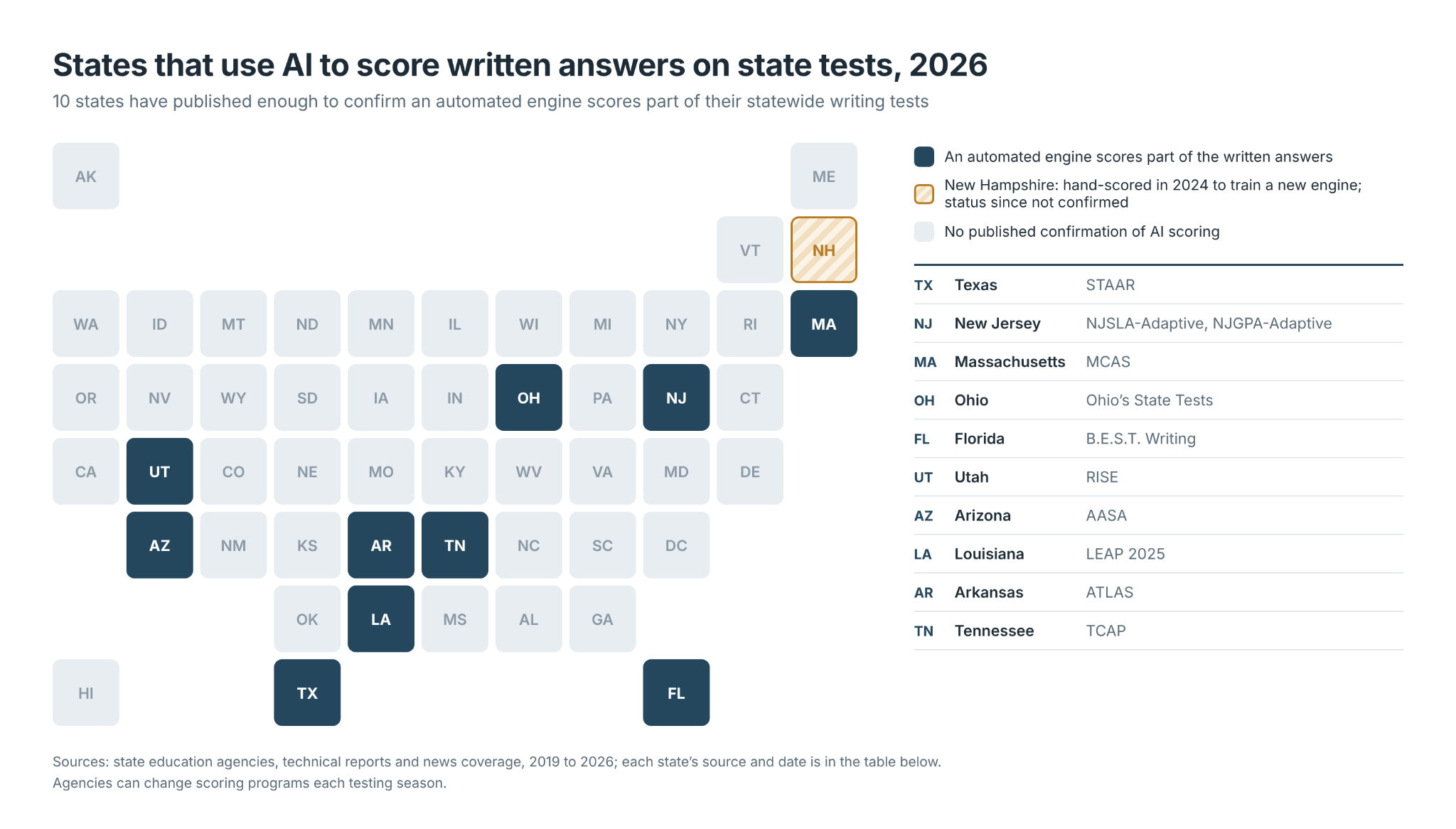
The state-by-state list (updated November 2026)
Below, we’ve explained some of the aforementioned rows for more clarity:
- Texas grades at least 25% of constructed response items with human graders, and the Spanish-language STAAR tests are graded entirely by human graders (Texas Education Agency, Dec 2023). Texas teachers use our AI grader for Texas STAAR on practice tests.
- New Jersey used the AI scoring engine to score two adaptive tests in Spring 2026. This included most ELA writing tasks (GovTech, 2026-03-09). Criteria can be found on the NJSLA writing rubrics page.
- Florida uses the scoring engine to score essays, but only partially. It is claimed that they send 40% of their B.E.S.T. Writing essays for scoring by humans (Florida Department of Education, Oct 2024). Criteria can be found on the Florida B.E.S.T. Writing rubric page.
- Tennessee has the reverse of this list. The first scoring is carried out by a human scorer, and then only 10% of the second scoring is done by the engine (Tennessee Department of Education, 2025-05-29).
States that paused or changed AI scoring
Some states have temporarily stopped AI scoring. As an example, the New Hampshire Department of Education had to hand-score writing exams for the first time in over 5 years in order to train a new scoring engine (NHPR, 2024-03-11). Its status since then is not confirmed.
A 2019 Vice survey counted at least 21 states, but it named none of them, so that count isn’t used here.
How to read the table
A quick explanation of what each term in the table means:
- “Human share” refers to the percentage of essays that were hand-scored and had any manual input. For example, Human share for the Florida B.E.S.T. is 40%.
- “Since” refers to the earliest year associated with the engine.
- “Not stated” means that the state agency has not provided information about this topic.
The data in this table is updated as of November 2026. However, these programs are updated each season by the agencies, so make sure to check their official pages.
What is AI scoring on a state test?
AI scoring on a state test is a scoring model trained on answers that human scorers already scored, not a chatbot like ChatGPT.
These scoring engines are trained through calibration. The state teaches the engine using answers scored by people, which is executed with precision.
For example, the state of Texas calibrated their system through 3,000 hand-scored answers, with two rounds of people reviewing them (Texas Tribune, 2024-04-09). After the engine is trained on a rubric, it then predicts scores of any new answer itself.
An important point here is that the AI scoring happens for constructed responses that a student writes when given a prompt.
We are not talking about multiple-choice questions here. There is also a concept of hybrid scoring, which means that humans and engines share the scoring work.
For one state assessment, cost was part of the case for automated essay scoring. The engine learns from human-scored answers and predicts rubric score points far more cheaply than a full team of human scorers.
This was also explicitly mentioned in a Texas Tribune article (2024-04-09) saying that TEA decided to implement automated scoring to save money, which was estimated at around $15 million to $20 million per year in costs for scoring constructed response questions.
How does a state's AI scoring engine score an essay?
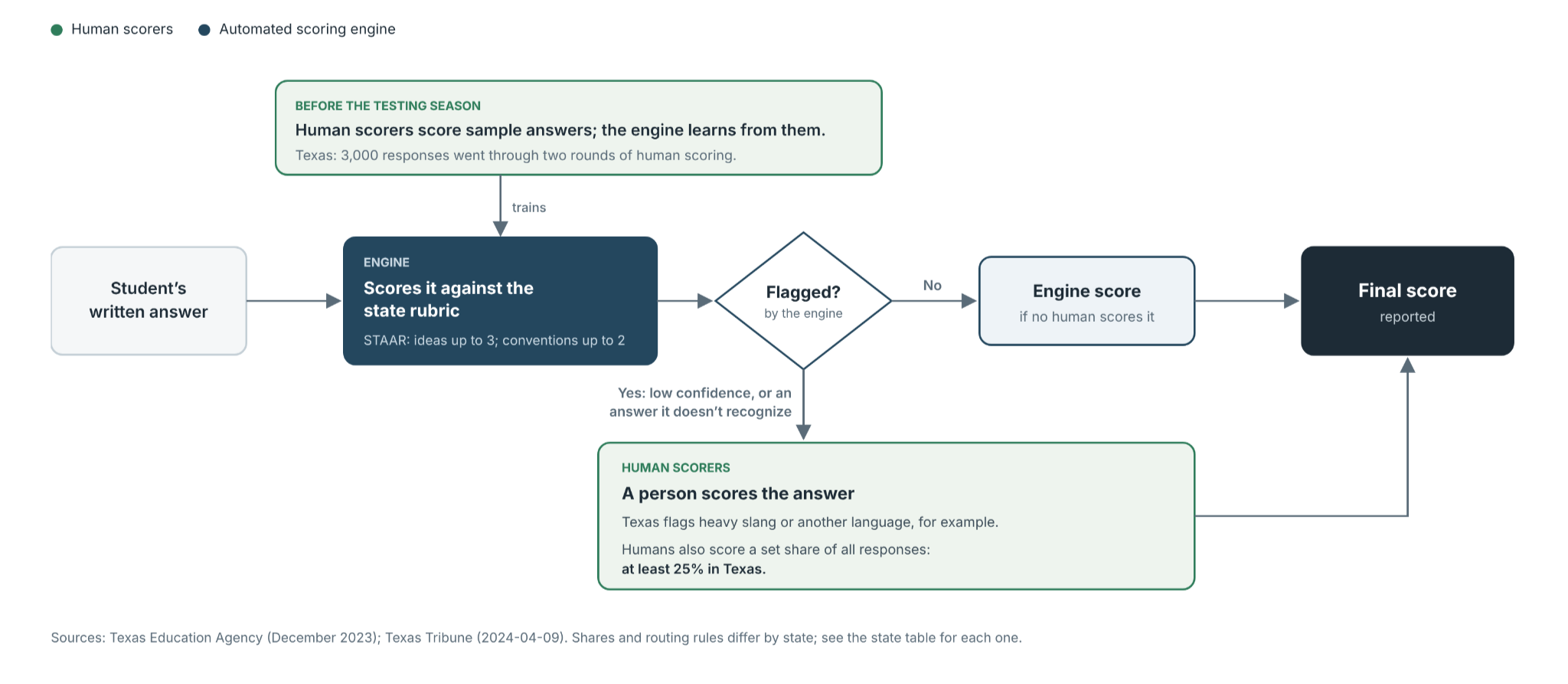
A state's scoring engine learns from answers human scorers already scored, scores each new answer against the state rubric, and sends answers it is unsure about to human scorers. There are three steps involved:
1. It learns from answers human scorers already scored
The AI scoring engine is initially trained to observe patterns, after being calibrated. This means that it will learn from the responses that have been scored by humans. Only then will the scoring engine be allowed to score a sample of essays first. For example, in Texas, 3000 responses were double-scored by people before the engine was used. (Texas Tribune, 2024-04-09).
2. It scores against the state rubric
The engine scores against the same rubric traits your students are taught. No new criteria or style is created. The process, according to TEA, is as follows: "initially scored by an automated scoring engine (ASE) and at least 25 percent of student responses are then routed to human scorers" (Texas Education Agency, December 2023)
3. It sends uncertain answers to human scorers
Any responses with low confidence scores, or unusual and different language, will be sent to human scorers. This is why there is a concept of hybrid scoring. If the engine is unsure of the score, it will flag it. Texas does this and sends any responses that the engine isn’t confident about to a person. These might also include any responses with heavy slang or foreign language. (Texas Tribune, 2024-04-09)
Other states have different thresholds:
In Utah: The first 500 responses are double-scored. Any responses with low confidence or unusual responses are routed to human scorers (Utah State Board of Education technical report, 2023-24).
In Ohio: Any low-confidence responses are flagged and sent to human reviewers. (Ohio Department of Education and Workforce, 2026).
Is AI scoring of state tests accurate and fair?
It varies by state, and the evidence so far comes from agency reports, news coverage and rescoring data rather than one national study.
What state agencies report
According to the Texas Education Agency, it has adopted a hybrid marking system. It uses a hybrid model in which human experts drive the scoring, and at least 25% of responses go to human scorers (Texas Tribune, 2026-10-07).
Massachusetts also had issues with its MCAS exams, with about 1,400 essays misscored in 2025 by the scoring engine, and they had to be sent for re-scoring (Boston.com, citing the state education department, 2025-09-17).
Problems reported since 2023
The problems reported with scoring engines are as follows:
- In December 2023, a school district in Texas reported a ‘drastic increase’ in the number of zero scores given on the constructed response reading assessments. However, the Texas Education Agency (which administers the tests) stated that other factors had contributed to this, including the fact that students retaking the test were different from those taking it for the first time.
- Additionally, the new scoring rubric designed by the education agency meant that students could receive a score of zero if their answer was incoherent. (Texas Tribune, 2024-04-09).
- The number increased further when rescoring was carried out. Also, the number of rescoring requests for the open-ended reading questions increased from 2,758 in Spring 2024 to 21,620 in 2025 and 64,489 in Spring 2026.
- Other than that, over 13,300 reading scores were increased following the rescoring in 2026. (Texas Tribune, 2026-10-07, citing data from Texas Education Agency)
- Less than 0.5% of the open-ended responses on reading exams were changed.
There is also the question of how English learners are graded in Texas schools. About 20% of students in Texas public schools are English learners, and the open question is whether the system grades bilingual students fairly (EdSurge, 2024-05-03).
Answers with Spanish words or informal terms are sent to a human for grading, and tests in Spanish are also graded by humans (Texas Tribune, 2024-04-09).
In addition to the issue of grading, scores on these tests are used to determine school ratings in Texas (Texas Tribune, 2024-04-09). In New Jersey, one of the tests that is scored by AI is a graduation exam, so the stakes are high (GovTech, 2026-03-09).
What states tell parents and teachers
The FAQs and technical reports that describe and inform the changes are listed in the above table, but many Texas teachers found out about the changes through media coverage (EdSurge, 2024-05-03).
Can a student's AI-scored answer be rescored?
Yes: every state in this list that explains its process lets a student, parent, or district ask for a human to review a score, though the steps and deadlines differ. The sources report:
Texas: All rescoring is done by humans. If the score doesn’t change, then districts pay $50 per test. If the score does change, then there’s no cost. The agency will automatically rescore any extended responses that are one point below the next performance level for free (Texas Tribune, 2026-10-07).
Ohio: Districts can request re-scoring (Ohio Department of Education and Workforce, 2026).
Massachusetts: The mis-scored essays were rescored (Boston.com, 2025-09-17).
Tennessee: Written answers that have different scores are marked by a human expert (Tennessee Department of Education, 2025-05-29).
If you get an incorrect score report, visit the score report page of the relevant state agency to find out how long you have to apply for a re-score and if there are any costs involved.
How can teachers prepare students for AI-scored writing tests?
Teachers prepare students for AI-scored writing tests the same way they prepare for human-scored ones: teach the state rubric trait by trait and practice against it.
1. Teach the state rubric trait by trait
Break the rubric down into its components. For example, there are two traits in the STAAR extended response rubric. These are development and organization of ideas (up to 3 points) and language conventions (up to 2 points) (Texas Education Agency, December 2023). Teach students how to answer each trait separately before asking them to apply both components to their response. See the full breakdown of the STAAR writing rubric on our STAAR writing rubric page for practice. For the rest, see other state writing rubrics on our state writing rubrics page.
2. Practice with released prompts and scored samples
Use the released prompts and scored anchor papers from your state agency to give an example of what a 2 is compared to a 3 in the eyes of your state. Give students an anchor paper without the score shown and ask them to assess it in pairs. Once they have decided on their score, show them what the correct score is. This is where most of the learning will happen.
3. Score practice essays against the same rubric
Scoring a class set of practice essays can easily take up your evenings for a week. But by using tools like EssayGrader, you can automatically score all of these essays based on your chosen state rubric and receive a score for every section of the rubric criteria.
After this, you can review the scores and make any adjustments where necessary. Only once you are satisfied can you provide the students with their results.
4. Does the engine reward formulaic writing?
This is a common concern teachers have. However, a Texas Education Agency official said, "The whole concept of formulaic writing being the only thing this engine can score for is not true" (EdSurge, 2024-05-03).
Despite this clarification, concerns still remain. The Executive Director of the Texas Association of School Administrators said, "Any writing that can be graded by a machine might incentivize machine-like writing" (EdSurge, 2024-05-03).
As there are two conflicting quotes here, the best approach is to teach students how to use the rubric. This is the only thing that both the engine and human scorers are based on.
How close can AI scoring get to a teacher's score?
In EssayGrader's published benchmark, 94% of its scores matched, or landed within 1 point of, experienced teacher scores. That’s across 22,000+ benchmark essays, and it scored 0.84 quadratic weighted kappa (QWK), a standard measure of scoring agreement, on Florida B.E.S.T. state-standard alignment (EssayGrader AI Grading Accuracy Center, July 2026).
EssayGrader is a classroom grading tool, not a state scoring engine, and the teacher reviews every score. Its published limits are that creative writing may score lower, and answers under 75 words are unreliable. The full method is described on our AI grading accuracy page.
94% of EssayGrader's scores matched, or landed within 1 point of, experienced teacher scores across 22,000+ benchmark essays (July 2026). See how accurate the grading is.
Frequently asked questions
These are the questions teachers and parents ask most about AI scoring on state tests.
Is the STAAR test graded by AI?
Partly. The Texas Education Agency has been using an automated scoring engine for written answers on the STAAR test since December 2023, and at least 25% of the constructed responses are routed to human scorers (Texas Education Agency). Try our AI grader for Texas STAAR practice.
Does New Jersey use AI to score state tests?
Yes. It uses AI to score most of the writing on its 2026 NJSLA-Adaptive and NJGPA-Adaptive tests (GovTech, 2026-03-09). The criteria are on our NJSLA writing rubrics page.
Does AP use AI to grade?
College Board says multiple-choice answers on AP exams are scored digitally, and free-response answers are evaluated by more than 31,000 high school and college educators at the annual AP Reading (College Board, 2025-07-01).
The aforementioned information is current as of November 2026. Scoring programs can change from year to year depending on the state agency. This information may vary from what is written here by Spring. Check your state agency’s assessment page or score report page to see what the current rules are, and till then, continue using your rubric to practice!
Grade an essay against your own rubric in minutes. The free plan covers 100 essays a month. Try the free AI grader.