Yes, AI can grade essays: on rubric-based writing, it often lands within a point of a trained teacher's score, but it still needs a teacher to review every grade before it counts. By definition, AI essay grading is the use of software, from trained scoring engines to large language models such as ChatGPT, to score student essays against a rubric and return written feedback.
The use of AI for grading essays isn't very recent. As a matter of fact, the accuracy of AI essay grading has been studied since 2012.
While results are better for some, they are not ideal for others. The point to be noted here is that AI essay grading yields results differently depending on the type of tool used.
I’m Lidia Pierre, head of AI and Data Science at EssayGrader, a rubric-based AI essay grading platform for K-12 and higher-education teachers. And I’ll be covering this topic. Below, you will find what the research says about accuracy, when AI fails, how ChatGPT compares to dedicated AI essay graders, a checklist to use when selecting an AI essay grader, and my verdict.
Grade an essay against your own rubric in minutes. The free plan covers 100 essays a month.
Can AI grade essays as well as a teacher?
AI can grade essays close to a teacher's score on many rubric-based tasks, often landing within one point, but it matches the exact score less often than two trained teachers match each other.
To answer this thoroughly, let’s consider what we know to be true regarding how well two trained teachers agree upon a given essay.
This is an honest baseline; at one point, Tate et al. (2024), in Computers and Education: Artificial Intelligence, state that exact agreement is “hard for humans.” You may have experienced this yourself too if you have ever compared your scores with those of another teacher during moderation. That is because judgment is subjective for human scorers.
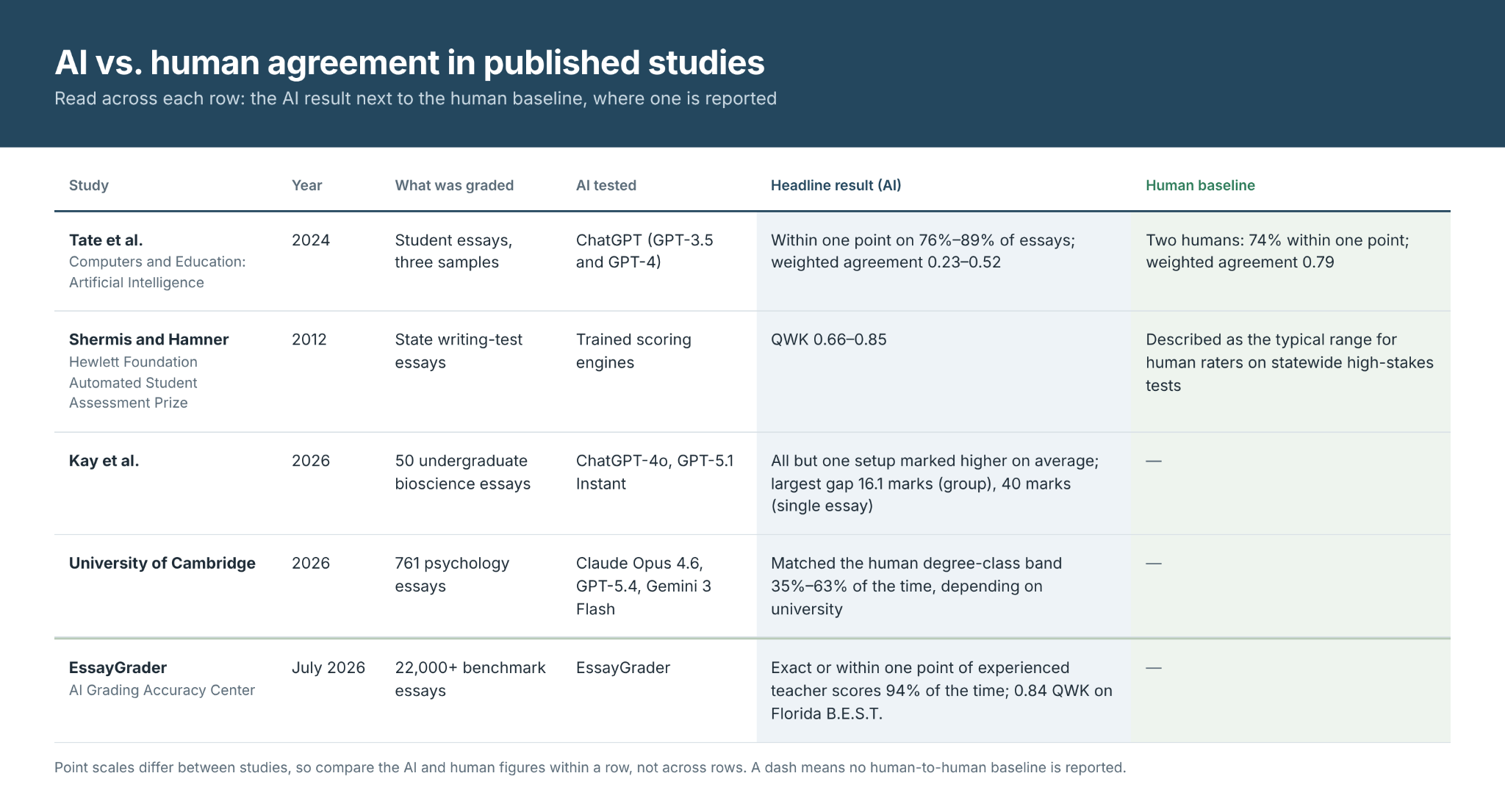
The research conducted by Tate et al. (2024) tested ChatGPT, both GPT-3.5 and GPT-4, across three separate samples of essays between 2023 and 2024. ChatGPT was within one point of the human score on 76% to 89% of essays, while two trained human raters were within one point of each other on 74%. Part of the reason that happened is that ChatGPT avoids the top and bottom scores.
Weighted agreement tells the other half of the story. In the same study, human raters had an average weighted kappa value of 0.79, whereas ChatGPT’s weighted kappa values ranged from 0.23 to 0.52. The authors described this range as “fair to moderate.”
Trained scoring engines, on the other hand, outperformed ChatGPT. In the Hewlett Foundation’s Automated Student Assessment Prize, Shermis and Hamner (2012) tested nine automated scoring engines against 22,029 student essays. The nine engines scored the essays with quadratic weighted kappa values ranging from 0.66 to 0.85. The authors described this range as “a typical range for human rater performance in statewide high-stakes testing programs.”
How does AI grade an essay?
AI grades an essay by reading it against the criteria in a rubric and predicting the score a trained human rater would give, either for the whole essay or criterion by criterion. But how it makes that prediction depends on which of three types of tools you're using:
Trained scoring engines
These are the renowned scoring engines set and used on state-level writing tasks on set rubrics like Texas STAAR, Louisiana LEAP, Florida B.E.S.T. Writing, etc. These automated essay scoring systems are not generative AI but have been calibrated on thousands of essays scored by humans, typically on a single prompt.
General chatbots prompted with a rubric
General-purpose chatbots such as ChatGPT, Claude and Gemini are also said to be used for grading. You paste the rubric and the essay into the chat and write a prompt for the model to generate a score and feedback for you. These are generative AI tools, and their models were not calibrated for your rubric. However, they do generate a score based on the rubric text and the instructions that you provided, which can be inconsistent even for the same set of essays you paste.
Rubric-based AI graders built for teachers
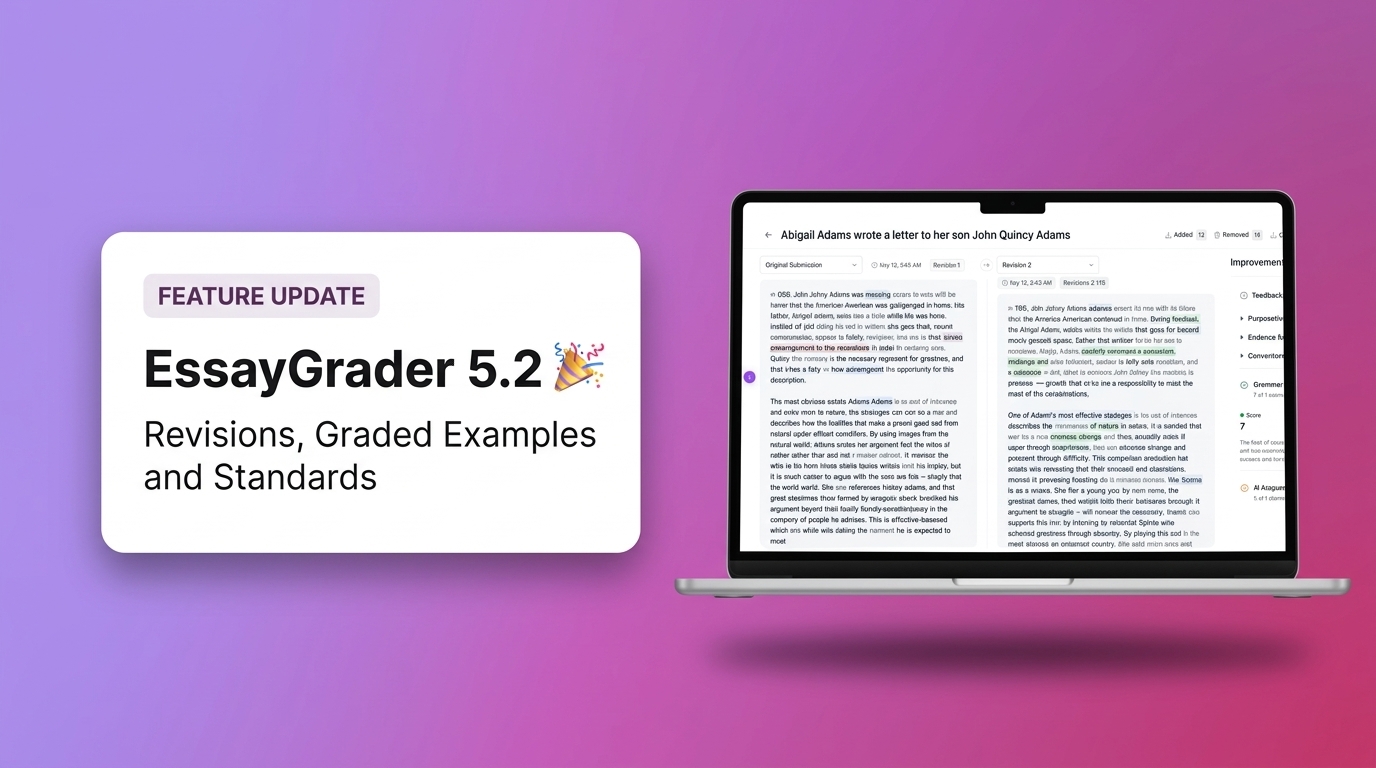
Then come dedicated rubric-based AI graders, which are purpose-built to score on each criterion of your own rubric. After grading, they return written feedback on each of those criteria along with the score for each essay. EssayGrader is an example of such a tool. It scores every essay against the rubric you defined and returns a score, a grammar report and a standards mastery report.
If you prefer to grade against your own rubric without inconsistent scores, the third type is the closest fit for how you already work.
How accurate is AI essay grading?
AI essay grading accuracy is measured by how often the AI's score agrees with a trained human rater's score on the same essays, and the published results range from fair agreement for general chatbots to the range of two human raters for trained scoring engines.
How accuracy is measured
Accuracy is measured in three ways:
- Exact agreement shows how many essays the AI scored the same as a human.
- Within-one-point agreement is the percentage of essays where the AI's score was within one point of the human's.
- Quadratic weighted kappa (QWK) measures agreement while reducing the impact of chance and punishing bigger mistakes more than smaller ones.
Remember, scores from different point systems can't be directly compared.
What independent research shows
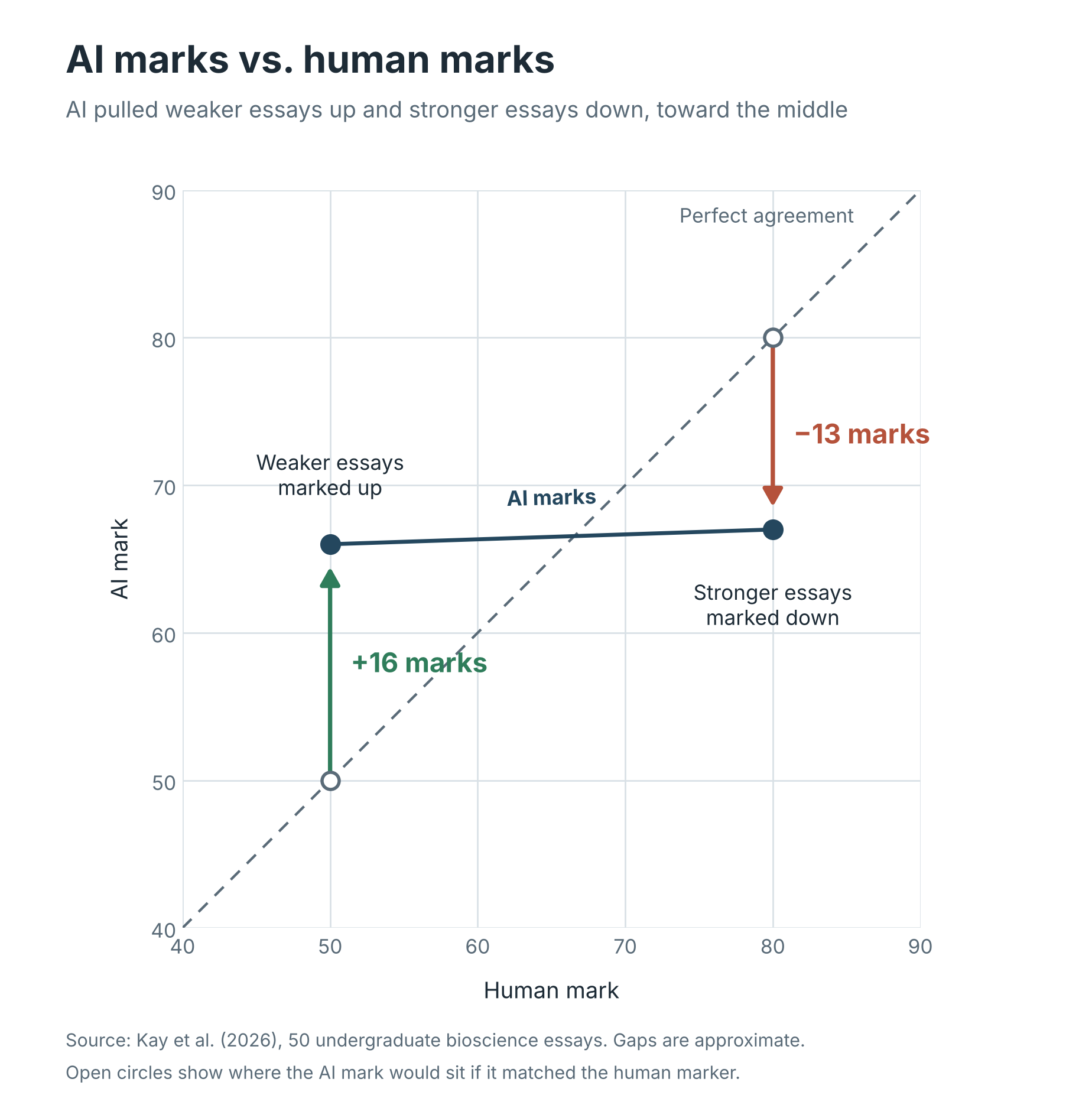
As mentioned before, Tate et al. (2024) found that ChatGPT's scores were within one point of human scores for 76% to 89% of essays. Shermis and Hamner (2012) found trained engines reached QWKs of 0.66 to 0.85. Kay et al. (2026) gave a sample of 50 undergraduate bioscience essays to ChatGPT-4o and GPT-5.1 Instant. In all but one setup, the AI’s average mark was higher than the human marker’s. The biggest gap was 16.1 marks across the group, and 40 marks on one essay.
The University of Cambridge (2026) also used three frontier models (Claude Opus 4.6, GPT-5.4 and Gemini 3 Flash) to mark 761 psychology essays and found that, on average, they matched the human degree-class band for 35% to 63% of the essays, depending on the university. At the low end of this range, the AI would be choosing a different band from the human on most of the essays.
What EssayGrader's published benchmark shows
Our published benchmark scores for EssayGrader are 94% exact agreement or within one point of experienced teacher scores for 22,000+ benchmark essays (AI Grading Accuracy Center, July 2026). The same Accuracy Center report for EssayGrader states that EssayGrader scored 0.84 QWK for Florida B.E.S.T., its top state-standard alignment (July 2026).
In our benchmark, the essays are cleaner than those you usually see in class. Therefore, 94% agreement is an upper limit. When you run your own sample or review your students' messier essays, I recommend checking the criterion-level feedback on your submissions. This way, you can better understand the scores before treating them as final.
See how accurate the grading is.
EssayGrader scores matched teacher scores 94% of the time across 22,000+ essays (July 2026).
What does AI grade well?
AI grades mid-range, rubric-based essays best: writing whose quality shows in the structure, evidence and organization a rubric names explicitly.
- AI grades mid-range essays the best. This is because it avoids both top and bottom scores. Kay et al. (2026) and the University of Cambridge (2026) found that AI and human marks align best near the middle of the scale.
- AI also performs well when grading the same essay twice. The same marks showed up in repeated runs with the same prompt in both studies. This means AI is consistent, even if it disagrees with you.
- AI can assess volume and speed in formative drafts. Tate et al. (2024) found that AI scores “may be sufficient for low-stakes, formative assessment purposes” such as rough drafts and practice prompts.
- AI provides good first-pass feedback on every criterion. It comments on each of your rubric’s criteria for all of the essays so you can focus your attention on the essays that need your judgment.
That last point ties to how much time teachers spend grading. EssayGrader estimates that teachers spend around 100 hours per semester. This is based on 100 students, 6 to 7 assignments each semester, and 6 to 8 minutes per essay.
Where does AI essay grading fall short?
AI essay grading falls short at the edges: it pulls very strong and very weak essays toward the middle, rewards surface features such as length and vocabulary, and scores some students, including English learners, lower than teachers do.
1. It squeezes scores toward the middle
Tate et al. (2024) found that the AI gave fewer top and bottom scores than the human raters. Kay et al. (2026) found that the AI gave, on average, 16 more points for essays that were given a 50 by the human raters, and 13 fewer points for the 80s.
The University of Cambridge (2026) calls this pattern "central tendency bias", i.e. the AI compresses your scale. It overrates weak essays and underscores strong ones, so your best writer and your struggling writer drift toward the same middling grade.
2. It rewards style over substance
According to the University of Cambridge (2026), all three AI systems were found to give higher marks for essays that were longer, had a much wider range of vocabulary, and had used more complex sentence structures. Basically, they all reward convention. Mathew et al. (2026), in Computers and Education: Artificial Intelligence, found the opposite pattern on length: the LLMs gave higher scores to short or underdeveloped essays and lower scores to longer essays with minor spelling or grammar errors.
Although the two studies arrive at different conclusions on length, both studies find that the AI is affected by the same ‘surface features’ of essays that would not affect the scores of a human teacher.
3. It can be unfair to some students
This was found to be the case for English learners in the study by Tate et al. (2024), where all AI scores for English learners were surprisingly lower than those given by the human raters. This finding alone should be sufficient for teachers of English learners to read their students’ essays themselves before sending them home to parents.
4. Essays it can't judge well
EssayGrader's AI Grading Accuracy Center (2026) lists the limitations of its grader, which are:
- It tends to fall short on creative writing and highly personal writing. This type of writing often fails to meet the criteria set in rubrics and can be graded as low quality by the AI.
- Grading factual claims outside the source material being provided can also result in limitations. This means when the reading isn't attached, the grader can't assume facts or check claims against it.
- It also doesn’t grade very short responses. These are typically not scored but are flagged as being too short.
The Accuracy Center (2026) also states that AI-writing detection is a signal, and it should not be treated as a verdict.
Can ChatGPT grade essays as well as a dedicated AI grader?
ChatGPT can grade essays, but the studies that tested it found weaker agreement with teachers than calibrated graders reach, because a general chatbot isn't tuned to your rubric or checked against scored example essays.
Tate et al. (2024) and Kay et al. (2026) tested general ChatGPT models with prompts, and the University of Cambridge (2026) tested general frontier models. None of them tested a grader built around a teacher’s rubric.
AI grading tools add four things that a general chatbot does not provide:
- They provide a fixed rubric that can be applied criterion by criterion. If you just paste a rubric into the prompt, it may get overlooked.
- They’re calibrated against human-scored exemplars, so their scores are checked against real teacher marks.
- Each run uses the same settings. Therefore, your third period is marked just like your first.
- The tool's accuracy is presented as a method. It can be read, questioned, and tested.
If you are still thinking about how to use ChatGPT to grade essays or to get low-stakes feedback on drafts, then there are several things you can test out to see how well it is working for you. First, copy and paste the entire rubric, including each row’s conditions and point values. Next, practice grading a few essays using the rubric. It is best to use essays that you have already graded and then compare the scores to see if there are any discrepancies. At last, just re-run one of the essays to see if the score stays the same.
If the scores change from run to run or are different from the marks you gave to the same essays, then use the output as feedback only.
What should teachers look for in an AI essay grader?
Look for an AI essay grader that scores against your own rubric, publishes its accuracy with a named method and dataset, and leaves every final grade with you. Use this checklist before you trust one with a class set.
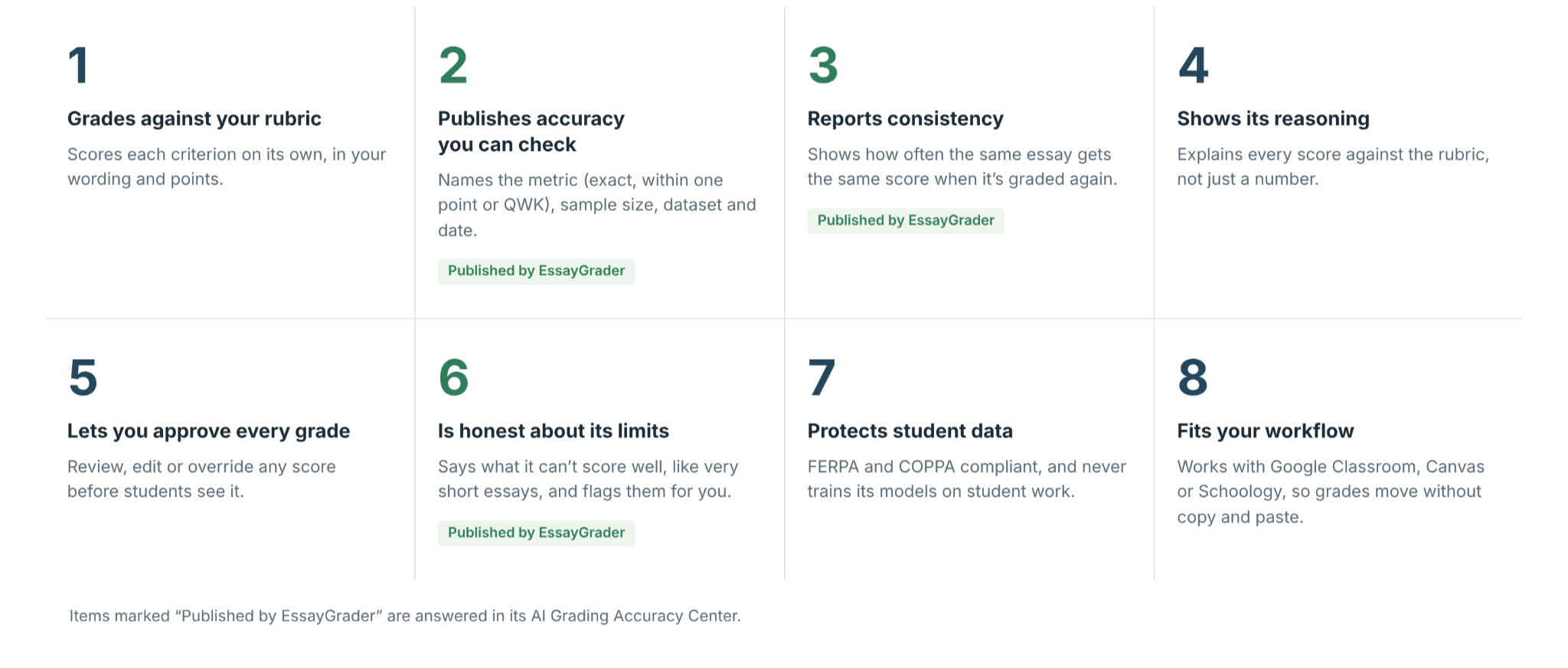
- It grades against your rubric
First of all, see if the grader provides rubric-based grading on each criterion. For instance, EssayGrader is a rubric-based platform that lets teachers create custom rubrics, lets them paste or upload their existing rubric, and provides them with a library of 800+ pre-loaded rubrics. Browse 800+ rubrics.
- It publishes accuracy you can check
The next most important thing to look for is accuracy; look for the metrics named (exact agreement, within one point or QWK), the sample size, the dataset and the date, plus a plain account of the method. Without those, an accuracy figure is hard to interpret.
- Consistency is reported as well
Verify what happens when the same essay is graded twice. If the score is consistent throughout, you can move forward. Also, how often does the score remain the same? Scores that vary on a re-run are hard to defend to students and parents.
- It shows its reasoning
Before landing on a choice, run a sample and see if the grader provides reasoning with the score, see if the feedback is detailed enough and whether it aligns with your rubrics or not. Remember, every score should come with an explanation tied to the rubric, so you can see why an essay earned a 3 rather than a 4.
- You approve every grade
No matter which tool you choose to grade your students' essays, a teacher should always have the last word and should be able to review, edit, override and approve every score or comment before it goes out.
- The grader is open about its limitations
It will state what types of essays it cannot score well (e.g. very short essays) and will flag those essays for you rather than attempting to score them.
- It protects student data
Privacy shouldn't be neglected; therefore, make it a point to look for FERPA and COPPA compliance and a written commitment to not use student work to train the model.
- It fits your workflow
Last but not least, look out for a grader that will connect to the platform you already use (Google Classroom, Canvas, Schoology) to transfer essays and grades between the two systems.
If you're comparing several options, our roundup of the best AI grading tools for teachers lays them out side by side. EssayGrader publishes its answers to items 2, 3 and 6 in the Accuracy Center.
How should teachers use AI to grade essays?
Use AI to grade essays as a first pass on formative work, test it on 20 essays you have already graded, and review every score before students see it. Begin with a 20-essay audit, a process described by EssayGrader’s AI Grading Accuracy Center for checking the accuracy of automated grading. Draw a random sample of 20 essays that you have previously hand-graded. Be sure that the 20 are a cross-section of your better and struggling writers. Run the 20 essays through the AI without including the previous grades. Then, compare the results of both gradings, looking at each criterion. If the AI aligns with your logic, it’s ready to help you grade student drafts. If the AI misses the mark on a specific criterion, you'll know where to focus your attention.
Tate et al. (2024) found that AI works well for low-stakes, formative assessment. But the University of Cambridge (2026) found that only a human can give the final grade in summative assessments.
When reviewing formative work, remember the known weak spots. Don’t rely on the tool without question. Pay special attention to your top and bottom essays. The AI often pulls scores toward the middle. Also, be mindful of your English learners’ essays. Automated systems can underestimate these students because of surface-level language barriers. And this is simply summed up how to use AI to grade essays.
Be open with students about your use of technology. Tell them you use the tool for initial grading and feedback, but you review and set every grade.
The verdict: should AI grade your students' essays?
Yes, as a first reader, not as the final judge: AI should give your students fast, rubric-based feedback and a draft score, and you should decide every grade that counts.
- The good: AI is fast, it gives the same or similar score when you re-run an essay, and it’s most accurate on mid-range, rubric-based essays.
- The bad: It squeezes scores toward the middle and rewards style over substance.
- The ugly: When nobody checks, some students, English learners in particular, get lower scores than a teacher would give.
What would change this verdict is graders publishing independent, classroom-level results, and not just benchmark figures. For now, if you're contemplating using AI to grade your students' essays, then start by testing a few samples and see if the vendor mentions its limitations or not.
I treat every AI score the way I treat our own benchmark: a useful first read, never the final word.
Try the free AI grader.
Grade an essay against your own rubric in minutes. The free plan covers 100 essays a month.
FAQ (frequently asked questions)
1. Is AI essay grading fair to all students?
No, not for every group of students. Tate et al. (2024) reported that AI scored English learners lower than humans did. The University of Cambridge (2026) found that AI systems favored length and vocabulary over other criteria. This could mean students who write more may get better scores, rather than those who write more effectively. Therefore, it's important to review essays from English learners, especially those that are too long or too short.
2. Do states use AI to grade state writing tests?
Yes, several states use AI on state writing tests, with human scorers checking part of the work. Texas sends at least 25% of AI-scored responses to human scorers (Texas Education Agency), and Massachusetts has humans re-read 10%. In 2025, about 1,400 MCAS essays were scored incorrectly by the AI and then corrected (Massachusetts DESE, 2025). Our guide to states using AI to grade state tests covers the rest
3. Will AI replace teachers in grading essays?
No, AI cannot replace a teacher's judgment in grading essays. This also settles the debate around the question: can artificial intelligence replace teachers? While AI can take the first pass at grading essays based on a set of rubrics, it is always recommended for teachers to review those scores and feedback first before sending it over to their students. Tools like EssayGrader allow teachers to review and edit the written feedback.
4. Can AI grade papers and other written assignments, not just essays?
Yes, AI can grade other types of written assignments as well. These include, but are not limited to, lab reports and short research papers, as long as they are graded against a rubric. Having said that, keep in mind that the same limitations apply, and a grader might not score the assignment. For example, very short answers, creative work, and factual claims that are outside of the source material are the most difficult for AI to score correctly and might not be scored.