A RAND Corporation study surveyed principals and teachers across the US and found that 99% of US public schools use interim or benchmark assessments at least once in an academic year in some form.
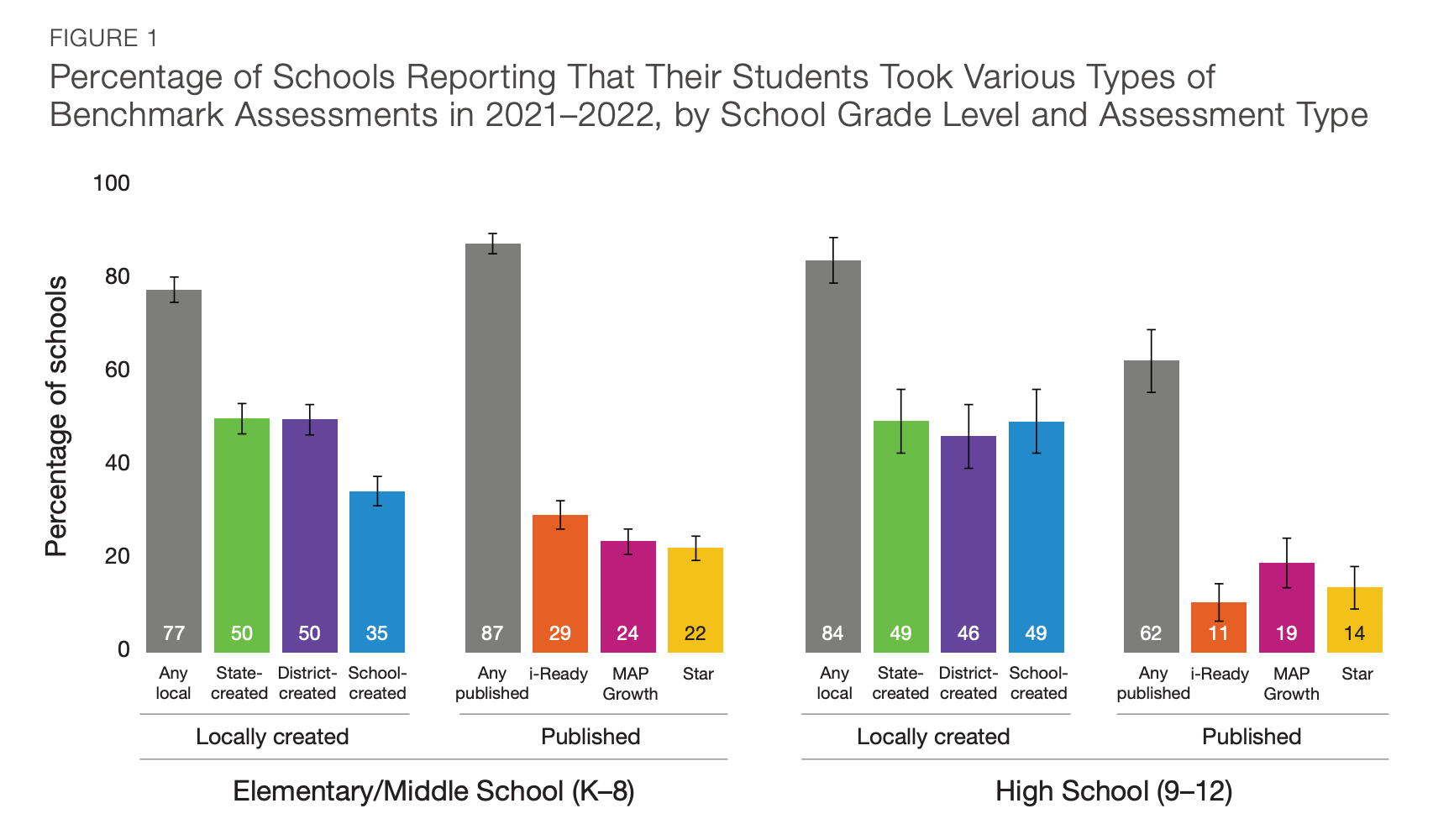
In other words, almost every school takes these tests.
Despite being common and happening multiple times a year, there's a fair bit of confusion around benchmark assessments.
So in this guide, we’ll clear that up for once. You will get a clear picture of what a benchmark assessment is, why schools conduct it, the main types out there, and how they're administered and scored.
So let’s start with the benchmark assessment definition.
What is a Benchmark Assessment
A benchmark assessment is a test that is given more than once to students of all grade levels during the school year to gauge how well they are progressing toward their grade-level standards.
These tests usually take place thrice a year, once at the start, then somewhere in the middle, and again near the end of the year. In some places, they might take place more than three times a year, but three is common.
The purpose of conducting a benchmark assessment at the start of the academic year is to establish a baseline, against which the assessments that follow will measure progress.
You may also have heard the term interim assessments, another name for benchmark assessments.
A school’s benchmark assessments are dictated by the state or district standards. The school district or educational board typically mandates, for example, the pool of questions or which benchmark testing platform to use (e.g., NWEA MAP or i-Ready).
So two schools in the same district usually share the same benchmark assessment framework. Only Computer-Adaptive Assessments like MAP or i-Ready can alter the question sequence in real time even for two students sitting next to each other.
A benchmark assessment can be either timed or untimed. When they are timed, the duration is typically one standard class period (45 to 60 minutes).
Based on the testing method and delivery mechanism, there are four categories of benchmark assessments:
Why Benchmark Assessments Matter
A school’s calendar is already packed, so why add another round of testing?
Benchmark assessments are necessary because they let schools measure students’ academic progress collectively, with time to change course based on the data.
Here are a few major things that data from benchmark assessments enable schools/districts to do:
- Help save struggling students: Benchmark assessments surface students who are about to fall too far behind in specific skills. Schools can intervene early and create small groups or simply reteach the parts where improvement is needed.
- Data-driven teaching: Teachers get to use their time and energy efficiently because now they know which standards a class has mastered and which can use another pass.
- Student growth chart: Benchmark data lets you track student progress from fall to winter to spring, showing how different students react to the teaching method. This can reveal flaws as well as opportunities to plan a better course of action for the future.
- Comparison of classrooms & schools: Collective data from multiple classes or schools help point out whether an issue is arising from the curriculum, teaching method, or some other elements.
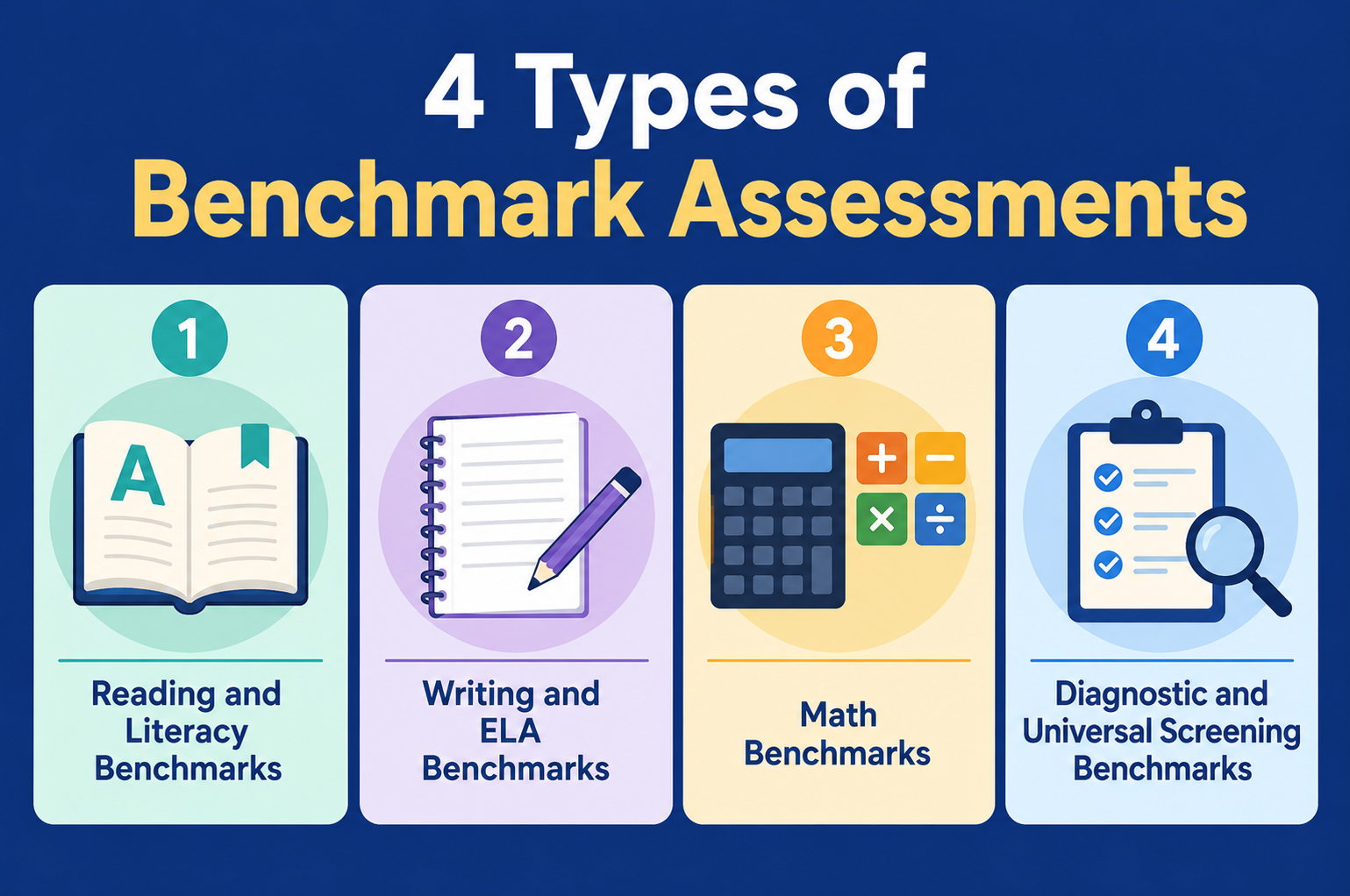
4 Types of Benchmark Assessments
Benchmark assessments can be sorted two ways: by how they're delivered, and by what they measure. The table above covered the first. Here's the second view.
Here are the 4 types based on the capability being measured.
1. Reading and Literacy Benchmarks
Reading is a foundational skill, and these benchmarks make sure students are developing this capability.
To be more precise, reading benchmarks check things like decoding, fluency, phonemic awareness, and comprehension. In early grades, the medium of these assessments is oral. A teacher sits with one student at a time and has them read aloud. In older grades, students are usually asked to answer questions after reading a passage.
The exact testing method/format changes with specific assessment systems, of course.
Examples of reading benchmarks include DIBELS, EasyCBM, Acadience Reading, and NWEA MAP.
2. Writing and ELA Benchmarks
Writing, just like reading, is an essential skill.
The benchmarks that test writing require students to draft argumentative, informative, and narrative essays. These assessments also commonly require students to read passages and answer questions with evidence from the passage.
In early grades, however, writing benchmarks focus on things like letter formation, spelling basic words, writing complete sentences, using end punctuation, etc.
Teachers and AI tools can evaluate writing benchmark assessments using a multi-trait rubric. When evaluated by teachers, they eat up the most grading time.
Examples of writing assessment benchmarks include aimswebPlus Writing, FastBridge (earlyWriting), WriteScore, and NoRedInk.
3. Math Benchmarks
Math benchmarks such as i-Ready and Star Math check students’ grasp of concepts such as number sense, arithmetic, algebra, geometry, data analysis, and more, depending on the grade. For instance, in early grades such as K-2, math benchmarks focus on basic addition and subtraction skills with the goal of moving students away from counting on their fingers.
Then, from grades 3-8, the focus shifts higher to multi-step word problems. The questions can include multi-digit operations, fractions, decimals, ratios, early algebraic concepts, etc.
Grades 9-12 are assessed for college and career-level mathematics, for which the test checks mastery of Algebra, Geometry, and Functions.
4. Diagnostic and Universal Screening Benchmarks
These benchmarks are given at the very start of the year, and their job is to figure out where students stand before even the new academic year properly begins.
The assessment duration in these benchmarks is typically very short, and their whole point is identifying struggling students, not why they are struggling. The respective course of action for struggling students is decided once they are identified.
Examples vary depending on what's being screened, but common ones include DIBELS 8th Edition, Acadience Reading, FastBridge, AIMSweb, and the Phonological Awareness Screening Test (PAST).
These screeners feed the data that MTSS and RTI frameworks use to decide which students get additional support.
How is a Benchmark Assessment Administered & Scored
Administration
In most cases, districts or state education bodies administer benchmark assessments.
They mandate which benchmark testing platform (e.g., NWEA MAP or i-Ready) every school under them should use. Then they open a testing window of a couple of weeks, usually, and the schools have to complete the required benchmark assessments.
What schools have to administer are the day-to-day logistics. And teachers have to perform duties like passing out devices and proctoring students while they take the test.
Scoring
Since most benchmarks are digital, the scoring almost never happens locally by the school or teacher. The testing platform instantly processes MCQs and other auto-scorable portions on its servers.
As per the standard, the platform calculates the raw number of correct answers and converts it into a scaled score so that results can be compared across different test forms and across the year.
The scaled score is then sorted into a performance level by the testing platform, which sets numeric boundaries (called cut scores) that separate one level from the next. Based on those cut scores and a student's scaled score, the student is rated Below Basic, Basic, Proficient, or Advanced (labels vary by state).
Scoring of open-ended work, and especially writing, has been a challenging part of benchmark assessments, though. Since essays cannot be graded based on an answer key, they had to be read and scored by teachers historically.
Thankfully, we now have AI grading tools like EssayGrader to address this challenge.
How EssayGrader Can Help Districts in Scoring Essays
If twenty different teachers are hand-scoring essays against a rubric, you'll get twenty slightly different interpretations of it. Even the same teacher can interpret the rubric differently across multiple essays.
The limitations not only make the process slow, but they also make results harder to compare fairly.
EssayGrader solves both problems at once. Using EssayGrader, you can apply the same rubric the same way to every submission coming from different classrooms and even schools. There are over 800 standards-based rubrics to pick from and apply to a bulk of submissions at once. The rubrics already cover programs like CCSS, Texas STAAR, Florida B.E.S.T., SBAC, AP, IB, and more.
In case a desired rubric isn’t available, you can build it from scratch in EssayGrader’s rubric builder. There’s also the option to upload your own rubric if your district uses something specific.
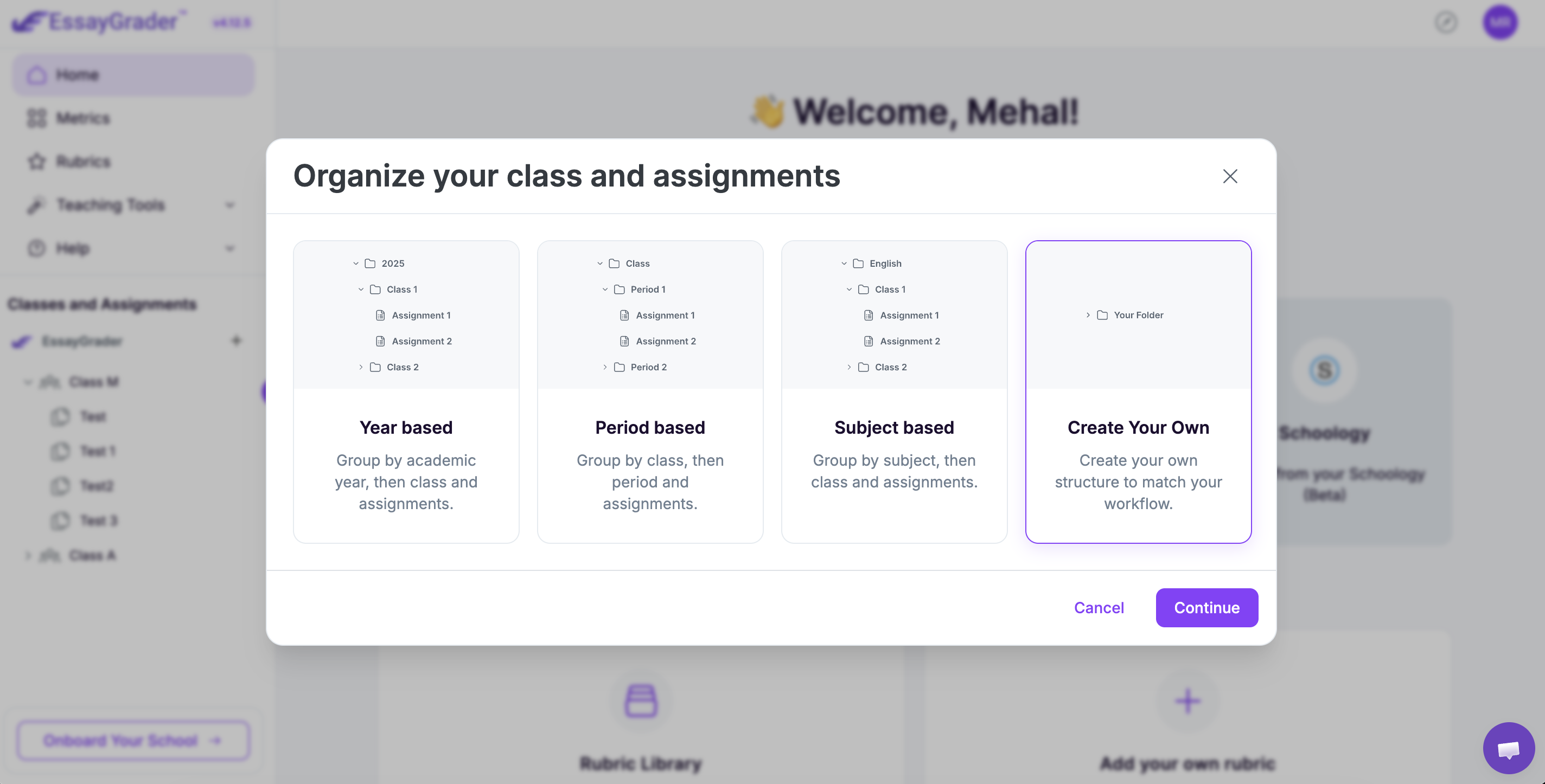
Moreover, EssayGrader has native integration with Google Classroom, Canvas, and Schoology, which means you won’t have to move files around manually.
On top of everything, once EssayGrader has scored submissions and left comments on them, you can still review and edit them. So, the final judges are still humans, not machines.
Give EssayGrader a try for free before using it for your next writing benchmark.
FAQs
What does benchmark assessment mean?
A benchmark assessment is a short test given to students at regular intervals throughout the school year to evaluate a student’s current academic performance against grade-level standards. The scores of a benchmark assessment typically don’t impact a student’s grades. Instead, the goal is to collect data on a large scale and help teachers identify and fill learning gaps early.
What is an example of a benchmark assessment?
The most widely recognized example of a benchmark assessment in schools is NWEA MAP Growth (Measures of Academic Progress). It is taken thrice a year and delivers a precise RIT score. Other notable benchmark assessment examples include DIBELS 8th Edition, i-Ready Math, and WriteScore, to name a few.
What are the 4 types of benchmarking?
Based on the measured capability, benchmark assessments are of four major types:
- Reading and literacy benchmarks
- Writing and ELA benchmarks
- Math benchmarks
- Diagnostic and universal screening benchmarks

.jpeg)



.avif)
.avif)
%201.svg)